

Table of Contents
Iran is not the regime that rules it
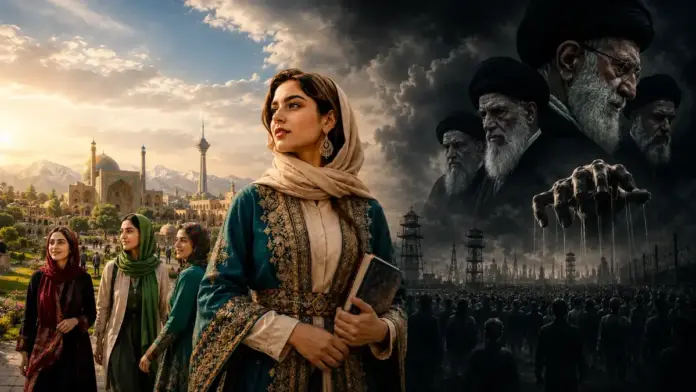
Iran is not the gallows, the prisons, the morality patrols, the closed political rooms, the clerical vetoes, or the security machinery that decides who may speak, dress, vote, organize, protest, or live freely. Iran is an ancient civilization, a proud people, a society of women, students, workers, artists, scientists, poets, believers, skeptics, families, and citizens whose human depth is far greater than the system that governs them.
That distinction is the starting point of any serious article about Iran. The Iranian people are not the Islamic Republic’s ruling machine. One is a society. The other is a state structure. One carries centuries of language, literature, memory, architecture, music, science, dignity, and human longing. The other governs through clerical control, political filtering, repression, surveillance, and ideological discipline.
The world often speaks about Iran through the face of the regime: nuclear pressure, the IRGC, Khamenei, executions, Hezbollah, mandatory hijab, sanctions, proxy networks, and war risk. All of that matters and must be reported. But behind that geopolitical surface stands another Iran: the country of ordinary people who did not choose to become the human cover for a state that uses their history, their faith, and their suffering as instruments of survival.
A civilization older than today’s darkness
The Iranian people cannot be reduced to the current political vocabulary of the regime. They are older, deeper, and wider than the theocratic state that has ruled since 1979.
Iran did not begin with the Islamic Republic. It did not begin with the ayatollahs. It did not begin with the morality police. It is one of the great civilizational spaces of Eurasia, a country whose cultural memory includes empire, poetry, philosophy, architecture, trade, administrative sophistication, and a language of beauty that has influenced regions far beyond its borders.
Iranian culture is especially known for its literary tradition, with Persian masters such as Ferdowsi, Nizami, Hafez, Jami, and Rumi continuing to shape cultural imagination well into the modern era, according to Encyclopaedia Britannica. That fact alone should prevent any serious observer from confusing the Iranian people with the narrow political machinery that claims to represent them today.
This is why the current image of Iran is so tragic. When a civilization of such depth is flattened internationally into the face of a repressive regime, the loss is not only Iranian. The loss is global understanding.
The Iranian people are not dark. The system ruling over them is.
The beauty of Iran is not only visual — it is human
There is an easy way to speak about Iran’s beauty: ancient sites, mountains, deserts, cities, bazaars, tiles, gardens, calligraphy, music, poetry, and the long memory of Persian civilization. All of that is real.
But the deepest beauty of Iran is human.
- It is in the women who refuse to accept that the state owns their bodies.
- It is in the young people who want internet access, music, education, work, travel, dignity, and a normal life.
- It is in families who carry culture and learning while living under economic pressure, censorship, fear, and political exhaustion.
- It is in filmmakers, doctors, engineers, students, teachers, workers, writers, entrepreneurs, and artists who do not fit either the regime’s propaganda or the caricatures of its enemies.
Iran is not only a geopolitical crisis. It is a society trying to breathe.
Iranian women as the clearest mirror of the truth
Anyone who wants to understand the real Iran should look at its women.
Not because Iranian women should be used as symbols for other people’s politics, but because the conflict between society and state becomes brutally visible through them. Mandatory hijab enforcement, dress codes, surveillance, punishment, and the policing of women’s presence in public life are not simply “tradition.” In the Iranian context, they are instruments of political control.
The “Woman, Life, Freedom” movement was not merely a protest over clothing. It was a demand for dignity against a system that claims the right to define how a woman appears, moves, speaks, and exists in public. The UN Independent International Fact-Finding Mission on Iran has continued to examine violations connected to the protests and the broader deterioration of human rights after Mahsa Amini’s death in custody.
The issue is not a Western demand imposed on an Eastern society. It is a basic human question: does a government have the right to turn a woman’s body into a border of state power?
When an Iranian woman removes a compulsory head covering, the act is not merely stylistic. In that political context, it says something larger: the state does not have total ownership over her presence.
Freedom is not chaos — it is dignity under rules that protect people
This point matters. Freedom does not mean a society has no rules. Every society has rules. The real question is who writes them, whom they protect, and whom they crush.
There are rules that protect human beings: do not harm others, do not torture prisoners, do not silence dissent, do not turn religion into a police manual, do not punish a woman for existing in public on her own terms, do not kill people because they challenge power.
And there are rules that protect power from human beings.
The problem in today’s Iran is not that the country has tradition. The problem is that tradition is used as a lock. The problem is not that people have faith. The problem is that power claims a monopoly over the interpretation of faith. The problem is not that society has identity. The problem is that the regime calls obedience “identity” and surveillance “morality.”
Newsio has already examined this mechanism in its English analysis of theocracy in Iran and how faith becomes a machine of power. The central distinction is simple: faith is one thing; state coercion in the name of faith is another.
The Iran that wants life does not look like the regime’s image
The regime presents itself as the natural representative of the nation. It is not.
A state that fears a woman’s hair, a student’s phone, a journalist’s sentence, a filmmaker’s camera, a singer’s voice, or a protester’s sign does not project confidence. It reveals insecurity.
The Iranian people have repeatedly shown that they are not passive. The protests after Mahsa Amini’s death, acts of public defiance, the participation of women, students, workers, and families, and the persistence of digital expression despite censorship all point to a society that cannot be fully reduced to the state.
Freedom House rates Iran as “Not Free,” with extremely low scores for political rights and civil liberties. That does not describe the worth of Iranian society. It describes the political system that restricts it.
The silence imposed by fear should never be mistaken for consent.
Elections alone do not make a democracy
Iran holds elections. But elections alone do not define a democracy.
Democracy requires more than ballots. It requires open competition, genuine political choice, independent institutions, protection of opposition, freedom of expression, civil society, the right to organize, and the real possibility of replacing power without ideological filtering by unelected authorities.
In Iran, the Supreme Leader and institutions around him shape the limits of political life. Newsio’s analysis of how democratic Iran really is explains how the Guardian Council screens candidates before elections and how the structure of the Islamic Republic places elected offices inside a system overseen by clerical authority.
The problem is not that Iranians do not want political agency. The problem is that the system narrows political agency before voters reach the ballot.
A system that decides who may compete does not fear chaos. It fears real choice.
The memory of a different Iran
Many people remember pre-revolutionary Iran as more open, urban, cosmopolitan, and visibly connected to global culture. Images of women in universities, public life, arts, and professional spaces before the Islamic Revolution still circulate because they reveal something the current regime cannot fully erase: Iranian society has lived differently before, and it can imagine living differently again.
That memory should not be romanticized into a false paradise. Pre-1979 Iran had authoritarianism, inequality, political repression, and deep social tensions. The truth does not need a fake golden age in order to criticize the present theocracy.
But one point remains clear: the capacity of Iranian society is far greater than the cage around it.
The current regime is not the natural destiny of Iranian civilization. It is a political system. Political systems can change.
Iran is not condemned to remain what it is today. Its own people prove that every time they insist on life.
Repression is not strength — it is power afraid of society
When a regime executes, imprisons, censors, tortures, and threatens, it wants to appear unbreakable. In reality, it shows that it governs through fear because it cannot govern through trust.
The UN human rights office said Iran executed more than 900 people in 2024, including dozens of women, with the UN High Commissioner for Human Rights calling the rise in executions deeply troubling. Reuters reported the UN figure as 901 executions in 2024, including 31 women.
The Associated Press later reported a UN assessment that placed Iran’s 2024 executions at at least 975, the highest number since 2015, while also noting concerns about torture, arbitrary detention, journalists, and disproportionate effects on minorities.
These numbers do not describe the Iranian people. They describe the machinery that rules over them.
That is why language matters. When people say “Iran executes,” “Iran represses,” or “Iran threatens,” they often erase the very Iranians who are suffering under those actions. The more accurate language is: the regime executes; society pays. The regime represses; citizens fear. The regime funds regional power networks; ordinary people live with sanctions, isolation, and economic hardship.
Newsio has drawn this line clearly in its English coverage of Khamenei, repression, and executions under his rule. The point is not caricature. It is structure: a system that repeatedly treats dissent as a security threat.
The Iranian woman as a political truth that cannot be hidden
The women of Iran carry something larger than a dress-code dispute. They carry the question of whether a human being belongs to herself or to the state.
The regime tries to present compulsory rules as moral order. But when a woman is endangered because she refuses state control over her public presence, that “morality” reveals itself as political ownership.
This is why images of Iranian women are so powerful. The state itself has turned women’s bodies into a battlefield. When power makes a woman’s appearance a matter of national discipline, every act of dignity becomes political.
Newsio’s English article on Tehran’s “Ghost Women” and regime propaganda explains why staged images of armed or veiled female figures should not be confused with empowerment. A woman placed inside the visual machinery of the state is not free simply because propaganda calls her strong.
Freedom is not proven by staged photographs. It is proven by the right to refuse.
A people carrying dignity under pressure
The Iranian people live under overlapping pressures: economic hardship, political repression, digital restriction, social policing, fear of war, sanctions, and the psychological burden of living inside a state that treats dissent as threat.
This is not abstract geopolitics. It is the salary that loses value. The medicine that becomes harder to find. The internet that slows or disappears. The family that worries. The student who plans to leave. The journalist who weighs each sentence. The woman who calculates risk before walking outside.
Digital control is part of that pressure. Freedom House reported that internet freedom in Iran remained highly restricted, with authorities making access to the global internet more difficult and costly while pressuring users toward a more controlled domestic internet environment.
And yet the people do not disappear.
They create. They learn. They resist. They form small communities of dignity. They preserve memory. They protect culture. They find ways to remain human where the system tries to turn them into subjects.
That is one of the great strengths of Iran: not a romantic image without pain, but the endurance of a society that has not surrendered its soul to the state.
The youth who do not want to live inside dead myths
Iran’s younger generations do not live inside the same mental world as the ruling vocabulary that tries to contain them.
They see global culture. They use technology. They learn languages. They listen to music. They compare realities. They know that life does not have to be a permanent ideological emergency. They want work, travel, education, dignity, expression, and a future that does not feel like punishment.
This does not mean all young Iranians think the same way. No society is uniform. But it does mean the regime governs a society far more complex than the image it projects.
The young Iranian is not merely a “subject of the Islamic Republic.” He or she is a human being watching the world, comparing possibilities, sensing injustice, and understanding that life cannot be reduced forever to obedience inside a room without windows.
The conflict is not only political. It is generational, cultural, and existential.
On one side stands a system demanding discipline in the name of the past. On the other stands a society that wants a future.
Faith is not the problem — state ownership of faith is the problem
This must be said clearly: the problem in Iran is not that many people have faith. The problem is not prayer, tradition, religious identity, or spiritual life.
The problem begins when power claims to own faith.
When a state says, “we are the correct interpreters of God,” every citizen who disagrees becomes more than a political opponent. They become morally suspect. That is where theocratic violence begins — not because personal faith is necessarily violent, but because power turns faith into a disciplinary weapon.
The world needs to understand this if it wants to stand with the Iranian people. It should not insult Iranian culture or mock the faith of ordinary people. It should expose the machinery that turns faith into state control.
Freedom does not require tradition to vanish. It requires tradition to stop functioning as a prison.
The Iran its people deserve
The Iran its people deserve is not an Iran without identity. It is not anti-Iranian, anti-culture, anti-faith, or detached from historical memory.
It is an Iran where the human being comes before the machine.
- An Iran where a woman does not fear public life because of how she appears.
- An Iran where a student can question without being treated as a threat.
- An Iran where a journalist does not write under the shadow of prison.
- An Iran where a believer can believe without becoming an instrument of state power.
- An Iran where a secular citizen, a religious citizen, a minority, a dissident, an artist, a worker, and a scientist all share one basic right: to exist without needing permission from a closed ruling structure.
That is not a Western fantasy. It is human normality.
Why the world must speak with respect about the Iranian people
Respect for the Iranian people is not sentimental decoration. It is analytical necessity.
If we confuse the people with the regime, we strengthen Tehran’s propaganda. That is exactly what the regime wants: to claim that anyone criticizing the state hates Iran. It wants to wear the whole country as armor.
It should not be allowed to do that.
The right position is clear: respect Iranian civilization enough not to abandon it to those who use it as an excuse. Respect the Iranian people enough not to confuse them with those who fear them. See Iranian women clearly enough not to turn them into either regime propaganda or foreign rhetorical tools.
The Iranian people do not need to be explained through their jailers.
What the world should remember
Iran is beautiful not because its regime is strong. It is beautiful despite its regime.
- It is beautiful because its people continue to want life.
- It is beautiful because its women have not stopped claiming space.
- It is beautiful because its cultural memory is larger than its current political cage.
- It is beautiful because beneath the darkness there is society, and beneath the imposed silence there is voice.
The world must stop seeing Iran only as a threat or only as a victim. It must see Iran as a country held between a great people and a state that fears them.
The regime may hold institutions, weapons, prisons, symbols, and international seats. But it does not own the truth of Iran.
The truth of Iran is in its people.
- In the women who refuse to become state property.
- In the young who do not want to live inside dead myths.
- In families that preserve dignity under pressure.
- In a culture that reminds the world a country can be much greater than the regime that rules it.
And perhaps that is what Tehran fears most: not foreign speeches, not sanctions, not military threats, but the moment when the Iranian people stop believing that their prison is their destiny.