


Table of Contents
When Iran loses the battlefield, the war may move to the screen
Iran does not need to defeat the West militarily in order to hurt it. If Tehran loses ground on the conventional battlefield, if its command structure is under pressure, if Hormuz becomes a bargaining lever rather than a shield, and if its regional network is being cut apart, the regime has every reason to search for a different battlefield: the screen, the banking system, the street, and the trust architecture of Western societies.
This is not a confirmed operation. It is a red-team scenario. That distinction matters. A serious newsroom does not sell speculation as fact. But a serious geostrategic analysis also does not wait for a hostile operation to become obvious before explaining why it would make sense.
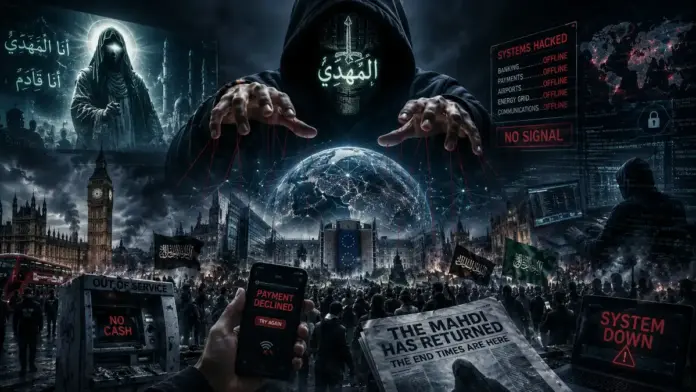
The question is not whether a “Cyber-Mahdi” event has already happened. The question is whether a pressured theocratic regime, backed by authoritarian information ecosystems, could attempt to turn religious symbolism, cyber disruption, deepfake media, and Western social tension into a single hybrid shock.
That scenario deserves attention because the foundations already exist. Reuters has reported that after Khamenei’s death, a U.S. intelligence assessment warned that Iran and its proxies could target the United States, with Iranian cyberattacks assessed as likely while large-scale physical attacks were considered less likely.
U.S. banks also went on high alert for Iran-linked cyber threats as the war escalated, with Reuters noting concerns about possible low-level attacks such as distributed denial-of-service operations against U.S. networks. U.S. banks also went on high alert for Iran-linked cyber threats
The confirmed context makes the scenario serious
The Cyber-Mahdi scenario does not come from empty imagination. It sits at the intersection of three real pressures: battlefield stress on Iran, cyber escalation risk, and information warfare driven by AI-generated content.
The first pressure is military and political. The Iran war has already created a crisis environment in which leadership, command, proxies, Hormuz, and diplomacy are intertwined. Newsio’s earlier analysis of Iran under pressure, U.S. carriers, Hormuz, and the IRGC framed the essential point: diplomacy around Tehran is not happening in a vacuum; it is taking place under force, deterrence, and internal fracture.
The second pressure is cyber. Unit 42, Palo Alto Networks’ threat intelligence team, reported renewed Iranian-linked interest in critical infrastructure, including operational technology and industrial control systems, while also describing phishing, hacktivist activity, DDoS attacks, data exfiltration, and wiper activity connected to the broader Iran conflict environment.
U.S. agencies have also warned that Iranian-affiliated cyber actors are targeting internet-exposed programmable logic controllers used in critical infrastructure. The issue is not only one campaign, but an established threat category that U.S. agencies have tracked for years through their Iran threat overview and advisories.
The third pressure is information pollution. The 2026 Iran war has already produced viral AI-generated imagery, fabricated videos, and misleading war content. That matters because modern influence operations do not need to convince everyone. They only need to delay certainty, overload institutions, and fracture public trust.
Europol’s IOCTA 2026 warned that encryption, proxies and AI are expanding cybercrime, while its broader reporting on digital threats shows how cybercrime-as-a-service and AI-enabled abuse increase the speed and scale of malicious operations.
Cyber-Mahdi is not theology — it is an information weapon
The phrase “Cyber-Mahdi” should not be read as a theological claim. It should be read as a strategic model.
In such a scenario, the religious symbol is not the final objective. The symbol is the payload. The operation would not need to prove anything about Islamic eschatology. It would need to trigger behavior: fear, confusion, mass sharing, street mobilization, institutional hesitation, sectarian tension, and a feeling that something larger than politics has entered the crisis.
This distinction is essential. The issue is not ordinary Muslim belief. It is the possible use of religious expectation, apocalyptic imagery, and community vulnerability as instruments of state or proxy information warfare. Newsio has already drawn that line in its analysis of Islamic eschatology and the Mahdi and in its work on Islamist expansionism in Europe: the problem is not peaceful worship or Muslim citizens, but the moment religious language becomes a political horizon of domination.
The West often fails because it treats religious language as either private devotion or irrational noise. But in hybrid conflict, sacred language can become operational. It can identify audiences, compress emotion, bypass rational filters, and give chaos a sense of destiny. Europol has already warned that deepfake technology can affect law enforcement, citizens and public trust by making manipulated audio-visual content harder to detect quickly.
The first 24 hours would look like confusion, not invasion
If a Cyber-Mahdi-style provocation appeared, the first 24 hours would not look like conventional war. There would be no tanks crossing borders and no formal declaration. It would begin with screens.
A video appears. Then “eyewitnesses.” Then short clips. Then translations. Then claims that banks are failing, that authorities are hiding something, that a sacred sign has appeared, that Western governments are suppressing the truth. The same material would surface in different languages, on different platforms, through accounts that appear independent but repeat the same emotional structure.
The objective would not be immediate belief. It would be institutional delay.
The state would need to answer basic questions: Is the video real? Who made it? Who is distributing it? Is it domestic, foreign, state-backed, proxy-driven, criminal, or opportunistic? Is the banking problem technical or hostile? Are the street gatherings spontaneous or coordinated? Are religious communities being targeted, mobilized, or both?
While governments investigate, the network moves. Telegram channels, short-video platforms, encrypted groups, bot-amplified accounts, AI-generated voice clips, and false “breaking news” posts can move faster than official confirmation. In information war, the false certainty of a network often outruns the cautious truth of a state.
Europe’s vulnerability is not Muslim citizens — it is synchronization
A serious analysis must reject collective blame. The threat is not “Muslim populations” as a mass. Millions of Muslims in Europe are citizens, workers, parents, professionals, students, believers, secular people, liberals, conservatives, anti-Islamists, and people who often fear extremists more than the average European does.
The vulnerability lies elsewhere: synchronization.
A small number of radicalized actors, closed networks, foreign influence nodes, religiously charged messaging, and pre-existing urban tension can create disproportionate pressure if they move at the same time. Cities such as Brussels, Paris, and London are not “occupied” cities. They are stress-tested democracies. They contain freedom, diversity, inequality, frustration, security pressure, and unresolved questions of integration. That makes them vulnerable not because ordinary Muslims are the enemy, but because hostile networks can try to exploit the gaps between communities, police, institutions, and media.
Newsio’s analysis of Islamism in Europe and the West that knows but will not say it remains directly relevant here: the central issue is not faith, but the machinery that turns religion, migration, tolerance, and fear of accusation into political leverage. That same machinery would be the ideal audience for a Cyber-Mahdi provocation.
Banking disruption would hit society before it hit ideology
If the information shock were paired with banking disruption, the first real damage would be functional.
Cards stop working. Mobile banking slows or fails. ATMs empty quickly. Gas stations form lines. Small shops ask for cash. Supermarkets limit transactions. People do not know whether the outage is local, national, continental, temporary, criminal, or part of the war. The point is not full financial collapse. The point is uncertainty at street level.
Markets would react before governments finish explaining. Oil, gold, the dollar, bank stocks, shipping insurance, and risk spreads would move on fear, not clarity. Reuters reported that U.S. banks were already on high alert for cyberattacks as the Iran war escalated, precisely because even low-level attacks can create operational and reputational pressure in a crisis.
This is why digital dependence has become a strategic vulnerability. Modern societies have outsourced everyday confidence to invisible systems. When those systems fail, even temporarily, the citizen does not first experience geopolitics. He experiences humiliation: the card does not work, the app does not load, the bank cannot explain, and the state sounds late.
Hormuz would multiply the psychological shock
Cyber disruption would be dangerous on its own. Combined with Hormuz, it becomes a multiplier.
Hormuz belongs in the Cyber-Mahdi analysis. The Strait is not only a maritime passage. It is a fear amplifier. The Strait of Hormuz is not symbolic; it is one of the world’s central energy chokepoints. The International Energy Agency also treats the Strait of Hormuz oil-security and emergency-response file as a critical global energy risk.
The logic is simple: if the world sees cyber instability, banking stress, and energy chokepoint pressure in the same crisis window, markets will not wait for philosophical certainty. They will price risk.
That is why the Strait belongs inside the same architecture as cyberwarfare and information manipulation. It is not only a shipping lane. It is a pressure point that can transmit fear from the Persian Gulf into inflation, insurance, Asian energy flows, European political stability, and U.S. economic confidence. Newsio’s analysis of the pipelines that bypass Hormuz explains why the Gulf has spent years trying to reduce that leverage without ever fully escaping it.
Newsio’s Five Pillars of Reality analysis made the broader point clearly: the modern world is not ruled by slogans, but by mechanisms of power — energy corridors, drones, sanctions, asymmetric warfare, authoritarian convergence, and the weaponization of history. Cyber-Mahdi would sit exactly inside that architecture.
Russia and China do not need to direct the operation to benefit from it
The most serious scenario does not require proving that Moscow or Beijing directed every step. That may not be knowable in real time. The more realistic danger is amplification.
Russian and Chinese information ecosystems, state-linked narratives, proxy media, influencer networks, and opportunistic accounts could take an Iranian or pro-Iranian signal and push it into wider circulation. They could translate it, reframe it, weaponize it against Western institutions, and use it to argue that the West cannot protect its own banks, cities, borders, or information space.
This is how authoritarian convergence often works. It does not always require a single command center. It requires aligned incentives. Newsio’s analysis of The Four-Part Axis and the Siege of the West explains why Russia, China, Iran and North Korea do not need a single operating room to benefit from the same erosion of Western confidence.
Russia wants the West distracted and discredited. China benefits from narratives of Western fragility. Iran wants leverage and revenge. Their methods differ, but their interests can overlap. Newsio’s reporting on Tehran’s operating room and the IRGC rift described the wider Russia-China-Iran pressure architecture as a network that can damage the world even when it cannot build a humane future.
Cyber-Mahdi would be useful to such actors because it would combine religion, technology, finance, and street tension into one fog machine.
The West’s greatest weakness is slow public language
The West’s technical systems are vulnerable. But its deeper weakness is often linguistic.
Democratic governments speak cautiously because they must avoid panic, legal error, discrimination, and premature attribution. That caution is often necessary. But in a hostile information environment, slow language creates a vacuum.
Into that vacuum comes the fake expert, the radical preacher, the bot network, the viral clip, the conspiracy account, the hostile state outlet, and the opportunist who claims to know what “they” are hiding.
Reuters has reported Europol’s warning on AI-driven crime, including the risk that AI can enhance organized crime, deepen cyber threats, and make impersonation and synthetic media more dangerous for governments, businesses and citizens. If the government needs 12 hours to speak and the false narrative needs 12 minutes to spread, the state begins the contest behind.
The answer is not reckless accusation. It is prepared language. Governments must be able to say, quickly and clearly: this content is unverified; this banking disruption is under investigation; do not share manipulated media; religious communities are being targeted for exploitation; police are protecting citizens; hostile networks are trying to create panic; verified updates will arrive at fixed intervals.
The fight is not only cyber defense. It is trust defense.
The surgical response would target the network, not the symbol
A serious article should not fantasize about covert assassinations or provide operational instructions. The necessary response is strategic, not theatrical.
If a Cyber-Mahdi-style provocation emerged, the priority would be to break the chain of transmission: attribution, disruption, takedown, containment, financial tracing, platform coordination, and exposure of the amplification network. The target would not be the religious symbol. The target would be the infrastructure that makes the symbol operational.
A fake video without a network is noise. A fake video with a network is an operation.
This is where intelligence agencies, cyber commands, banking regulators, platforms, police, and diplomatic channels must move together. The technical layer and the social layer cannot be separated.
If the banks stabilize but the streets burn, the operation succeeds. If the platforms remove the videos but the banking outage continues, the operation succeeds. If police protect the street but governments cannot explain what happened, the operation succeeds.
Hybrid war wins when the defender responds in pieces.
The Cyber-Mahdi scenario is a warning about Western dependency
This scenario exposes a deeper truth: Western societies have become extremely efficient and extremely fragile at the same time.
They rely on digital payments, instant information, cloud infrastructure, platform moderation, banking uptime, social trust, just-in-time logistics, and public confidence that the invisible systems will keep working. That is power. It is also vulnerability.
Iran, Russia, China, and other hostile or revisionist actors do not need to match Western strength symmetrically. They can look for the places where a small disruption creates a large psychological effect. A temporary payment failure, a fake apocalyptic video, a few street incidents, and a wave of AI propaganda may not defeat a state. But they can make citizens feel that the state is late, confused, and weaker than it claims.
That feeling is a battlefield.
The final conclusion: the next shock may begin with a screen
The West must understand the hard lesson of the present war: when an adversary cannot win the field, it may try to win the perception of the field.
Iran does not need to seize a European capital to create a European crisis. It may only need a fake sacred image, a banking disruption, a hostile amplification network, a few radical nodes, and a state that hesitates to name the mechanism while the lie travels.
Cyber-Mahdi is not a prophecy. It is not a confirmed operation. It is a warning model.
It says that the next phase of war may not begin with sirens. It may begin with a screen everyone looks at at the same time.
If the West wants to endure that moment, it must defend more than servers. It must defend language, trust, banking continuity, civic confidence, religious freedom, and the line between ordinary citizens and networks that try to use them.
Because the next serious attack may not ask whether the West has tanks.
It may ask whether the West can still tell the truth faster than the lie can organize fear.