

Table of Contents
From the Mufti to Modern Hatred: How Totalitarian Currents Converged from World War II to the Present
History punishes two kinds of people: those who forget it and those who simplify it beyond recognition. On the question of the relationship between Nazi Germany and certain Islamist or Arab nationalist actors during World War II, both dangers are alive at once.
One illusion says that 1945 destroyed not only the Third Reich as a state, but every related structure of hatred, propaganda, and totalizing political imagination. The other illusion swings to the opposite extreme and tries to collapse an entire religion or civilization into the history of Nazism itself. Both positions fail.
The serious line runs elsewhere. This is not a story about “Islam and the Nazis” as two monolithic blocs moving in lockstep. It is a story about specific political actors, specific propaganda networks, specific military recruitments, and specific wartime convergences.
And precisely because the truth is more precise, it is also more dangerous: it shows how different totalitarian currents, even when they are not identical, can still meet on common ground — antisemitism, the cult of violence, the destruction of individual freedom, and the dream of absolute obedience.
The same structural anxiety about culture, memory, and civilizational confidence that appears here also echoes in Newsio’s analysis of Nantes: When a Bookstore Becomes a Target — Europe’s Crisis of Reason in the Heart of the 21st Century, where symbolic attacks on knowledge reveal a deeper crisis of self-defense.
The historical transfer of evil was not a myth — but it was not a slogan either
World War II produced strange, cynical, and highly strategic alignments. Nazi Germany did not search only for armies. It searched for amplifiers — political multipliers in regions where British and French influence could be weakened. In that context, the best-known and most historically documented figure is Haj Amin al-Husseini, the Grand Mufti of Jerusalem.
According to the United States Holocaust Memorial Museum, al-Husseini sought support from Fascist Italy and Nazi Germany as early as the 1930s, while his anti-British position and radical antisemitism made Berlin appear to him as a natural wartime partner.
This matters because it breaks two comforting myths at once. The first is that all of this is merely later propaganda projected backward. It is not. There were real contacts, real political calculations, real propaganda alignments, and real wartime collaboration.
The second myth is that this history can be turned into a lazy civilizational equation, as if an entire faith community can be reduced to the choices of particular ideological actors. It cannot. History becomes most revealing when it is told correctly: the convergence was not universal, but it was real enough to leave a lasting political and symbolic trace.
The meeting with Hitler was not a photograph. It was a signal
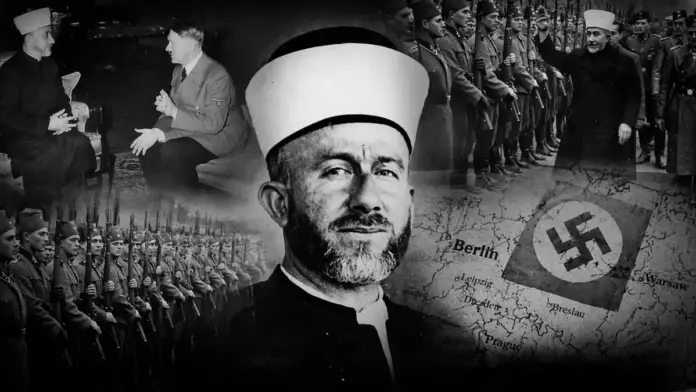
The most iconic moment remains the meeting between al-Husseini and Adolf Hitler in Berlin on November 28, 1941. This was not a symbolic footnote.
It was a political signal. The USHMM record of the meeting preserves not just the image, but the context: a former Mufti of Jerusalem entering the inner orbit of Nazi power at a moment when Berlin hoped to expand its influence across the Middle East.
The Britannica entry on Amin al-Husayni similarly places him at the center of Arab nationalist politics of the era and as a fierce opponent of both British rule and Zionist aims in Palestine.
The importance of the meeting lies not in visual shock, but in what it reveals structurally. Berlin saw the Middle East as terrain for destabilizing British imperial interests. Al-Husseini saw Nazi Germany as a powerful patron for his own struggle.
There was no total fusion of worldviews in every respect. But there was enough common ground for political alignment where all totalitarian currents recognize one another: in the sanctification of hatred, in the reduction of politics to enemies, and in the willingness to turn mass propaganda into moral weaponry.
From Berlin to the airwaves: when hatred becomes transmission
Al-Husseini was not simply a diplomatic contact. He also became a wartime propagandist. The USHMM account of his propaganda role shows that he participated in Arabic-language broadcasts aimed at the Middle East, using the radio as a vehicle for anti-British and anti-Jewish mobilization.
This is one of the places where the article must stay especially disciplined. Propaganda is not a side note to history. It is where ideology stops being only theory and becomes a recruitment system for the mind.
That pattern did not die in 1945. It mutated. In a completely different setting, Newsio explored the same deeper mechanism in When a Regime Stops Seeing Its Own People as Its People: The Anatomy of Iran’s Repression: the first target of every totalizing system is language.
It must first rename dissent as treason before it can rename repression as justice. That is why the study of propaganda is never only backward-looking. It is a guide to how totalitarian systems keep teaching society to misrecognize reality.
Bosnia, the SS, and Muslim recruitment: yes, it happened — and it must be told exactly as it happened
One of the most explosive parts of this history is the recruitment of Muslims into the Waffen-SS, especially in Bosnia. That is precisely why it must be treated with the most light and the least demagoguery.
The USHMM timeline on al-Husseini notes that the SS established imam training for the 13th Waffen Mountain Division of the SS “Handschar,” and that al-Husseini took part in recruitment efforts, speaking to Bosnian Muslim recruits about their alliance with the “Greater German Reich.” At the same time, the USHMM’s fuller discussion of his wartime activity is careful not to overstate what particular units did in every context.
That precision is the whole point. Yes, Muslim recruitment into the SS happened. Yes, the Mufti helped encourage it. Yes, religious language was used to strengthen a Nazi military structure. But none of that justifies the dishonest leap to “Muslims were with the Nazis” as a totalizing civilizational claim.
The honest conclusion is more severe and more useful: Nazism was flexible enough to instrumentalize religious identities, and certain Islamist or Arab nationalist actors were willing enough to meet it on the terrain of hatred, hierarchy, and absolute obedience.
The Farhud and the Iraqi episode: when ideological convergence spills into blood
The violence did not remain abstract. It entered streets and homes. The USHMM account of the Farhud in Iraq makes clear that the 1941 pogrom unfolded in the atmosphere created by the pro-Axis coup of Rashid Ali al-Kailani, with support from the Golden Square and the political influence of al-Husseini.
Here one sees more than symbolic sympathy. One sees how European antisemitism and local political radicalization could reinforce one another and turn a wartime ideological atmosphere into direct violence.
This does not mean every later crisis in the Middle East becomes an automatic Nazi continuation. That would be false. What it does mean is that already during the war there were environments where the antisemitic logic of the Third Reich intersected with regional political and religious dynamics, producing a shared vocabulary of hostility.
That shared vocabulary is historically important because ideologies often survive not by remaining identical, but by leaving behind portable patterns.
After 1945: technology is absorbed, ideas migrate
Another point often abused in public discourse is Operation Paperclip. Here the National Archives overview of Operation Paperclip is important because it reminds us that the postwar world was never a moral cleansing ritual.
The victors absorbed German expertise, technical knowledge, and scientific personnel for strategic reasons. The West, in other words, took pieces of the body of the Third Reich.
But your argument goes deeper than Paperclip alone. The real question is not whether former Nazi science was reused. It is whether some of the ideological functions of totalitarianism — antisemitism as metaphysical obsession, the cult of death, absolute submission, propaganda as a social operating system, and the reduction of the human being to an instrument — survived in other political and ideological theaters.
That is the harder and more serious question. It is not a “biological inheritance,” which would be crude and false. It is a functional resemblance between different forms of totalitarian control.
The metastasis is not literal repetition — it is the recycling of patterns
This is where the article must become heavier without becoming reckless. The point is not that there is a literal “Fourth Reich” reproducing Nazi Germany line by line. The point is that ideologies rarely disappear cleanly. They fragment, migrate, mutate, and reappear inside new languages, new symbols, and new historical environments.
We are not looking at a cloned repetition. We are looking at recurring totalitarian patterns: the absolute enemy, the metaphysics of extermination, the sanctification of violence, the cult of submission, the targeting of books, memory, and autonomy.
That is what makes the subject so serious. If you say it badly, it collapses into a slogan. If you say it correctly, it exposes a mechanism of historical recycling. The totalitarian impulse can wear racial language, religious language, national language, revolutionary language, or anti-colonial language. The surface changes. The deep structure — hatred, hierarchy, dehumanization, propaganda, obedience — can remain frighteningly familiar.
What is really at stake now
If this history matters now, it is not because we need another simplistic civilizational enemy. It matters because we need to become more exact in recognizing the machinery of hatred. Europe is not endangered when it reads this history seriously.
It is endangered when it treats such histories either as taboo or as shouting material. It is endangered when it loses the ability to distinguish between faith and the political weaponization of faith, between human communities and fanatic networks, between religion and the totalitarian operating systems that parasitize religion for control.
That is why naïveté is dangerous. To ignore such historical convergences is blindness. To generalize them into hatred against entire peoples is injustice. The only serious position is the difficult one: to say that real relationships existed between Nazi machinery and specific Islamist or Arab nationalist actors, that those relationships left ideological and symbolic traces, and that history does not permit the crude fusion of an entire religion with those traces.
Conclusion: the battle is not with religions, but with systems of control
The strongest conclusion is also the most disciplined one. Nazism did not transfer intact into another world like a biological graft. That would be an overstatement. But some of its darkest operating elements did survive and reappear in other settings: antisemitism as transcendental obsession, the cult of death, total obedience, the deification of propaganda, and the reduction of the person into an expendable tool.
That is the real line of the article: not a war against religions, but an uncompromising analysis of the mechanisms that take belief, identity, grievance, and historical injury and convert them into a totalitarian program. As long as societies fail to see that distinction clearly, they will keep confusing civilizations with the parasites that seize them.