


Πίνακας περιεχομένων
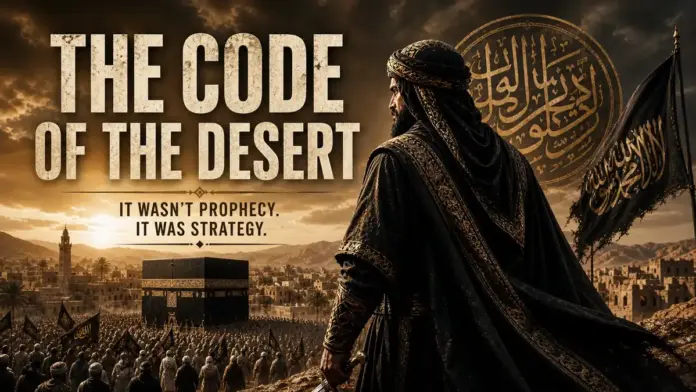
The Code of the Desert did not remain in the desert
The modern world cannot understand political Islam if it treats Muhammad only as a private preacher or only as a religious symbol. The decisive historical fact is harder and more consequential: after the Hijra to Medina in 622, Muhammad became not only the proclaimer of Islam, but also the leader of a new political community, a law-giving authority, and a military-political figure whose model fused revelation, governance, loyalty, and power.
Britannica identifies Muhammad as the founder of Islam and the proclaimer of the Qur’an, born in Mecca around 570 and dying in Medina in 632.
That is the core of the issue. The story is not merely theological. It is political. It is institutional. It is civilizational. The “Code of the Desert” is the moment where a religious message moved from preaching into rule, from warning into command, from community into state formation.
This article does not indict Muslims as people. It does not reduce 1.9 billion human beings to the actions of extremists, regimes, militias, or ideologues. It asks a stricter question: what happens when a sacred claim becomes a political system, when obedience becomes law, and when later movements use religious memory as a software of power?
Why this must be analyzed without fear and without caricature
Two mistakes dominate Western discussion of Islam.
The first is cowardice. Many institutions avoid the political question entirely, as if any serious inquiry into Muhammad’s state-building role were automatically hatred.
The second is crude hostility. Some voices collapse all Muslims into one violent category and turn analysis into collective accusation. That is not serious journalism. It is noise.
The real task is more demanding. A serious analysis must distinguish ordinary believers from political theology, historical sources from modern propaganda, faith from coercive ideology, and devotional Islam from militant or state-driven projects that turn religion into governance and conflict.
Newsio has already taken that exact path in its analysis of Islamic eschatology and the geopolitical depth of belief, because religious ideas matter politically only when they become active inside institutions, regimes, movements, and strategic behavior.
The turning point: Mecca was message, Medina was power
The decisive historical break is Medina.
In Mecca, Muhammad’s mission began as proclamation: monotheism, warning, judgment, moral correction. In Medina, the mission acquired political form. After the Hijra, Muhammad entered a city divided by clans, tribal rivalries, and competing loyalties. He did not merely preach there. He governed.
Britannica describes the Constitution of Medina as an early Islamic document based on agreements concluded between the clans of Medina and Muhammad soon after the Hijra in 622. It organized relations among the groups of Medina and formed a political framework for the new community.
That matters because political Islam is not an invention that appeared centuries later from nowhere. Its roots lie in the early fusion of religious authority and public order. Medina did not only give Islam shelter. It gave Islam a political architecture.
The Constitution of Medina: covenant, order, and authority
The Constitution of Medina is often presented today as a model of pluralism. That reading captures only one layer.
Yes, the document organized relations among different communities. Yes, it recognized a structured relationship between Muslims and other groups. But it also created a political order around Muhammad’s authority. It was not a modern liberal constitution. It was a practical order of allegiance, protection, dispute management, and collective security in a tribal environment.
That is why the document matters. It shows the transformation of religious leadership into political arbitration. It placed a new community inside a legal and security framework. It gave form to the ummah not only as a faith community, but as a political body.
The important question is not whether Medina can be simplified into tolerance or conquest. It cannot. The important question is what kind of power was born there: a power in which sacred legitimacy and political command no longer lived in separate houses.
The desert code: loyalty, law, war, and obedience
Every civilization produces codes of authority. The early Islamic order emerged in an Arabian environment shaped by tribe, honor, alliance, trade, blood compensation, raiding, retaliation, and survival.
The power of Muhammad’s project was that it did not merely abolish the desert code. It restructured it.
Tribal loyalty became religious-political loyalty. Fragmented allegiance became ummah. Warfare became morally framed. Law became sacralized. Obedience became more than political discipline; it became part of the path of salvation.
This is the hard historical point many modern readers avoid. The early Islamic project was not only a spiritual movement. It also became a system for ordering people, managing conflict, distributing loyalty, defining insiders and outsiders, and creating command.
Le Monde’s historical analysis made the same central distinction: Muhammad’s career moved from a Meccan phase of proclamation into a Medinan phase in which he became a political leader, legislator, military commander, and head of a new politico-religious order.
Muhammad as prophet, statesman, and commander
Modern audiences often want religious founders to fit clean categories. Prophet. Teacher. Mystic. Reformer. Moral voice.
Muhammad does not fit only one category. Historically, he occupies several roles at once: prophet in Islamic belief, founder of a religious community, political arbitrator in Medina, military leader, lawgiver, and state-builder.
That combination is precisely what makes Islam politically distinctive. Christianity emerged around a figure who did not govern a state and was executed by one. Islam emerged around a figure whose community became a governing order during his lifetime.
That does not mean every Muslim wants theocracy. It does not mean all Islamic thought is violent. It means the founding memory of Islam contains a political model much closer to rule than to withdrawal from rule.
That fact still matters.
Why this is not just ancient history
The modern world lives with the afterlife of founding models.
Christian political history cannot be understood without Rome, empire, church authority, councils, schisms, and the long contest between throne and altar. Judaism cannot be understood without law, covenant, peoplehood, exile, and return.
Islam cannot be understood without Medina, the ummah, the caliphate, sharia, conquest, sectarian division, and the memory of sacred rule.
Those memories do not control every believer. But they provide political language to movements that want to control states, societies, women, minorities, borders, law, education, and public morality.
That is why modern Islamist projects repeatedly return to origin stories. They do not simply argue policy. They claim restoration. They present power as obedience, expansion as destiny, and law as sacred recovery.
The dangerous myth of “only spirituality”
The comfortable Western myth says all religions are basically private spirituality with different symbols. That myth collapses when it meets political theology.
Islam, like other world religions, has devotional, mystical, legal, philosophical, cultural, and reformist traditions. But it also contains a powerful political inheritance. The question is not whether that inheritance exists. It plainly does. The question is who activates it, how, and for what purpose.
When a Muslim physician in Europe lives a private religious life, that is not the same phenomenon as the Taliban, the Islamic Republic of Iran, ISIS, Hamas, al-Qaeda, or the Muslim Brotherhood. Serious analysis must preserve that distinction.
But it must also refuse the opposite lie: that militant or authoritarian Islamist projects have no relationship to religious-political concepts at all. They often do. They select, weaponize, simplify, and radicalize those concepts — but they do not invent the entire vocabulary from empty air.
From Medina to empire: the problem of succession
Muhammad’s death in 632 created an immediate political problem: prophecy could not simply continue in the same form.
What happens when the founder dies but the community, law, territory, and mission remain?
The answer became the caliphate. It was not merely an administrative arrangement. It was a way to preserve political-religious continuity after the end of prophetic leadership.
This is why the early succession crisis matters so deeply. The split between Sunni and Shia Islam cannot be understood only as theology. It was also a dispute over authority, legitimacy, leadership, and the right to inherit the political meaning of the Prophet’s project.
The desert code did not disappear after Muhammad. It entered history through institutions.
Why Iran matters in this discussion
Modern Iran is not the same as early Islam. It is a Shia revolutionary state born from the 1979 Islamic Revolution, shaped by Persian political culture, clerical hierarchy, anti-Western ideology, and the doctrine of Velayat-e Faqih.
But Iran shows how religious authority can still become state machinery.
Newsio has already analyzed how Iran’s political system limits democracy through clerical guardianship, and that example matters here because it shows the modern version of a much older question: who has the right to rule in God’s name?
When the answer becomes a clerical-security state, theology stops being a private belief. It becomes constitution, police power, candidate vetting, censorship, prison, foreign policy, and proxy warfare.
The “software” of power
The deeper issue is not whether every Islamic society becomes Iran. It does not.
The deeper issue is that political theology can operate like software. It supplies categories: believer and enemy, obedience and rebellion, purity and corruption, divine law and illegitimate law, martyrdom and betrayal, sacred land and hostile space.
That software can remain dormant, symbolic, cultural, or devotional.
But when regimes, militias, or revolutionary movements activate it, it can become a system of mobilization. It tells men why to fight. It tells rulers why dissent is treason. It tells followers why compromise is weakness. It tells movements why history belongs to them.
This is why Newsio’s work on Iran’s network of violence across the region connects with this subject. The modern battlefield is not only missiles and militias. It is also the ideological code that tells people what those missiles and militias mean.
The West’s analytical failure
The West often fails because it swings between two false comforts.
The first says religion has nothing to do with violence or power. It blames only economics, colonialism, borders, poverty, humiliation, or foreign intervention.
Those factors matter. But they do not explain everything.
The second false comfort says Islam itself mechanically produces violence everywhere. That view is analytically weak and morally reckless. It ignores history, diversity, reformist traditions, secular Muslims, dissidents, victims of Islamist regimes, and the reality that many Muslims are themselves targets of jihadist and authoritarian violence.
The truth sits in a harder place. Political Islam is neither a Western hallucination nor the essence of every Muslim life. It is a real ideological-political tradition that must be studied, named, and confronted where it becomes coercive.
Why Christians, minorities, and dissidents often become targets
Across multiple regions, Islamist movements have often framed religious minorities, apostates, secularists, women’s rights activists, reformists, Jews, Christians, Yazidis, and dissenting Muslims as obstacles to sacred order.
That violence cannot be explained only as random extremism. It often flows from a political worldview in which law, identity, and power must be purified.
This does not mean every Muslim endorses persecution. Many Muslims oppose it, suffer under it, and die resisting it. But when militant ideology claims divine authority, dissent becomes more than disagreement. It becomes rebellion against the sacred order.
That is why the victims matter. Their suffering reveals the difference between personal faith and coercive political theology.
The issue is power, not ethnicity
This article is not about Arabs as a people. It is not about Muslims as a race, because Muslims are not a race and Islam includes many cultures, languages, and histories. It is not about demonizing ordinary believers.
It is about power.
It is about the political use of religious authority. It is about the transformation of faith into command. It is about the historical moment in which a religious community became a governing structure and the modern movements that still draw from that memory.
That distinction is essential. Without it, analysis becomes either cowardice or bigotry.
The image of peace and the record of power
Many modern presentations of Muhammad emphasize mercy, peace, forgiveness, and spiritual guidance. Those elements exist within Islamic tradition and matter to millions of believers.
But an honest historical analysis cannot stop there.
Muhammad was also a political founder. He led a community that fought, negotiated, judged, punished, allied, expanded, and governed. The historical record is not the record of a private spiritual teacher detached from power. It is the record of a founder whose message became a state-forming project.
This does not require theatrical outrage. It requires accuracy.
The question is not whether Muslims may honor Muhammad as prophet. They do. The question is whether modern analysis may examine the political architecture built around him. It must.
What the modern world must understand
Political Islam becomes dangerous when it claims that sovereignty belongs not to citizens, law, debate, or human accountability, but to a sacred order interpreted by those who hold power.
At that point, opposition becomes impiety. Journalism becomes blasphemy. Women become regulated bodies. Minorities become tolerated subjects or enemies. Elections become conditional. Violence becomes purification. Expansion becomes destiny.
This is why the issue matters globally. It affects Europe through integration, radicalization, free speech, asylum, security, and minority rights. It affects the Middle East through regimes, militias, civil wars, and sectarian competition. It affects the United States through terrorism, foreign policy, campus debates, religious liberty, and the challenge of distinguishing Islam from Islamism.
The world does not need panic. It needs clarity.
The line Newsio draws
Newsio’s line is simple: defend people, expose power.
Defend ordinary Muslims from collective blame. Defend Christians, Jews, Yazidis, secular dissidents, ex-Muslims, women, reformists, and minorities from intimidation. Defend the right to analyze religious history without fear. Defend the distinction between private belief and coercive ideology.
At the same time, expose every system that turns sacred language into domination.
That is the only honest path. Anything else either protects the powerful behind the shield of sensitivity or attacks the innocent through the language of civilization war.
The Code of the Desert is still readable today
The Code of the Desert is not a slogan against a religion. It is a warning about political memory.
In Medina, a religious movement became a political order. After Muhammad’s death, that order sought continuity through the caliphate. Across centuries, different rulers, empires, scholars, rebels, reformers, and militants fought over what that inheritance meant.
Today, the question returns in new forms. Can religion live inside pluralistic citizenship without claiming the state? Can sacred law coexist with equal civil rights? Can Muslim-majority societies separate faith from coercive authority? Can the West defend free inquiry without sliding into hatred? Can journalists analyze Muhammad’s political role without fear?
Those are not academic questions. They are global questions.
The final conclusion
Muhammad was not only a preacher in the desert. Historically, he became the founder of a community that joined belief, law, war, arbitration, identity, and power.
That does not make every Muslim violent. It does not make every Islamic tradition authoritarian. It does not erase the spiritual lives of millions of decent believers.
But it does make one thing impossible: the childish claim that political Islam has no roots in the founding memory of Islam.
The world must be mature enough to say both truths at once. Muslims are not the enemy. But political systems that turn religious authority into coercive power must be analyzed without fear.
That is the real Code of the Desert: not a myth of simple prophecy, and not a cartoon of hatred, but the hard architecture of power that began in history and still speaks to the present.