


Table of Contents
The biggest shift is not a signature — it is the collapse of a myth
The most important change in the Middle East is not a photograph of leaders shaking hands. It is the quiet collapse of an old assumption: that the region’s central dividing line will always be “Arabs versus Israel.”
Today, the real line is moving elsewhere — between states trying to build security, technology, air defense, post-oil economies, and trade corridors, and forces that live from nuclear pressure, proxy wars, ideological captivity, and permanent crisis.
Israel, the United Arab Emirates, and Saudi Arabia have not become a single formal trilateral alliance. The UAE normalized relations with Israel through the Abraham Accords, while Saudi Arabia still publicly links full normalization to a Palestinian state. That distinction matters.
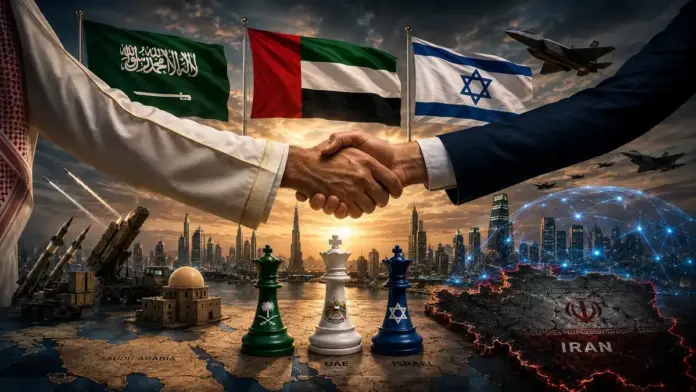
But it does not cancel the deeper strategic movement: Iran has become the shared threat pushing old adversaries toward a new regional security logic. The Abraham Accords began with Israel, the UAE, and Bahrain in 2020, while Saudi Arabia has not joined that formal normalization framework.
This is not the “peace of prayers.” It is the peace of radars, drones, pipelines, cyber defense, data centers, air-defense batteries, maritime chokepoints, and the fear that a theocratic power can hold an entire region hostage. That is why this may become one of the great strategic shifts of the century.
The alliance not yet signed
The first mistake would be to say that Saudi Arabia, the UAE, and Israel have already signed a full strategic alliance. They have not. In diplomacy, words matter. Treaties matter. Recognition matters. Ambassadors matter. The UAE-Israel normalization treaty is real. Saudi-Israeli normalization is still unfinished.
The second mistake would be to underestimate what is happening because the final Saudi signature is not there.
History does not always change on the day a treaty is signed. Often it changes earlier, when leaders begin to redraw their threat map. That is what is happening now. Riyadh has not crossed the final diplomatic threshold, but the strategic environment around Riyadh has changed. Iran’s missiles, drones, proxy networks, nuclear threshold, pressure around Hormuz, and the uncertainty of unconditional U.S. protection all push the Gulf into a more mature security architecture.
This is not yet a declared alliance. It is the architecture of an alliance before the name arrives.
The old Arab-Israeli myth is not erased — but it no longer explains the region alone
For decades, the Middle East was read through one dominant frame: Arabs against Israel. That frame was not imaginary. It came from wars, occupation, displacement, Palestinian suffering, ideological mobilization, and real historical wounds.
But that frame can no longer explain the whole region.
Gulf states do not look only at Israel now. They look at Iran. They look at the Houthis. They look at Hezbollah. They look at the ability of Tehran and its network to threaten sea lanes, ports, energy infrastructure, drones, missiles, and political vacuums. They see that the greatest danger to their future may not be the old ideological conflict alone, but a regional destabilization machine capable of damaging economies, investment plans, and national transformation projects.
That does not mean the Palestinian issue has disappeared. It has not. Saudi Arabia has repeatedly said there will be no diplomatic relations with Israel without an independent Palestinian state, and Reuters reported Riyadh’s position that such a state must be recognized on 1967 borders with East Jerusalem as its capital.
But the strategic hierarchy has changed. States cannot live on myths alone when missiles, markets, and chokepoints write their own laws.
Iran has become the great unifier of its opponents
For decades, Tehran tried to present itself as the guardian of Islam against the “Zionist enemy.” That narrative gave the Iranian regime ideological reach far beyond its borders. It allowed Tehran to speak to Arab streets, fund proxies, and present Hamas and Hezbollah as extensions of a grand “resistance” front.
But Iran has weakened its own myth.
When a state threatens the Gulf, plays with Hormuz, arms militias, pressures Iraq, Lebanon, Syria, and Yemen, and moves close to the nuclear threshold, it becomes more than an ideological actor. It becomes a shared danger. Arab leaders do not need to love Israel to cooperate with it. They only need to fear Iran more.
That is the geostrategic turn.
Newsio has already framed this pressure map in its English analysis of Iran under pressure as U.S. carriers, Hormuz, diplomacy, and the IRGC converge. The issue is no longer one isolated front. It is a chain of pressure linking energy, maritime routes, military signaling, proxy warfare, and regime survival.
The UAE read the new map first
The United Arab Emirates understood earlier than most that the old region was dying. Abu Dhabi did not move toward Israel because it suddenly abandoned Arab political sensitivities. It moved because it read the century ahead.
Israel offers technology, cyber defense, intelligence, air defense, innovation, Washington access, and battle-tested strategic depth. The UAE offers capital, ports, logistics, global finance, regional ambition, and a Gulf gateway. The relationship is not romantic. It is functional.
And because it is functional, it may prove more durable than old slogans.
The UAE-Israel treaty established full normalization, diplomatic relations, and a framework for cooperation. The U.S. State Department’s posted treaty text makes clear that the agreement was not only symbolic; it created a formal architecture for bilateral relations.
That is what Iran fears most: not a speech, but a system.
Saudi Arabia and the hardest threshold
Saudi Arabia is different from the UAE. It is not just another Gulf state. It is the custodian of Islam’s two holiest cities, Mecca and Medina. It carries a unique burden inside the Muslim world. It must manage religious legitimacy, domestic politics, regional leadership, U.S. security ties, the Palestinian issue, and its own Vision 2030 transformation.
That is why Riyadh cannot move exactly like Abu Dhabi.
Saudi Arabia needs a narrative, a price, a diplomatic cover, a Palestinian framework, and time. Publicly, it has not abandoned its Palestinian condition. That is why any serious article must avoid pretending that a full Saudi-Israeli alliance already exists.
But the deeper point remains: even when Saudi Arabia delays the diplomatic ceremony, its strategic behavior changes. Riyadh needs air defense, technology, energy security, U.S. partnership, protection against Iran, and a post-oil economy. Those needs pull it closer to the Israeli-Gulf strategic axis, even before the political signature arrives.
This is the core reality: Saudi Arabia may not yet recognize Israel, but it already lives inside a regional equation in which Iran makes Israeli capabilities harder to ignore.
The new dividing line: development or destabilization
The Middle East is being cut by a different blade now. Not simply Arabs versus Israelis. Not simply Sunnis versus Shiites. Not simply West versus anti-West.
The new line runs between two models.
On one side stand states trying to buy a future: artificial intelligence, logistics, tourism, renewable energy, data centers, advanced defense, trade corridors, ports, investment, and international credibility.
On the other side stand networks and regimes that draw power from permanent crisis: nuclear ambiguity, proxies, ideological mobilization, regime survival, strategic blackmail, and the production of ruins.
This does not make the first camp angelic. Gulf states remain authoritarian in many ways. Israel remains deeply contested because of Palestinian suffering and its own policies. The region’s societies do not always follow their leaders. Memory does not disappear because markets demand it.
But strategy is not morality theater. The fact that these actors are imperfect does not erase the strategic direction. Some states need stability to build. Others need crisis to rule.
Hormuz is the geostrategic heart of the new Middle East
To understand why this is geostrategy and not just diplomacy, look at the Strait of Hormuz.
Hormuz is not a footnote on the map. It is one of the world’s most important energy chokepoints. The U.S. Energy Information Administration says the Strait connects the Persian Gulf with the Gulf of Oman and the Arabian Sea, and that very few alternatives exist to move oil out of the Gulf if it is closed.
The International Energy Agency says nearly 20 million barrels per day of oil were exported through Hormuz in 2025. It also estimates only about 3.5 to 5.5 million barrels per day of available alternative export capacity through Saudi and UAE routes. That means bypass routes matter — but they do not make Hormuz irrelevant.
This is where rhetoric ends and geography takes over. The Gulf can reduce part of Iran’s leverage. It cannot erase it.
That is why Newsio’s English analysis of the pipelines that bypass Hormuz is directly relevant. Those pipelines are not technical details. They are strategic shock absorbers against Iranian pressure.
Energy security has become national security
The new Middle East is not only about flags and alliances. It is about whether energy can move, whether ports can function, whether insurance costs explode, whether global markets panic, and whether one narrow maritime passage can become a weapon.
The IEA’s broader Middle East energy analysis adds another crucial point: about 80% of oil and oil products transiting Hormuz in 2025 were destined for Asia, and large volumes of LNG also passed through the Strait, including most of Qatar’s and the UAE’s LNG exports. For those LNG flows, there are no alternative routes to bring those volumes to market.
That means the Gulf is not a regional problem. It is an Asian problem, a European problem, an American problem, and a global inflation problem.
Iran understands this. So do Saudi Arabia, the UAE, Israel, and Washington.
That is why the quiet convergence matters. It is not built on affection. It is built on vulnerability.
Air defense is the new language of peace
In the twentieth century, the Middle East often spoke in the language of ideology. In the twenty-first, it increasingly speaks in the language of air defense.
Drones, cruise missiles, ballistic missiles, and proxy networks have changed the nature of threat. A traditional invasion is no longer required to paralyze a state. A strike on a refinery, port, airport, undersea cable, data center, desalination plant, or export terminal can carry strategic consequences.
That is where Israel becomes valuable to the Gulf. Not as an ideological ally, but as a technology and security node. Israel has experience in missile defense, cyber operations, intelligence, surveillance, rapid response, and layered threat management.
The Gulf needs exactly that type of architecture.
The new peace, if it comes, will not be born because leaders forgot the past. It will be born because they understand that the future can be lost to a drone before it can be saved by a slogan.
The U.S. security bill has changed the equation
There is also an American layer. The United States remains the central outside security power in the region, but the age of automatic, unlimited, free protection is over.
Washington increasingly expects regional actors to carry more cost, accept more responsibility, and build more resilience. Gulf leaders understand that they cannot build their entire future on the assumption that every U.S. administration will protect every oil facility, every sea lane, and every red line with the same intensity.
That does not mean the United States is leaving. It means the region must mature strategically.
It must share risk. It must build networks. It must integrate air defense, intelligence, infrastructure resilience, maritime security, and alternative export routes. It must stop treating security as an American public utility.
This is exactly where Israel, the UAE, and Saudi Arabia meet — even when they do not say it publicly in the same language.
The burial of Iran’s great myth
The deepest blow to Tehran is not only military. It is narrative.
Iran wanted to appear as the center of “resistance.” It wanted to convince the region that only Tehran defended Muslim dignity against Israel. It wanted to use the Palestinian issue as ideological fuel while hiding its own regional expansion behind sacred language.
But when the most powerful Sunni states begin to calculate Israel as a possible security, technology, or indirect strategic partner, Iran’s myth cracks.
It does not crack because someone defeated it in a television debate. It cracks because the interests of the states that were supposed to serve that myth are moving elsewhere.
Tehran offers sacrifice, encirclement, nuclear ambiguity, proxy wars, and permanent mobilization. The Gulf wants investment, logistics, technology, tourism, energy security, ports, data centers, and post-oil survival.
Those two futures cannot live together forever.
Hamas and Hezbollah fear the new regional logic
The new architecture threatens not only Iran as a state. It also threatens the networks that feed on the old myth.
Hamas and Hezbollah live politically from the idea that conflict with Israel must remain eternal, sacred, non-negotiable, and useful to those who control the weapons. Every serious Arab-Israeli convergence narrows their ideological market.
Hezbollah especially needs a Lebanon held hostage to preserve its role as “resistance.” But the more Lebanon pays for a war it does not fully control as a state, the more that narrative weakens.
Newsio’s English analysis of Iran, Qatar, and Saudi Arabia and why regional energy strikes matter belongs inside this wider map: the battle is no longer only military. It is energy, legitimacy, infrastructure, state survival, and the ability of proxies to keep countries trapped inside someone else’s war.
A new Middle East would be a nightmare for every force that profits from keeping the fire alive.
This is not a liberal paradise
A serious analysis must not become naïve. This new convergence does not mean the region is becoming a liberal paradise. Gulf monarchies still restrict political life. Israel’s policies remain central to Palestinian suffering and global controversy. Arab publics do not simply erase decades of anger. The Palestinian question does not vanish because leaders discuss technology.
But history rarely moves through clean moral categories. It moves when interests reorder themselves.
The point is not that the players became saints. The point is that Iran, drones, energy vulnerability, technology, and the cost of instability have become stronger than the old obligation to perform the same ideological theater forever.
That is cold. That is hard. That is why it is historic.
Dead myths against living interests
The deeper lesson reaches beyond the Middle East.
When dead myths collide with the living interests of states, states eventually choose survival. They may do it slowly. They may hide it behind statements. They may maintain public conditions to protect domestic legitimacy. But the map changes.
That is what we are seeing now.
The region is not abandoning its history. It is not waking up without memory, religion, trauma, or hostility.
It is beginning to admit that history cannot be its only security program.
The past does not intercept drones. It does not protect ports. It does not secure pipelines. It does not power data centers. It does not guarantee investment. It does not keep Hormuz open. It does not save an economy from strategic blackmail.
The new Middle East has not fully been born — but the old one is dying
The new Middle East is not complete. It has no final treaty. It has no single name. It has not solved the Palestinian issue. It has not neutralized Iran. It has not dismantled proxy networks. It has not found a stable balance between security, sovereignty, and legitimacy.
But the old Middle East has lost its monopoly.
The old myth that everything can be explained through the eternal Arab-Israeli divide no longer works. Iran changed the equation. Technology changed the equation. Energy changed the equation. American fatigue changed the equation. Drones changed the equation. Markets changed the equation.
When so many equations change together, this is not routine diplomacy. It is historical movement.
The victory of reality
Reality does not ask permission from myths. It wears them down until they can no longer explain the world they claim to control.
That is happening now in the Middle East. Leaders did not suddenly become idealists. They became more realistic because the cost of illusion increased. Tehran tried to use the old myth as a weapon. But the more it used it, the more it convinced its opponents that they needed a common architecture against it.
There is no formal trilateral Saudi-UAE-Israeli alliance yet. But there is something that often comes before a signature in history: a convergence of needs.
And that convergence says something enormous. A century does not change only when a document is signed. It changes when the old carriers of the myth begin to behave as if the myth is no longer enough to keep them alive.
The Middle East has not reconciled. It has matured strategically.
For Tehran, that may be more dangerous than any signing ceremony.