


Table of Contents
The report from Hezbollah territory does not only show a militia — it shows a state struggling to exist
The most revealing thing in a report from Hezbollah-influenced Lebanon is not always the gun, the poster, or the slogan. It is the feeling that the formal state exists somewhere in the distance, while daily authority, fear, protection, silence, and the decision of war move through another system.
That is the real story. Lebanon is not dealing only with an armed organization. It is facing the most basic question of statehood: who decides security, foreign policy, peace, and war? Beirut, or a parallel armed structure tied to its own ideology, its own social system, and Iran’s regional strategy?
The field report from areas such as the Beqaa Valley and Baalbek does not simply show Hezbollah support. It shows the deeper crisis of a country that has lost critical portions of sovereignty over decades. Where the state fails to provide security, services, trust, and national authority, Hezbollah does not appear only as a militia. It appears as a substitute state.
The first signal: posters, martyrs, and the geography of authority
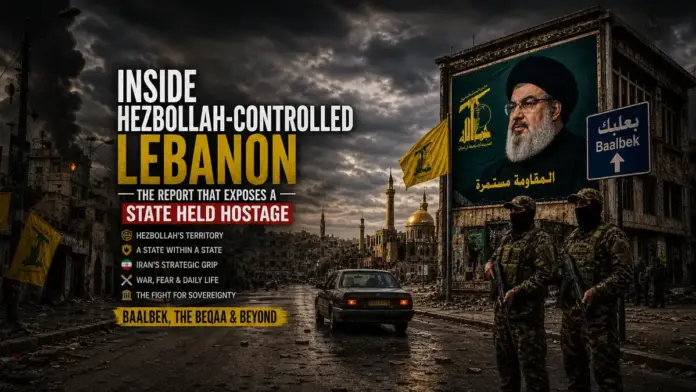
The report begins with entry into “Hezbollah territory,” marked immediately by large posters of martyrs, leaders, and political-religious symbols. That image matters. It is not decoration. It is territorial language.
The posters tell the visitor and the resident who dominates the public space. They define memory. They assign political meaning to the dead. They turn roads, villages, walls, and checkpoints into an ideological corridor.
Hezbollah does not need a fighter on every corner to show power. It needs symbols, social networks, memory, fear, and the ability to make people adjust their behavior before anyone formally orders them to do so.
That is why the video’s warning about filming is important. The reporters understand they must be more careful because cameras are not neutral in Hezbollah areas. Public space has rules. Some are written. Many are not. The power is visible in the moment a visitor self-censors before raising the lens.
The RocaNews video report captures this atmosphere directly: an ordinary road can become a map of political control, not because it looks like a battlefield at every second, but because the signs of authority are everywhere.
A shadow state begins where the state disappears
One of the strongest points in the report is the explanation that Hezbollah gained strength because government services were weak, absent, or distrusted. Where the state does not arrive, someone else arrives first.
That does not justify Hezbollah. It explains the terrain on which it grew.
When a community feels marginalized, insecure, and abandoned, an armed organization can present itself as protector, provider, mediator, identity machine, and social safety net. It can distribute money, food, services, security, and a sense of dignity. But the price is severe: society receives protection while losing political freedom.
Lebanon has lived inside that contradiction for decades. Hezbollah is not simply an armed force next to the state. It is a system that expanded inside the state’s absences.
That is why Newsio’s previous analysis of Iran, Lebanon, Gulf pressure, and Hezbollah’s strain remains central. Hezbollah is not only a military problem. It is a sovereignty problem, a social problem, an economic problem, and a regional problem at the same time.
Lebanon’s older wound: foreign wars on sovereign land
The report returns to Lebanon’s civil war and to the arrangements that allowed Palestinian armed organizations to operate from Lebanese territory. The key idea is mercilessly relevant today: when a state allows another actor to fight a war that is not the state’s national war from its sovereign land, the corrosion of sovereignty begins.
That pattern did not disappear. It returned in a different form with Hezbollah.
Lebanon has repeatedly paid the price for armed actors using its territory as a platform for wider conflicts. Each time, the cost falls on civilians, infrastructure, the economy, communities, and the very idea of the state.
Hezbollah presents its weapons as a shield against Israel. But a growing counter-argument inside Lebanon is sharper: those weapons do not only protect the country. They also make Lebanon a permanent platform for a war the Lebanese state does not fully control.
This is exactly the logic behind UN Security Council Resolution 1701, which called for the disarmament of all armed groups in Lebanon and for no weapons or authority in the country other than that of the Lebanese state.
The UNIFIL mandate also reflects the same principle: support for Lebanese state authority, the Lebanese Armed Forces, and a security zone in the south without unauthorized armed actors.
The problem is not that the rule is unclear. The problem is that Lebanon has never fully been able to enforce it.
Baalbek: culture, fear, and armed normality
Baalbek is one of the strongest symbols in the report. On one level, it holds one of the great archaeological landscapes of the eastern Mediterranean. On another, it appears as a place of posters, war memory, possible drone strikes, armed presence, and political identification.
That contrast is Lebanon in one frame.
A country of history, culture, tourism, urban memory, cosmopolitan identity, and deep social complexity lives beside a reality in which a meal, a cultural club, an ancient temple, or a drive through town can coexist with a destroyed building, a Hezbollah poster, and the possibility of another strike.
The local voice saying that attacks do not change life very much reveals something deeper than indifference. It reveals the normalization of the abnormal. When people grow used to living with danger as background noise, the state has already lost part of its basic function: making security feel ordinary.
A state does not exist only through flags, ministries, and speeches. It exists when people no longer have to organize daily life around the possibility that someone else’s war may arrive from the sky.
Hezbollah as “resistance” and as a system of captivity
The Hezbollah supporter interviewed in the report does not speak like someone who sees himself as part of a criminal machine. He speaks through the language of resistance, memory, fear, family, and historical injury. He says people were killed, families suffered, and no one can trust that Lebanon will be protected if Hezbollah gives up its weapons.
That must be treated seriously, not as caricature.
Hezbollah does not survive only because it has weapons. It survives because it has a story. It has a social base. It has families of the dead. It has real fears on which it builds political legitimacy.
But fear does not solve the problem of sovereignty. It makes it harder. If every community that fears an external threat keeps its own armed power, the state ceases to be a state and becomes a geographic arrangement of armed anxieties.
This is where the myth breaks. Resistance may have emerged from real historical conditions. But when it maintains an army, an economy, political leverage, ideology, and the ability to wage war outside full state control, it becomes a mechanism of captivity.
The key line: it is not only terrorism — it is the hijacking of the state
The most important point in the transcript comes near the end. A Lebanese voice says the primary issue is not only “terrorism.” It is the “hijacking of the state”: the hijacking of decisions, foreign policy, diplomatic relations, and sovereignty.
That is the sentence that unlocks the entire report.
The Hezbollah question cannot be reduced to whether the United States, Canada, the United Kingdom, or the European Union designate Hezbollah as a terrorist organization, or designate part of its structure as such. The United States lists Hezbollah through the State Department’s Foreign Terrorist Organizations framework, while the European Union added Hezbollah’s military wing to its terror list in 2013.
But the deeper Lebanese question is not a label. It is practical sovereignty.
- Can a country have one foreign policy when an armed faction can choose escalation on its own?
- Can a country have national defense when the state does not monopolize weapons?
- Can a country negotiate peace when one organization holds a veto on the battlefield?
This is the real center of the issue. Not the abstract designation. The actual control of the state.
Hezbollah as a “state within a state”
The Council on Foreign Relations describes Hezbollah as a Shia political party and militant group in Lebanon, long regarded as a “state within a state,” with deep ties to Iran. That description matters because Hezbollah is not only one thing.
- It is not only a party.
- It is not only a militia.
- It is not only a social network.
- It is not only a proxy.
- It is a hybrid.
That hybrid structure is visible throughout the report. There are posters of leaders. There are references to schools and supermarkets. There is local security. There is aid where public services are weak. There is a cultural presence. There is trauma from Israeli strikes. There is resistance ideology. There is fear. And there is the constant shadow of Iran.
That is not a simple armed presence. It is a social ecosystem of power.
And once such an ecosystem is established, disarmament is not a technical operation. It becomes state reconstruction.
Iran is not background — it is the strategic architect
The report mentions posters of Iran’s Supreme Leader Ali Khamenei and Qassem Soleimani on the road into Hezbollah-influenced areas. That image is a geopolitical text.
It does not show only political sympathy. It shows strategic identity. It shows that Hezbollah does not define itself only as a Lebanese force. It belongs to a broader axis in which Tehran provides ideological, military, financial, and strategic gravity.
This does not mean every Hezbollah supporter is an Iranian agent. It means Hezbollah has a structural relationship with Iranian strategy. And that relationship brings consequences into Lebanon that extend far beyond Lebanon’s borders.
Newsio has already mapped this broader structure in The Network of Violence Behind the Regime in Tehran. Hezbollah is the most documented and important example of Iran’s ability to turn ideology, money, weapons, and local grievances into regional leverage.
For Lebanon, the result is brutal and simple: Beirut often pays for decisions that fit Tehran’s regional needs.
The Lebanese government is no longer speaking as it once did
The new phase is different because the Lebanese state has begun speaking more openly about Hezbollah’s weapons and military autonomy. Reuters reported in March 2026 that Lebanon’s government banned Hezbollah military activities after fire was launched toward Israel, while Prime Minister Nawaf Salam called on Hezbollah to hand over its “illegal” weapons to the state. (reuters.com)
That does not mean Beirut can easily enforce the decision. It does not mean disarmament is immediate. It does not mean Lebanon suddenly has full monopoly over force.
But it does mean the political vocabulary is changing.
For years, much of Lebanon’s political system lived inside forced balances, fear of civil conflict, and compromise with Hezbollah’s real power. Now the language of sovereignty is becoming more public, sharper, and harder to withdraw.
The question is whether that language becomes policy or remains a ritual of self-defense by a state still afraid to confront the parallel power inside it.
Disarmament is national reconstruction, not a simple military order
Reuters has reported that Hezbollah rejected a government disarmament plan and a four-month timeline, while Lebanon’s government sought to bring all weapons under state control. Hezbollah framed the pressure to disarm as a threat to security and as a move serving Israel. (reuters.com)
That is the central battle of narratives.
For Hezbollah, the weapons are the guarantee of survival. For its opponents, the weapons are proof that Lebanon is not a full state. For the international community, the weapons are a permanent factor of instability. For many citizens, they are both fear and shield, depending on community, geography, and lived experience.
Disarmament, therefore, cannot be treated as a simple military command. It is a social contract that must be rewritten.
The state must prove it can protect. Society must believe it will not be left exposed. Hezbollah must lose the argument that it is the only force capable of guaranteeing survival. External powers must stop treating Lebanon as a message board for larger conflicts.
Without that, disarmament remains correct in principle but difficult in practice.
The conflict is not only Israel versus Hezbollah
The report emphasizes that after October 7, 2023, Hezbollah began firing rockets into northern Israel, linking Lebanon to the war that began from Gaza. That moment is decisive because it returns Lebanon to its recurring nightmare: the country is pulled into war through decisions not taken by the state as one national body.
This does not erase Israel’s responsibility for airstrikes, destruction, civilian harm, or military escalation. The human cost inside Lebanon is real. Reuters reported on May 3, 2026, that the Israeli military urged residents in southern Lebanon to evacuate amid operations against Hezbollah, saying the group had breached a ceasefire. (reuters.com)
But Israeli military pressure does not erase the Lebanese sovereignty question. It makes it more urgent.
If one organization opens or sustains a front and the whole country absorbs the consequences, sovereignty becomes an existential issue.
Lebanon cannot live with two strategic wills. It cannot have a government that seeks peace and an armed organization that chooses escalation. It cannot ask for international support while appearing unable to control the war decision inside its own borders.
Hezbollah has weakened, but it has not disappeared
One mistake would be to present Hezbollah as untouched. Another would be to present it as finished. Both readings distort reality.
Reuters reported that Hezbollah has paid a steep price in its effort to reverse its fortunes, facing heavy losses, internal Lebanese opposition, and pressure over its armed status. At the same time, the group remains active, continues to resist disarmament, and still operates as a major force in Lebanese politics and regional strategy. (reuters.com)
That shows a group under pressure, not a group erased.
Hezbollah may have lost military assets, senior figures, political prestige, and part of the myth of invincibility. But its social footprint, ideology, institutions, and relationship with Iran do not vanish because its operational capacity has been reduced.
The report reaches the same cold conclusion: even if Hezbollah disappeared as a formal name, the anti-Israel and anti-American ideology of resistance would not simply disappear.
That is correct. And it is why the answer cannot be only military.
Ideology survives when the state fails to earn trust
An armed movement can weaken militarily and survive politically. It can lose weapons and retain narrative. It can lose commanders and preserve social networks. It can take strikes and still reappear as protector if the state does not fill the vacuum.
That is the lesson from places such as the Beqaa and Baalbek. Hezbollah is not only a product of war. It is a product of state failure, marginalization, fear, identity, external support, and regional conflict.
If the Lebanese state wants to recover sovereignty, it cannot only say “hand over the weapons.” It must become more credible than the organization. It must provide security without sectarian dependency, services without patronage, justice without fear, and a national identity capable of containing all communities.
Without that reconstruction, every vacuum will be filled again by someone offering protection in exchange for obedience.
Beirut’s dilemma: confrontation or paralysis
Beirut faces two dangers.
If it moves too abruptly, it risks internal conflict. The memory of Lebanon’s civil war is not theoretical. It remains a living trauma that shapes political behavior.
If it does not move, however, it accepts paralysis. It accepts that the state does not have the final word on security. It accepts that one armed faction can decide for everyone. It accepts that foreign policy can be held hostage by a power network tied to another capital.
That is Lebanon’s tragic dilemma.
Confrontation can break the country.
Inaction breaks it slowly.
The solution cannot be civil-war-style confrontation or endless postponement. It must be gradual but real restoration of state sovereignty. The army, institutions, international partners, and domestic communities must move toward one principle: no weapons outside the state.
The report shows the daily life of captivity
The importance of the video is not that it shows “terrorists in the streets.” In fact, one of its most useful features is that it shows ordinary people, food, cultural discussions, ancient ruins, humor, and routine.
That is what makes it powerful.
The captivity of a state does not always look like a war movie. It can look like ordinary life next to martyr posters. It can look like lunch beside a bombed-out building. It can look like a cultural club with an Iranian flag visible outside the window. It can look like people saying that strikes nearby do not change their lives.
Normality does not mean the absence of a problem.
Sometimes normality is the proof that the problem has become the environment.
When society adapts to that environment, freedom is not always lost in one spectacular act. It is lost gradually, through adjustments, silences, fears, and compromises.
“Resistance” cannot replace the republic
The idea of resistance carries real historical weight in Lebanon. It cannot be dismissed in a simplistic way. Israeli occupation, past wars, collective trauma, and communities that felt abandoned created a genuine social foundation for Hezbollah.
But historical origin is not an eternal license.
A movement can begin as a response to occupation and evolve into a sovereignty problem. It can start as a protector and become a controller. It can gain social legitimacy and later use that legitimacy to keep a whole country tied to strategies it did not democratically choose.
This is where the language of resistance stops answering the questions of the present. The issue is not only what Hezbollah was in 1982, 2000, or 2006. The issue is what Hezbollah does to the Lebanese state today.
And the answer is severe: it prevents Lebanon from achieving full sovereignty.
Lebanon is not just a stage — it is a node in a regional crisis
Hezbollah is not only a Lebanese issue because its actions affect the entire regional architecture. Escalation from Lebanon toward Israel, ties to Iran, U.S. policy, Gulf pressure, and the wider Middle East crisis are all connected.
Newsio has already analyzed the wider picture in Middle East escalation: Tehran, Beirut, Gulf attacks and Hezbollah’s new rocket barrage. Hezbollah does not function as a secondary front. It is a heavy variable inside a regional system where one front can pressure another.
That means Lebanon cannot afford to treat Hezbollah only as an internal issue. When the organization operates as part of a broader Iranian pressure structure, its decisions affect Israel’s security calculations, Washington’s options, Tehran’s leverage, Gulf stability, and European fears of a wider regional fire.
Lebanon is not only a stage.
It is a node.
Disinformation begins when everything becomes a caricature
The Hezbollah debate often falls into two traps.
The first presents Hezbollah only as “resistance,” ignoring its parallel armed power, its relationship with Iran, attacks, international terrorist designations, and the captivity of Lebanese sovereignty.
The second presents Hezbollah only as a gang with no social base, ignoring why it rooted itself in specific communities, regions, memories, and state failures.
Both readings are inadequate.
The truth is harder: Hezbollah is simultaneously a social mechanism, an armed force, a political party, an ideological community, an Iranian strategic arm, and a sovereignty problem for Lebanon.
Anyone who keeps only one of these pieces does not see the whole machine.
Serious journalism must do exactly that: refuse the easy frame and show the system.
The final question: who decides for Lebanon?
Everything returns to one question.
Who decides for Lebanon?
If the government decides, then the weapons must belong to the state.
If the army defends the country, then there must be one army, not multiple armed authorities.
If the people decide, then no community can drag all others into war.
But if an armed organization decides through its own network, ideology, and regional strategy, then Lebanon is not a full state. It is a state under condition.
The report from Hezbollah-influenced territory shows exactly that: a country where sovereignty was not lost in one moment. It was eroded by civil war, abandonment, occupation, fear, Iran, state weakness, and the transformation of “resistance” into permanent parallel power.
What readers should take away
The first conclusion is that Hezbollah cannot be explained only as a terrorist organization or only as resistance. It is a hybrid power system operating inside the gaps of the Lebanese state.
The second conclusion is that Lebanon cannot regain full sovereignty while the decision of war and peace can pass through an armed organization outside complete state control.
The third conclusion is that disarmament cannot be only a military order. It must be state reconstruction. Without security, services, trust, and national cohesion, the vacuum will return.
The fourth conclusion is that Iran is not a spectator. The Tehran-Hezbollah relationship turns Lebanon into a field of regional strategy.
The final conclusion is the clearest: Lebanon can survive pluralism, religious diversity, difficult history, and political disagreement. It cannot survive forever with two authorities over one state.
The country must decide whether it will become a republic again or remain a platform for wars decided elsewhere.