


Table of Contents
When a Former CIA Director Invokes the 25th Amendment Against Trump: What Was Actually Said, What the Constitution Allows, and Why the Warning Matters
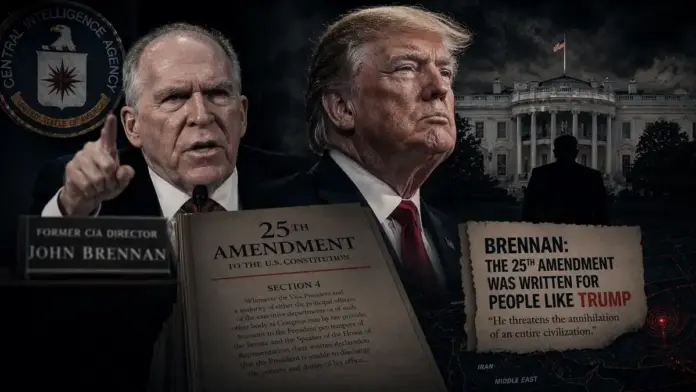
John Brennan’s argument that the 25th Amendment was effectively “written with people like Donald Trump in mind” is not just another loud anti-Trump soundbite. It is a warning with unusually heavy institutional weight because it did not come from a cable panelist, a partisan activist, or a generic opposition figure.
It came from a former CIA director speaking about the judgment, stability, and constitutional fitness of a sitting U.S. president in the middle of a major geopolitical crisis. That matters on its own.
But it matters even more because Brennan tied his warning to Trump’s own language about Iran, including the now-notorious line that “a whole civilization will die tonight” if Tehran failed to make a deal.
Reuters reported that phrase on April 7, and The Guardian later reported Brennan’s response that the 25th Amendment was made for precisely this kind of presidential danger.
The real issue here is not simply whether Trump used inflammatory rhetoric. American presidents have often used hard language in moments of war and crisis. The issue is that Brennan’s intervention tries to move the debate from the field of normal political criticism into the field of constitutional alarm.
He is not saying merely that Trump is reckless or offensive. He is saying, in substance, that Trump’s conduct raises the question of whether he remains fit to exercise the full powers of the presidency — including command authority and nuclear responsibility.
Once the debate moves to that level, the story stops being about style and becomes a story about institutional survival, executive capacity, and the guardrails of the American system itself.
That is why this development needs to be read carefully. On one side, there is the temptation to dismiss it as more elite anti-Trump outrage. On the other, there is the temptation to treat it as if the 25th Amendment is already somehow in motion.
Neither reading is serious enough. Brennan’s intervention is more important than a routine attack, because it carries national-security prestige and constitutional language. But it does not mean the machinery of removal is close to activation.
The truth sits in a harder place: the warning is politically explosive precisely because it revives the most severe constitutional question available short of impeachment, while remaining far from actual implementation.
What Brennan actually said — and why it hit so hard
The key line, as reported by The Guardian, was Brennan’s claim that the 25th Amendment was “written with Donald Trumps in mind.”
That formulation did not arise in the abstract. It followed Trump’s public language on Iran, and especially the reported threat-like framing that “a whole civilization will die tonight” if Tehran did not accept a deal.
Brennan’s point was not merely that Trump sounded harsh. His point was that such rhetoric, coming from a president who controls the U.S. military chain of command, cannot be treated as just another burst of theatrical messaging.
In Brennan’s telling, the danger lies in the combination of enormous state power with language that sounds impulsive, maximalist, and catastrophic.
That distinction matters because the presidency is not just another office. It is the office through which the United States can move military force, issue commands with global consequences, and create strategic reality in hours.
A president who sounds unstable, vindictive, or intoxicated by escalation is not simply a communications problem. He becomes a constitutional problem if enough people inside the state conclude that judgment itself is impaired.
That is the threshold Brennan is trying to place back on the public agenda. Whether one agrees with him or not, his intervention is not casual. It is calibrated to frame Trump not merely as wrong, but as dangerous in a way the Constitution itself was built to anticipate.
This also fits into a wider pattern already visible across Newsio’s recent U.S.–Iran coverage. Trump, Netanyahu, Europe, and Iran: Why the West Is Splitting matters here because the crisis is no longer only about external confrontation with Iran.
It is also about how Trump’s personal style of power is becoming a fracture point inside the West itself. That article focuses on strategic division, but the Brennan moment pushes the same issue inward, into the constitutional core of the United States.
What the 25th Amendment actually says
The 25th Amendment is one of the most misunderstood parts of the U.S. Constitution. It is not a general-purpose political override. It is not a quick way to remove a president because he is unpopular, extreme, or aggressive.
Its central role is to govern succession and incapacity. The relevant part here is Section 4, which allows the vice president and a majority of the principal officers of the executive departments — in practice, the Cabinet — or another body designated by Congress, to declare that the president is unable to discharge the powers and duties of the office.
At that point, the vice president becomes acting president. The official Constitution Annotated explains that if the president contests that declaration, Congress can ultimately decide the issue.
That matters because the 25th Amendment is conceptually different from impeachment. Impeachment is a political-legal response to misconduct, abuse, or high crimes and misdemeanors.
The 25th Amendment is about inability. That inability can be physical, medical, cognitive, or otherwise related to a president’s capacity to fulfill the office. This is why Brennan’s move is so severe in constitutional terms. He is not primarily saying Trump committed an impeachable offense through one phrase.
He is raising the darker question of whether Trump’s conduct points toward incapacity, volatility, or dangerous unfitness at the level of presidential judgment itself.
This is also why the 25th Amendment remains politically taboo until the moment someone makes it sound unavoidable. Once it is named publicly by someone with state credibility, the entire conversation changes.
The issue is no longer “did the president go too far?” It becomes “is the system still safe with this person in command?” That is a far deeper question, and it is why invoking the amendment carries such extraordinary force even when no formal process is close.
Why Trump’s “whole civilization” line became a turning point
Reuters reported on April 7 that Trump said “a whole civilization will die tonight” if Iran did not make a deal by his deadline. Even by Trump standards, that line landed as unusually explosive.
It sounded less like bargaining language and more like the rhetoric of civilizational annihilation. The Pope publicly called the threat “truly unacceptable,” according to Reuters, which shows how quickly the remark escaped the normal American partisan frame and entered a broader moral and geopolitical one.
That matters because presidential rhetoric is never just rhetoric in a vacuum. When a U.S. president speaks in apocalyptic terms during a real strategic standoff, markets move, allies react, adversaries calculate, and bureaucracies begin planning around the possibility that language may become policy.
A phrase that might sound like theatrical excess in a campaign rally becomes something else entirely when spoken by a sitting commander in chief amid actual force posture and rising military tension.
Brennan’s intervention takes exactly that point and turns it into a constitutional argument: once words of this scale and character come from the Oval Office, the burden on the system changes. It is no longer enough to say “that’s just how he talks.”
This is also why the Hormuz file belongs inside the same reading chain. Trump Escalates in Hormuz: What the U.S. Blockade of Iranian Ports Really Means for Oil, Shipping, and the West is not just a separate geopolitical story.
It is the operational environment in which these remarks were made. The more concrete the escalation becomes, the less plausible it is to treat catastrophic language as harmless theater.
Why Brennan’s status changes the meaning of the intervention
John Brennan is not a neutral public figure. That should be said clearly. He is deeply polarizing, and his long conflict with Trump is part of the background to any statement he makes. But that fact does not erase the institutional weight of who he is.
A former CIA director belongs to a small class of officials who have lived inside the operational logic of U.S. state power, covert strategy, escalation risk, and executive chain-of-command reality.
When someone from that world starts using the language of presidential incapacity, the intervention lands differently than a standard media attack. It signals that concern about Trump is being framed not only as political opposition, but as a national-security problem.
In other words, the Brennan statement matters not because he is necessarily right, but because of the category into which he places the concern. He is telling the public that Trump’s behavior should be read not only as morally offensive or politically destabilizing, but as something that might challenge the constitutional assumptions under which a president is trusted with vast coercive power.
That is why the statement travels. It speaks in the vocabulary of American state continuity, not just in the vocabulary of partisan outrage.
That same problem of institutional trust also links naturally to Newsio’s wider verification frame. How to Read the News Without Being Manipulated belongs in this chain because stories like this one are especially vulnerable to distortion. Some people will inflate Brennan’s words into a false claim that removal is imminent.
Others will reduce the intervention to “deep state hysteria” and refuse to engage the constitutional substance at all. Serious readers need a cleaner method than either of those reactions.
Can the 25th Amendment actually be activated now?
In strict constitutional terms, yes. In current political reality, it still appears highly unlikely. The vice president and a majority of the Cabinet would have to act, or another body designated by Congress would have to be involved.
That means the decisive power is not held by op-ed writers, former officials, critics on television, or even by most of Congress in the first instance. It sits inside the executive branch itself. Unless Trump’s own governing circle turns against him at that level, Brennan’s appeal remains a warning rather than a mechanism in motion. The Constitution Annotated makes this structure very clear.
But political improbability is not the same thing as irrelevance. The real significance of Brennan’s intervention is not that the amendment will necessarily be triggered tomorrow. The significance is that the argument over Trump’s presidential fitness has returned in the language of constitutional emergency.
That alone is a marker of how abnormal the U.S. political environment has become. Democracies do not casually drift into public debate about whether a sitting president may be too dangerous or too unstable to safely continue in office.
When that vocabulary becomes even remotely plausible, something deeper than ordinary polarization has already broken.
That broader institutional stress is also visible in Newsio’s EN-US political and strategic coverage. The Critical U.S.–NATO Turning Point: What Is Cracking Between Washington and Europe helps here because it shows that the Trump problem is not only about domestic American division. It is also about how allied governments increasingly see U.S. behavior itself as a source of strategic instability.
When constitutional alarms and alliance fractures begin to mirror each other, the presidency is no longer functioning as an anchor of order. It starts becoming a generator of uncertainty.
What this says about the condition of American democracy
At its deepest level, this story is not only about Trump. It is about the United States. It shows a system in which the constitutional tools of last resort are being named more openly and more often than a stable republic would ever want.
The very fact that serious people can now discuss presidential incapacity in public, without the conversation sounding utterly absurd, is already a sign of institutional exhaustion. The issue is not whether every critic is fair.
The issue is that the normal political vocabulary has become insufficient to describe what many actors believe they are seeing. That is what pushes them toward the constitutional vocabulary of incapacity.
This is where the story becomes larger than one quote or one crisis cycle. A presidency that repeatedly produces questions about judgment, escalation, and basic fitness starts to destabilize not only politics, but also the public’s confidence in the presidency as an office.
Once the office itself begins to look like a risk multiplier rather than a stabilizing institution, constitutional guardrails stop being abstract features of civic textbooks. They become living questions. That is not where a confident democracy wants to live.
The most dangerous part: when personal style and state power become indistinguishable
Trump’s defenders will say that he has always spoken in maximalist, theatrical terms and that his critics are overreading his words. But that is precisely the point Brennan’s argument is trying to destroy.
The president of the United States is not a commentator, a rally host, or a social-media provocateur detached from consequence. He is the person at the center of the American command system.
The more his rhetoric sounds indistinguishable from personal impulse, personal branding, or apocalyptic entertainment, the harder it becomes to maintain the fiction that rhetoric and responsibility remain cleanly separated.
That is the most dangerous line in the whole story. America has spent years normalizing Trump’s theatricality. The argument now being revived by people like Brennan is that the line between “politically extreme” and “constitutionally unsafe” cannot be blurred forever when the speaker controls real coercive power.
Once words about total destruction, civilizational death, or maximal retaliation are paired with actual military pressure, the system is forced to ask a harder question: can this style of presidency still be treated as unusual politics, or has it become a structural threat to constitutional order?
The central conclusion
Brennan’s intervention does not mean the 25th Amendment is about to be used. It does not even mean the internal executive support for such a move exists. What it does mean is something politically and constitutionally serious: the argument over Trump has shifted again from ordinary criticism to the language of presidential fitness and systemic danger. That is a major escalation in itself.
And that matters well beyond Washington. When the public question becomes whether the president of the United States is so reckless or so unfit that the Constitution’s incapacity mechanism deserves to be discussed, the crisis is no longer merely partisan. It becomes a crisis of confidence in the command center of the Western system.
The presidency does not only make American decisions. It shapes alliance psychology, deterrence credibility, war risk, and market fear. Once trust in the judgment of that office begins to crack, the consequences travel far beyond U.S. borders.
The safest conclusion for serious readers is this: Brennan did not simply say that Trump should leave office. He said, in effect, that the U.S. Constitution contains a mechanism for moments when a president may be too dangerous or too incapable to safely remain in command — and that Trump, through his rhetoric and conduct, has forced that mechanism back into serious public discussion. That by itself is a very large story.