


Table of Contents
The Four-Part Axis and the Siege of the West: How Russia, China, Iran, and North Korea Converge in a Geopolitics of Attrition
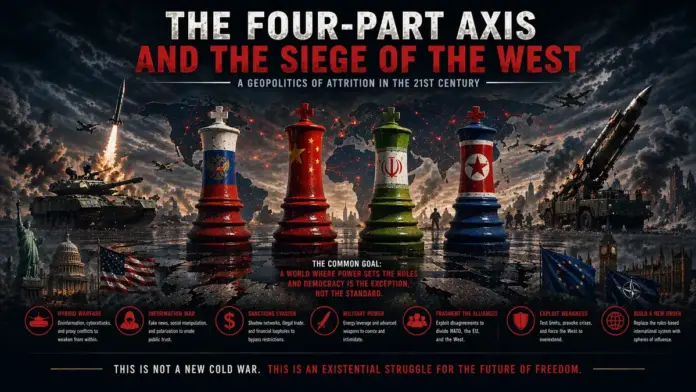
There is no single treaty, no shared flag, and no unified command structure binding Russia, China, Iran, and North Korea into one formal bloc. But pretending they are unrelated strategic actors would now be its own form of denial. What has emerged is something more flexible and, in some ways, more dangerous: a functional convergence of authoritarian powers that do not need identical ideologies in order to damage the same adversary.
Each of them benefits, in different ways, from a weaker West, a more fractured democratic alliance system, looser enforcement of sanctions, and a world in which raw power increasingly outruns the language of rights and rules. That larger pattern is now visible in military supply chains, sanctions evasion, maritime crises, proxy warfare, cyber pressure, and information manipulation.
Europe’s own diplomatic and security institutions now openly treat foreign information manipulation and interference as a rising strategic threat to democratic resilience.
That is why the word “axis” needs discipline rather than theatricality. It does not mean Beijing, Moscow, Tehran, and Pyongyang trust one another fully or share one grand ideological blueprint. It means they have found enough common ground to make mutual disruption worthwhile.
Russia wants to break the post-Cold War European security order. China wants a world in which its economic and technological rise is not constrained by Western export controls, sanctions, and value-based pressure. Iran wants regime survival through regional leverage, deterrence, and proxy projection.
North Korea wants to turn its weapons industry and nuclear posture into survival, leverage, and international relevance. These aims are not identical. But they converge around one strategic reality: the liberal democratic West remains the main external constraint on how far each of these systems can go.
This is also why the story cannot be reduced to geography alone. What links these powers is not only where they operate, but how they operate. They stretch the West across multiple theaters at once.
They force Washington and Europe to spend political will, industrial capacity, military stocks, diplomatic attention, and public trust in several crises simultaneously. In that sense, the real objective is not always direct victory. It is cumulative exhaustion. Readers who want the broader
Newsio frame for how this kind of pressure already benefits Tehran and the wider anti-Western camp can naturally place this article alongside The Critical U.S.–NATO Turning Point: What Tehran and the Anti-Western Bloc Gain.
The common root: not shared ideology, but shared strategic benefit
The deepest bond between these four powers is not emotional, civilizational, or even fully ideological. It is transactional and structural. They all gain from a world in which democratic cohesion weakens,
Western deterrence becomes more expensive, and the credibility of liberal norms declines. This is why the convergence matters even when their interests do not line up perfectly. They do not need to love one another. They need only to understand that each Western crisis creates room for the others.
Russia absorbs Western weapons, money, and attention in Ukraine. North Korea helps sustain that pressure through ammunition supply and military-industrial depth. Iran raises the temperature in the Middle East through drones, proxies, missile pressure, and maritime destabilization.
China supplies economic scale, technological capacity, and strategic ambiguity, often stopping short of open military identification while still benefiting from Western overextension and from weaknesses in sanctions enforcement. That is not a formal alliance in the old sense. It is a distributed model of authoritarian pressure.
The consequence is strategic compression. The West is no longer managing one crisis at a time. It is being forced to think in linked theaters. What happens in Donbas affects munitions and stockpiles. What happens in Hormuz affects energy, shipping, inflation, and alliance politics.
What happens in East Asia affects deterrence calculations and American force posture. What happens online affects public opinion, electoral confidence, and democratic trust. This is why the axis should be understood not as a static geopolitical photo, but as a system of reinforcing pressure points.
Russia and North Korea: the military partnership of attrition
The most concrete and brutal example of this convergence is the Russia–North Korea relationship. In 2024, Moscow and Pyongyang signed a mutual defense pact that committed each side to provide military assistance if the other were attacked. That alone marked a major deepening of the relationship.
But the partnership did not remain symbolic. Reuters reported, based on a multinational monitoring team, that North Korea had sent more than 20,000 containers of munitions and related material to Russia, materially supporting Russian attacks on Ukraine and civilian infrastructure.
This matters because it shows that Pyongyang is no longer just a rhetorical supporter of Moscow.
It has become, in real terms, an arsenal for Russia’s war effort. In return, Western and South Korean concerns have focused on whether Moscow may be transferring technical assistance back to North Korea in missile, satellite, or other military fields. Reuters reported in 2024 that South Korea’s defense ministry saw mounting evidence of military cooperation between the two states.
That is how a European war begins to widen strategically into the Pacific. One authoritarian state helps another keep a long war affordable; the second may then help the first grow more dangerous in another region.
This is a classic attrition logic. Russia needs to reduce the cost of sustaining a long war. North Korea needs hard currency, relevance, protection, and technology. Each gives the other something the West would rather deny them. The result is not just more shells on the battlefield.
It is more pressure on U.S. and allied planning across two theaters at once. For readers who want the wider escalation frame, the broader strategic logic also connects naturally to Global War 2025–2035: Five Escalation Scenarios and Greece’s Position, because the core lesson is that regional crises no longer stay regional for long.
China: the economic and technological battering ram
China operates differently, which is precisely why it is so important. Beijing does not usually project the same overt military brutality as Moscow or the same ideological theatricality as Tehran or Pyongyang. Its power is subtler, wider, and more systemic.
China combines global-scale manufacturing, trade, finance, surveillance technology, infrastructure investment, and diplomatic reach in ways the others simply cannot. That makes it the strategic enabler most capable of softening the impact of Western pressure on authoritarian partners, even when it does not openly declare itself part of a military bloc.
Reuters reported in 2024 that the European Union saw signs of Chinese entities supplying dual-use components to Russia. In 2025, Reuters also reported that the EU was preparing sanctions targeting Chinese refiners and traders linked to Russian oil circumvention.
These are not trivial details. They show how economic and logistical ecosystems can help keep a sanctioned war machine breathing without a public declaration of alliance.
It is important to stay precise here. China does not want to become a transparent co-belligerent in Russia’s war. But it clearly benefits from a world in which the West is overextended, sanctions are more porous than advertised, and democratic governments must keep choosing between principle and cost.
China’s role is therefore not best understood as open warfighting. It is best understood as structural leverage: the ability to make Western reaction slower, more expensive, and more politically difficult. That is more than enough to make Beijing a central pillar in the wider attritional environment.
Iran: the regional accelerant
Iran’s role is different again, but no less central. Tehran acts as a regional accelerant of instability through missiles, drones, proxy networks, maritime pressure, and ideological projection. It is not only trying to survive as a revolutionary-theocratic regime. It is trying to turn survival into leverage.
Reuters reported in 2026 that Russia was sharing cyber support and intelligence-related capabilities with Iran, deepening a relationship that had already been defined by Iran’s provision of drone technology relevant to the war in Ukraine.
That is a major point: Iranian military tools have already crossed from Middle Eastern battle logic into the European security environment through the Ukraine war.
That transfer matters because it erases the comforting illusion that Iran is a “regional problem” while Russia is a “European problem.” The two are linked. The same drones, operational lessons, and deterrence concepts move across theaters.
Tehran therefore matters not only because of what it does in its immediate neighborhood, but because of how it feeds the wider anti-Western pressure ecosystem.
This is why the Newsio explainer Is Iran Threatening the World? What Is Real, What Is Not, and What Comes Next belongs naturally in this reading chain. It helps separate exaggerated rhetoric from the much more important question of how Iranian destabilization actually works.
At the same time, serious writing has to avoid crude overreach. Iran is not secretly controlling every social fracture in Europe, and not every radical network is reducible to Tehran. But Iran does exploit weak points where it can: symbolic narratives, regional resentment, anti-Western mobilization, and proxy environments where formal deniability remains useful.
Its strength lies in asymmetry, not in symmetrical conventional power. And asymmetry remains one of the most efficient ways to drain democracies that are richer in capability than in political patience.
Turkey at the hinge: the role of the opportunistic revisionist
Turkey does not belong formally inside this four-part axis. It remains a NATO member, retains deep economic interdependence with the West, and still sits inside the broader Western security architecture.
But that is exactly why its position is so consequential. Ankara has become less a predictable ally and more a strategic hinge state that tries to turn ambiguity into leverage. Reuters reported that President Erdoğan openly said Turkey would deepen ties with the East while still facing West, and has repeatedly signaled interest in frameworks such as BRICS and the Shanghai Cooperation Organization.
This does not mean Turkey is about to leave the West and join an authoritarian camp wholesale. It means Turkey wants to keep the benefits of NATO and the European economic sphere while maximizing its room to maneuver with Russia, China, and other non-Western centers of power. In that sense, Ankara is not primarily a defector.
It is a bargaining state. It wants every side to understand that it has options, and that its strategic geography, military importance, and regional reach make it too valuable to discipline easily. That is a very different kind of challenge for the West than straightforward opposition.
The internal political layer matters too. The West still represents, however imperfectly, a model of institutional limits, judicial independence, opposition rights, and public accountability that sits uneasily with Turkey’s increasingly centralized and coercive political order. Reuters and European institutions have repeatedly documented pressure on opposition mayors and wider rule-of-law concerns.
That does not turn Turkey into Russia or China. But it does explain why Ankara often appears far more comfortable with a global order based on power flexibility than with one rooted in binding democratic discipline.
Turkey’s use of migration pressure has to be described with care but also with clarity. It is not serious to treat migrants themselves as weapons by nature. It is serious to note that Ankara has repeatedly been accused of using migration flows as political leverage against Greece and the EU.
Reuters reported on the 2020 Evros crisis as a border assault in which Greece said Turkey had encouraged the pressure. That is the key distinction: the human reality is humanitarian, but state handling of that reality can still become coercive strategy.
This is where the Turkey chapter becomes especially important for a Greek and European audience. Ankara does not need to abandon NATO in order to behave revisionistically. It only needs to stay inside while making the alliance less certain of where it stands, less sure of its southern coherence, and more vulnerable to tactical blackmail.
That is why Turkey belongs in this article not as a fifth member of the axis, but as the unstable hinge that can magnify Western uncertainty when it suits its interests.
The inner siege of the West: hybrid war, FIMI, and democratic fatigue
Perhaps the most dangerous part of this four-part convergence is not only what it does on battlefields, sea lanes, or weapons markets. It is what it does inside Western societies. The European External Action Service now openly treats foreign information manipulation and interference, or FIMI, as a serious strategic threat.
Its latest threat reporting makes clear that authoritarian actors use information operations, amplification networks, emotional manipulation, and strategic falsehood not as side tactics, but as part of statecraft.
This is the contemporary form of siege. Not one secret gate left open by accident, but democratic systems that struggle to respond with speed and coherence because they fear overreach, polarization, legal complexity, and political cost.
Their adversaries know this. They build precisely on Western hesitation, on the fragmentation of digital discourse, and on the gap between free expression and organized manipulation. The result is not just misinformation in the abstract. It is the erosion of democratic self-confidence.
That is why the strongest external link in the article belongs here. The European External Action Service’s 4th Report on Foreign Information Manipulation and Interference Threats is not decorative sourcing. It is institutional confirmation that information warfare and democratic interference are now treated as real strategic pressure, not fringe speculation. This is the point at which the article stops sounding like geopolitical mood and becomes documented warning.
For Newsio readers, that internal front also fits naturally with the broader site logic that runs through The Critical U.S.–NATO Turning Point and related analysis: Western weakness is not only measured in tanks and ships. It is also measured in narrative fatigue, civic confusion, and the declining ability to distinguish strategic reality from manipulated noise.
The hour of choice
The biggest mistake would be to misread this landscape in either of two easy ways. One would be to call it a new Cold War and assume clear lines, stable blocs, and familiar rules. The other would be to dismiss it as alarmism and insist these are just disconnected crises. Neither reading is sufficient.
What we have instead is a looser but highly consequential convergence of authoritarian interests, one that does not always need formal alliance structure because it is already producing practical strategic benefit through simultaneous Western exhaustion.
The West therefore faces a harder test than simple reaction. It has to decide whether it still wants to act as a political and strategic community with confidence, or whether it will remain a wealthy but hesitant cluster of democracies that are powerful in tools and uncertain in will.
If it cannot answer that question, then the four-part axis does not need to win a direct global war. It only needs to prove that liberal democracy is slow, divided, and reluctant to defend itself in the very moment when its adversaries have already accepted permanent competition as the norm.
That is the safest conclusion for serious readers: the greatest danger is not only outside the West. It is also inside its own difficulty in recognizing the changed form of conflict. The siege of the 21st century is not conducted only with armies.
It is conducted with shells from Pyongyang, drones from Tehran, dual-use networks and economic leverage tied to China, strategic cynicism from Moscow, and information corrosion running straight through the societies that still like to imagine they are living outside history.