


Table of Contents
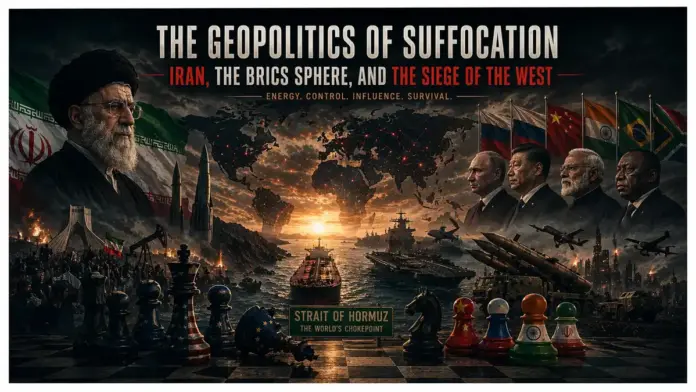
The Geopolitics of Suffocation: Iran, the BRICS Sphere, and the Siege of the West
Iran can no longer be read only as a regional Middle Eastern problem. That frame is now too small for the reality. Tehran remains a central player in regional destabilization, maritime pressure around Hormuz, the proxy economy, and missile-based deterrence. But its significance has widened.
Iran now functions as an operational accelerant inside a broader anti-Western environment in which Russia, China, and other non-Western power centers do not need to share one ideology in order to benefit from the same Western fatigue.
Reuters has reported deepening Russia-Iran cooperation in cyber and intelligence support, while China remains the main external economic lifeline for Iranian oil and therefore a key buffer against full-scale isolation.
That is why this story is not exhausted by slogans or moral theater. Iran has become central to a geopolitics of suffocation: it pressures the world’s most sensitive energy chokepoint, supplies strategic value to Russia, leverages proxy networks as force multipliers, and survives inside an economy weak enough to produce chronic social anger but not weak enough to bring down the regime.
Reuters has described Iran’s economy as badly shattered even where the state preserves coercive capacity, while also showing that Tehran has spent years investing in regional militant influence rather than in domestic recovery.
For Newsio readers, this article belongs in the same chain as Trump, Netanyahu, Europe, and Iran: Why the West Is Splitting and The Critical U.S.–NATO Turning Point: What Tehran and the Anti-Western Bloc Gain. Both matter here because the Iran file is no longer just about one regime and one region. It is about how multiple adversarial actors profit from Western overextension, alliance friction, and strategic hesitation.
“Death to America”: from revolutionary slogan to state strategy
One of the most persistent Western mistakes has been treating “Death to America” as if it were mostly an overheated relic of revolutionary pageantry. In reality, the slogan evolved into a durable state logic.
It no longer functions only as propaganda aimed at mobilizing loyalists. It compresses a worldview: American and Western influence should be pushed out of the Middle East, weakened economically, challenged politically, and forced to operate under permanent pressure.
Reuters’ profile of Ayatollah Ali Khamenei after his death underscored how deeply his rule rested on hostility to the United States and Israel, not as temporary rhetoric but as a governing principle.
That logic is not confined to military confrontation. It also includes pressure on dollar dominance, sanctions evasion, the use of alternative commercial channels, proxy warfare, and maritime leverage.
Tehran does not believe it can defeat the United States symmetrically. It believes it can make U.S. presence more expensive, Western unity more fragile, and the global economy more vulnerable. That is the real strategic meaning of the slogan once it matures into doctrine: not symbolic hatred, but organized attrition.
The Strait of Hormuz: the choke chain of global commerce
Hormuz is not just a narrow passage on the map. It is one of the great choke chains of the global economy. Reuters and AP have both stressed that roughly one-fifth of global oil and gas flows through the strait, which is why every Iranian move there immediately becomes a world event.
When Tehran threatens transit, mines or militarizes the waterway, imposes selective pressure, or raises insurance risk, it is not merely harassing a shipping lane. It is pricing fear into the entire energy system.
Here, precision matters. There is not strong public evidence that Iran simply lets every “friendly” BRICS-linked tanker move freely while targeting only Western shipping in a clean binary way.
But there is a harder and better-supported reality: China has been the main importer of Iranian oil, and Beijing reacted sharply when the United States moved to blockade traffic tied to Iranian ports.
Reuters also reported that even bypass routes such as Saudi Arabia’s East-West pipeline and the UAE’s Fujairah route proved vulnerable during the recent Hormuz crisis, showing that the problem is not only who is allowed through. The deeper problem is that Iran can make the whole Gulf energy architecture feel unsafe.
That is why the strongest external anchor in this article belongs right here: Reuters’ report on Iran’s Hormuz gamble and the tense new normal for Gulf energy. It supports the central claim of the piece better than almost any single source:
Iran does not need total control to impose strategic suffocation. It needs enough leverage to make the world pay for uncertainty. For the broader Newsio energy and maritime frame, this article also belongs beside Trump Escalates in Hormuz: What the U.S. Blockade Really Means and Would a Seizure or Blockade of Hormuz Benefit the U.S. Economy?.
BRICS: more than economics, but not a military alliance
One of the easiest analytical traps is to describe BRICS as if it were a military alliance waiting to become NATO’s mirror image. It is not. Reuters reported in 2025 that BRICS foreign ministers failed even to agree on a joint statement, which is an important reminder that the bloc contains real internal divergence, competing interests, and inconsistent priorities.
But dismissing BRICS as irrelevant would be another mistake. What BRICS gives Tehran is not an integrated war command. It gives Tehran something softer but still powerful: diplomatic breathing room, economic companionship, institutional visibility, and a broader non-Western setting in which Iran is less isolated than it would be in a strictly Western-centered order.
Reuters reported in April 2026 that Russia was already using the BRICS platform to push ideas like joint food reserves amid Middle East crisis risks. That is not military alliance behavior, but it is absolutely geopolitical shelter-building.
So the serious conclusion is this: BRICS is not Iran’s army. It is part of Iran’s strategic oxygen. It reduces the sense of aloneness. It widens the diplomatic room in which Tehran can maneuver. It helps create an international environment where pressure from the West no longer automatically means total suffocation.
Drones, Su-35s, and the Russia-Iran exchange of strategic value
The Russia-Iran relationship is no longer just political cover. It has become material. Reuters reported in January 2025 that a top Revolutionary Guards commander said Iran had purchased Russian-made Su-35 fighter jets, giving official Iranian confirmation to a cooperation track that had been discussed for months. At the same time, Iranian-origin Shahed drones had already become a defining feature of Russia’s war in Ukraine.
That matters because this is not ordinary arms commerce. Iran gives Russia cheap, scalable, operationally useful drone capacity. Russia gives Iran greater airpower depth, technology, and strategic prestige.
Even more important, both sides learn through live conflict. The battlefield becomes a laboratory. Systems evolve under pressure. Tactics migrate from one theater to another.
That is why Iran can no longer be treated as a separate Middle Eastern file detached from European security. For the wider strategic chain, this belongs naturally beside The Four-Part Axis and the Siege of the West, because Russia-Iran exchange is one of the clearest working links inside that larger authoritarian convergence.
China’s umbrella
If Russia offers military upgrading, China offers breathing room. That may be even more important over time. Reuters reported in 2025 that the United States issued sanctions targeting Chinese importers of Iranian oil, including a China-based “teapot” refinery. That move itself reveals the scale of the underlying reality: without Chinese absorption capacity, Iran’s economic resilience would be much weaker.
China does not need to become Iran’s military ally in order to be decisive. It acts as an economic umbrella, a major energy customer, and a diplomatic counterweight to complete Western isolation.
Reuters reported in April 2026 that Beijing opposed the U.S. blockade of Iranian-linked maritime flows in Hormuz and urged restraint, underscoring just how tightly Chinese interests are tied to stability in that corridor and to continued access to Iranian-related energy routes.
That does not mean China is preparing to fight for Tehran. It means China helps keep the Iranian system from being cornered beyond recovery. It offers time, market space, and political cover. In strategic terms, that can be enough.
Regime versus people: Iran’s internal siege
Perhaps the most important moral and political correction in this subject is this one: the Iranian regime is not the Iranian people. Serious analysis cannot merge them. Reuters has described an Iranian society battered by inflation, currency collapse, price shocks, infrastructure damage, and fear of new unrest.
That picture does not support the fantasy of a society fully fused with the regime’s confrontational strategy. It points instead to a country where coercive power and public fatigue coexist uneasily.
This is the deeper tragedy. Tehran presents itself as a defiant anti-imperial center of dignity, but in practice it has spent decades funneling resources into missiles, coercive security structures, and proxies such as Hezbollah, the Houthis, and allied Iraqi militias while ordinary Iranians absorb the cost.
Reuters reported in March 2026 that Iran’s proxy networks in Iraq, after years of cultivation, were themselves fraying under the strain of war, leadership losses, and competing interests. That detail matters because it shows something profound: even the regime’s regional machine is costly, unstable, and not infinitely obedient.
So the internal story is not one of a regime perfectly synchronized with its nation. It is one of a state that still has coercive instruments, but pays for them with deep social suffocation.
Trump’s strategy: madness or strategic clarity?
This is where the article has to stay serious and avoid easy tribalism. Trump’s hard line on Iran is seen by some as reckless adventurism and by others as the only language Tehran truly respects. Reuters and AP both showed that after talks failed, the U.S. move to blockade shipping to and from Iranian ports revived exactly that argument: unless Tehran’s revenue, access, and coercive capacity are hit hard, the regime simply buys time and returns stronger.
The case for the hard line is straightforward. Appeasement lets the regime breathe, preserves its security apparatus, and turns every deal into a temporary pause before the next round of coercion. The case against it is equally serious. Excessive escalation can crush the Iranian population further, destabilize markets, and increase the risk of a wider war whose costs spread far beyond Tehran. Reuters reported oil above $100 and severe dislocation in physical energy markets during the Hormuz crisis.
That means the right conclusion is not “Trump is insane” or “Trump alone understands Iran.” The right conclusion is harder: a hard line against Tehran remains, for many, the only realistic language of deterrence, but the cost of that language is enormous and global.
That is exactly why this piece belongs beside Trump Escalates in Hormuz: What the U.S. Blockade Really Means, because pressure on Iran is never just a doctrine. It is an immediate crisis for oil, shipping, inflation, and alliance politics.
The four-part axis and Greece
No serious Greek analysis can now discuss Iran without seeing the larger map. The wider convergence between Russia, China, Iran, and North Korea affects the Eastern Mediterranean, shipping, energy pricing, Western cohesion, and Turkey’s strategic behavior.
The more power drifts toward a rougher, more fragmented, more post-Western environment, the more Ankara will try to stand on two boats at once: NATO participation, but eastern courtship; Western market access, but BRICS-style autonomy language; cooperation with allies, but pressure in the Aegean and Eastern Mediterranean.
Reuters reported in 2024 that Erdoğan said Turkey would deepen ties with the East while still facing West.
This is the Greek strategic lesson. The Iran-Hormuz file is not “far away.” It shapes shipping costs, naval risk, energy security, Western focus, and the calculations of states like Turkey that constantly probe where power is moving. That is why Iran is no longer a stand-alone actor. It is a node inside a larger structure of pressure.
Final conclusion
Tehran does not need to defeat the West in open war. It only needs to keep the West permanently paying. Paying more for oil. Paying more for maritime security. Paying more for alliance cohesion. Paying more for political will.
If China provides economic air, Russia provides military exchange, BRICS provides diplomatic space, and the West continues to swing between appeasement and panic, then Iran has already achieved a large part of its strategic purpose.
That is the clearest conclusion of this companion article: Iran is no longer just an authoritarian regime shouting anti-American slogans. It is a strategic accelerant inside a wider system of attrition. And as long as the West responds without clarity, unity, and endurance, Hormuz will remain not only an energy chokepoint but a psychological noose around the neck of the free world.