


Table of Contents
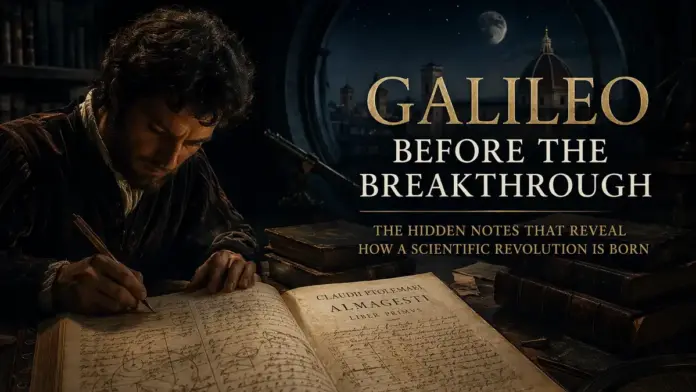
Galileo Before the Breakthrough: The Hidden Notes That Reveal How a Scientific Revolution Is Born
Introduction: The myth of instant genius
History likes its heroes fully formed. It prefers the clean silhouette of the lone genius, the sudden flash of insight, the neat drama of one mind breaking from the old world in a single act of courage. That version is elegant. It is also incomplete.
The newly discussed notes attributed to a young Galileo inside a 1551 edition of Ptolemy’s Almagest matter because they disrupt that comforting simplification. They do not reduce Galileo. They restore him. They return him to the long interior labor that every genuine intellectual rupture requires.
The discovery is important not because it gives us a theatrical surprise, but because it reveals process. It shows that Galileo did not become Galileo by springing outside the old cosmos in one leap.
He first entered it, studied it, measured it, absorbed it, and only then moved beyond it. That is the real story here. Not the romance of instant rebellion, but the harder truth that revolutions in thought are born inside the systems they later overturn.
This is why the article must be read as more than literary admiration for a great name. It is about the anatomy of intellectual transformation. It is about what must happen before a civilization’s most powerful assumptions can be challenged with real authority.
And it is about the discipline that lies beneath every breakthrough large enough to alter the architecture of human understanding.
Chapter I: The weight of the old world
To understand why the discovery matters, one must first understand the magnitude of the Almagest. It was not merely an old astronomical text. It was one of the central machines through which the premodern world organized the heavens.
For centuries, Ptolemy’s geocentric system offered a mathematically sophisticated structure of order. It explained motion, anchored education, and helped sustain a broader intellectual confidence that the cosmos could be mapped through stable inherited principles.
What later generations call “the old model” was not weak. It was formidable. It endured for so long precisely because it had explanatory force, technical elegance, and institutional authority. The Almagest was not an embarrassment waiting to be laughed away by progress. It was a system powerful enough that only a mind willing to take it seriously could eventually expose its limits.
That is what gives the newly identified notes their true gravity. If Galileo was studying the Almagest in this close, deliberate way, then he was not merely browsing the past. He was wrestling with the strongest available cosmological framework of his intellectual world.
He was training his mind against the full resistance of tradition, not the weak caricature of it. And that matters, because no one truly surpasses a system by despising a straw version of it. One surpasses it by mastering its strongest form.
This is the first major lesson the discovery restores: scientific courage without scientific discipline is performance. Galileo’s later greatness becomes more credible, not less, when we see how thoroughly he passed through the intellectual gravity of the old order before helping to displace it.
Chapter II: Discipline before rupture
Modern culture glorifies disruption because disruption is visually dramatic. Study is not. Discipline is not. Apprenticeship is not. Yet every real act of intellectual reordering begins there.
The image of a young Galileo marking, analyzing, and thinking his way through Ptolemy matters because it restores the missing prehistory of genius. Before the breakthrough comes the burden. Before the defiance comes the submission to difficulty. Before the new language comes the painful fluency in the old one.
That is the invisible labor people prefer not to see. It is far easier to admire the man who breaks than to honor the mind that prepared itself to break correctly. But those are not separate people. They are the same person at different stages of truth.
Galileo did not earn the right to challenge inherited cosmology by instinct alone. He earned it by seriousness. By reading carefully enough to discover where the model held and where it began to strain. By learning the internal logic of the world he would one day weaken. By taking knowledge more seriously than reputation, more seriously than comfort, and more seriously than inherited prestige.
This is not merely an inspiring detail from the history of science. It is a principle. Genuine transformation is not born from impatience. It is born from prolonged intellectual contact with complexity.
Chapter III: How revolutions are actually made
One of the most misleading habits in public discourse is the tendency to remember revolutions as moments instead of processes. We remember the afterimage, not the formation. We preserve the declaration, not the apprenticeship. We quote the rupture, but not the years of disciplined internal pressure that made rupture possible.
The newly discussed notes belong to that hidden zone of formation. They point to a Galileo who had not yet become the canonical figure of modern science, but who was already building the internal machinery that such a figure required.
They remind us that intellectual revolutions do not erupt from nowhere. They accumulate. They gather force through study, tension, dissatisfaction, refinement, and the eventual inability of an older framework to carry the weight of newly clarified reality.
This matters because it changes how we understand scientific progress itself. The story is not that one generation was blind and another suddenly became enlightened. The story is that the very tools of the old system were often necessary for the birth of the new one. The revolution was not external to the previous order. It was incubated within it.
That is the deeper beauty of this discovery. It makes the history of science more difficult and more human. It replaces the shallow thrill of instant genius with the more demanding truth that intellectual greatness is often built from long obedience to difficult thought.
This chapter also connects naturally with the logic already developed in your Greek science ecosystem. The same editorial principle that appears in the Greek piece on why scientific discoveries unsettle us more than they explain the world also applies here: the real story is rarely just the finding. It is the change in mental scale produced by the finding. Galileo’s notes matter because they resize our understanding of how thought becomes historical force.
Chapter IV: Galileo before the symbol
Public memory always simplifies its heroes. It must. Symbols travel farther than real people do. So Galileo becomes the emblem of reason against dogma, science against power, inquiry against fear. None of that is false. But it is not enough.
The newly surfaced annotations help recover Galileo not as a polished symbol but as a working mind. A reader. A technician. A thinker formed under pressure. A man willing to dwell inside inherited complexity before claiming the authority to challenge it.
That recovery is invaluable. Once historical figures become too symbolic, their labor disappears. Their sharpness remains, but their formation vanishes. They begin to look supernatural. Their achievements lose the disciplined path that made them possible. The result is a modern audience that loves brilliance but underestimates the severity required to produce it.
The Galileo revealed through these notes is, in that sense, greater than the myth. The myth offers a statue. The discovery gives back a mind. And a mind is always more interesting, more difficult, and more useful than a statue.
Because once we see him this way, the lesson becomes less decorative and more demanding. Galileo is no longer just a heroic exception. He becomes a model of intellectual seriousness. He becomes proof that greatness is often less theatrical than posterity would like, and far more exacting.
Chapter V: Why this matters now
This is not only a story about Renaissance astronomy. It is also a story about us.
We live in an age that rewards rapid conclusion, surface-level certainty, and symbolic opposition. People want the finished answer before they have entered the problem. They want the feeling of rebellion without the burden of study. They want to announce the collapse of old systems long before they have understood what made those systems persuasive in the first place.
That is why Galileo’s newly illuminated pathway matters so deeply today. It offers a counter-model to the age of instant posture. It reminds us that authentic intellectual authority does not come from loudly rejecting what came before. It comes from understanding it well enough to reveal where it fails.
In that sense, the discovery is not merely archival. It is corrective. It rebukes impatience. It insists on depth. It suggests that true originality is not improvisation without structure, but the ability to press inherited structure until it yields its hidden insufficiency.
This is a lesson far beyond astronomy. It belongs to every serious field: science, politics, philosophy, law, culture. Wherever people confuse noise for rupture, this story restores proportion. Wherever people perform certainty without discipline, this story restores hierarchy. Wherever people forget that real revolutions are earned, this story restores memory.
The same editorial principle appears in Newsio’s analysis of what serious data actually show: strong arguments do not begin with viral certainty, but with disciplined reading of the strongest available evidence.
Chapter VI: Against cheap astonishment
The easiest possible treatment of this discovery is also the weakest: to present it as a sensational twist, a magical key, a sudden rewriting of everything. That route is tempting because it is emotionally efficient. But it empties the discovery of its real significance.
The notes do not matter because they create a cheap shock. They matter because they deepen a serious historical truth. They show that the break with the old cosmos was not spontaneous rebellion. It was prepared through study.
It was disciplined into being. It was made possible by a mind strong enough to submit itself first to the old framework and then, from within that submission, to see beyond it.
That is a much larger and more durable story than any click-driven surprise could ever provide.
This is also why the strongest external link for the English article is the Science analysis rather than a lighter secondary summary. It supports not only the discovery itself, but the interpretive core of the article: that Galileo’s revolution was born through mastery before opposition. The external lift should sit exactly where the article makes that central claim, because that is where the authority of the piece becomes structural rather than decorative.
That is also why serious readers should resist cheap astonishment and stay close to method, sources, and interpretive discipline — exactly the habit Newsio lays out in How to Read the News Without Being Manipulated.”
Conclusion: The true birth of a breakthrough
The most powerful takeaway is also the simplest.
Galileo did not overthrow the old order by refusing to understand it.
He overthrew it by understanding it completely.
That is how real revolutions are born. Not from slogans. Not from impatience. Not from symbolic self-display. But from the long, disciplined, often invisible work of entering an inherited structure so deeply that its limits become impossible to ignore.
The notes attributed to the young Galileo matter because they restore that truth to view. They show that the making of a scientific revolution is not a miracle of sudden genius. It is a drama of endurance, method, pressure, and finally, rupture.
And that may be their deepest importance. They do not merely tell us something new about Galileo. They tell us something old and easily forgotten about knowledge itself.
That every true breakthrough has a hidden apprenticeship.
That every genuine rupture has a long interior history.
And that the mind changes the world not when it shouts first, but when it has learned enough to speak last with authority.