

Table of Contents
Back to the Middle Ages: When the Taliban Turn Education Into a Crime and Imprison the Mind
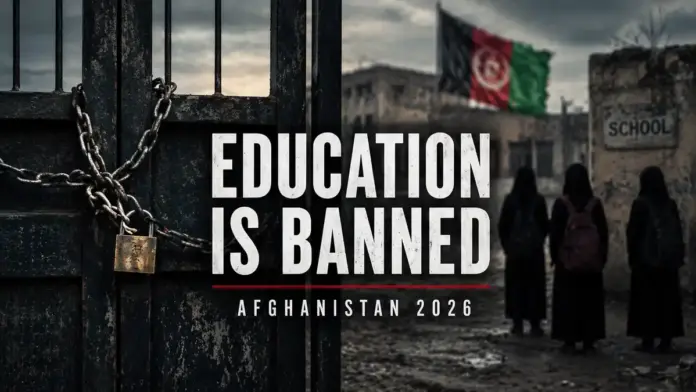
When the Taliban keep secondary schools and universities closed to girls and women, they are not merely enforcing a hardline social rule. They are constructing a system of power based on the deliberate denial of knowledge.
UNESCO has documented that Afghanistan remains the only country in the world where girls and women are barred from secondary and higher education, with roughly 2.2 million girls already excluded from school beyond primary level.
That is the first point that has to be stated clearly. This is not a temporary administrative measure. It is a program of social redesign. Once a regime blocks half of its population from learning, it is no longer “regulating education.”
It is regulating the future. It is rebuilding society around dependence, silence, and a monopoly over truth. The right external anchor belongs exactly here, on the institutional fact itself: the official UNESCO assessment of Afghanistan’s education ban is the strongest authority link because it turns moral outrage into documented reality.
Fear of knowledge as a tool of rule
The essential question is not whether the Taliban dislike women’s education. The real question is why they fear it so much. The answer lies in the structure of the regime itself. Knowledge is dangerous to any order that depends on total ideological discipline.
An educated woman is not simply a woman with more choices. She is a person with judgment, language, legal awareness, and the ability to question the doctrine imposed on her as the only acceptable truth.
That is why the assault does not stop at the school gate. UN human rights bodies and international monitors have described a much wider system of restrictions on work, movement, participation in public life, and even women’s access to UN compounds and roles. In other words, the educational ban is only one part of a larger strategy of social erasure.
The deeper truth is stark: the Taliban do not merely fear women in public. They fear female autonomy. And autonomy always begins with learning, with books, with literacy, with the capacity to interpret the world without asking permission from power.
Gender apartheid is not a metaphor
The weakest possible description would be to say only that Afghan women are “being treated unfairly.” That is true, but it is far too small for what is happening. The reality is that the Taliban are attempting to redefine women as beings confined to silence, domestic containment, and obedience.
UN High Commissioner for Human Rights Volker Türk has explicitly warned that Taliban measures deepen repression in ways that resemble gender apartheid, while international organizations continue to describe the regime as one of systematic discrimination against women and girls.
That matters because it shows the education ban is not an isolated measure. It is the cornerstone of a two-tier society in which women are not treated as full civic subjects but as a population to be managed.
When education is prohibited, dependence becomes permanent. When access to institutions, work, and public speech is stripped away, inferiority stops being a social consequence and becomes a governing principle.
The regime’s hypocrisy is total. It speaks of “protecting dignity,” while systematically removing the real foundations of dignity: education, voice, livelihood, public agency, and the ability to exist in society as a full human being.
The cost is not only moral. It is national.
There is also a second layer to this story that the world too often understates. The Taliban are not only destroying women’s rights. They are destroying Afghanistan’s future. Excluding millions of girls from education means wiping out half the country’s human capital.
That translates into fewer doctors, fewer teachers, fewer health workers, fewer professionals, lower productivity, deeper poverty, and greater dependence on an authoritarian state that masks decline as virtue.
The health sector shows this especially clearly. Reuters and UN experts have warned that Taliban restrictions are endangering women and children because they limit access to care and sharply reduce the pipeline of female health professionals. In such a system, repression is not merely ideological. It becomes a public-health emergency and a long-term demographic wound.
This is the deeper political indictment: the most extreme form of fanaticism is not only cruel. It is self-destructive. It hollows out a nation’s human capacity and then presents that hollowing out as moral order.
The deafening weakness of the international response
Perhaps the most disturbing fact is that none of this is hidden. UNESCO, OHCHR, UN Women, the United Nations, and governments around the world all know what is happening. The problem is not ignorance. The problem is the gap between knowledge and political will.
A whole country cannot be pushed this openly into institutional darkness in 2026 while the global response remains trapped inside formulas of concern. That is where the failure of the West becomes geopolitical, not only moral. After two decades of Western presence in Afghanistan, the final outcome was a collapse so abrupt that millions of women were handed back to a regime that does not even bother to conceal its contempt for their freedom.
This is the modern geopolitical “side gate” of the Afghan tragedy: values were proclaimed, but never rooted deeply enough to survive after force withdrew.
Kabul as warning, not slogan
This is where the article should stay disciplined. It is not serious to claim that Europe will simply “become Afghanistan tomorrow.” But it is entirely serious to say that Kabul offers a warning about what happens when religious fanaticism captures the state and begins to treat knowledge, women, and freedom as political threats. That is the lesson worth defending.
This chapter also aligns naturally with Newsio’s earlier English-language analysis The Voice of the Adversary: What the Al-Zahar Vision Reveals and Why Such Hamas Leadership Survives. The connection is not that the Taliban and Hamas are identical. They are not. The connection is that both examples reveal a political logic in which freedom is treated as danger, knowledge as threat, and submission as ideal social order.
The same wider frame appears in The Geopolitics of Suffocation: Iran, the BRICS Sphere, and the Siege of the West, where different authoritarian and theocratic systems are shown moving in the same direction: shrinking freedom, disciplining society, and using ideology as a structure of rule.
Final conclusion
The clearest conclusion is the hardest one. The Taliban are not simply banning education. They are banning the future. They are banning the possibility of a society that can think, breathe, and reproduce free citizens. And when the international community limits itself to concern, it is in practice allowing that system to consolidate.
If anyone wants to see what happens when fanaticism becomes statecraft, they should look at Kabul. There, the book is treated as a threat, the educated girl as a danger, and society itself is trained not to think but to obey. That is not only an Afghan tragedy. It is a warning to the wider world.