

Table of Contents
When a Regime Stops Seeing Its Own People as Its People: The Anatomy of Iran’s Repression
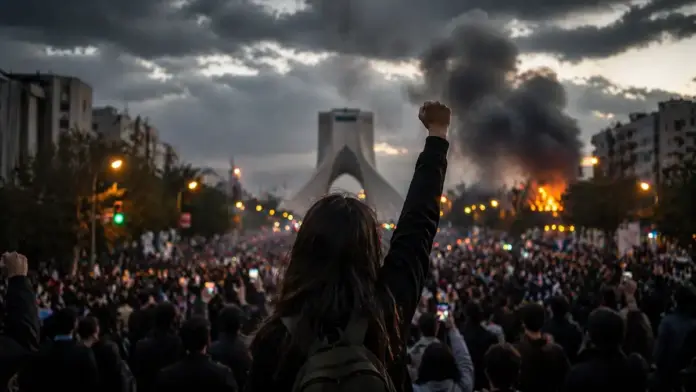
In Iran, the crisis is not visible only in the streets, the prisons, the courtrooms, or the cemeteries. It is also visible in language. In the language of official statements. In the language of threats. In the language of state-aligned figures who increasingly speak in public, often on video, with the kind of bluntness authoritarian systems reveal only when they stop believing they need to persuade anyone at all.
That is why the growing number of authentic public videos circulating online, especially on X, matters so much. Their value is not merely documentary. Their deeper value is political. They function as a running self-portrait of a regime in moral and political decay. They show a system that no longer tries to justify itself through legitimacy, performance, or public trust. It increasingly speaks through intimidation.
Watch: On Iran’s state TV (Islamic regime), an official regime agent warns that any person who dares to take to the streets to protest will be shot and executed on the spot.
— Liza Rosen (@LizaRosen0000) April 14, 2026
Muslims and weak leaders in the West support this regime.pic.twitter.com/FasaXbtNuT
And the moment a regime abandons the language of persuasion and moves fully into the language of punishment, it has already confessed something essential: it has lost the argument.
This is the first point that must be made clearly. Iran’s repression is not only a story of force. It is a story of a state that has begun to sever its own bond with the society it claims to represent.
That broader logic also connects directly to Newsio’s earlier English-language analysis of how Iran projects pressure far beyond its borders in Khamenei Repression and Executions: Fact-Checked. A regime that governs inward through fear almost always seeks to project outward through coercion, propaganda, and strategic intimidation.
Treason as operating software
When a regime labels protest “treason,” it is not showing confidence. It is advertising political bankruptcy.
A government that still possesses a meaningful sense of legitimacy may fear dissent, dislike dissent, manipulate dissent, or suppress dissent. But once it reclassifies dissent itself as betrayal, it crosses into something deeper: it denies the basic distinction between disagreement and enmity. At that point, the dissenter is no longer treated as a citizen in conflict with power. He becomes an internal enemy.
Just week ago, Mohseni Ejei, head of Iran’s judiciary, orders faster executions of detained protesters in Iran.
— Liza Rosen (@LizaRosen0000) April 14, 2026
No one in the EU seems to care, please share if you do!pic.twitter.com/oYBKOjtX9p
That is one of the clearest markers of authoritarian decay.
The reason is simple. A system with real confidence can still attempt to argue with society, even dishonestly. A system that immediately calls criticism “treason” is admitting that it no longer has persuasive language left. It has reached the stage where it survives by criminalizing thought itself.
This is why free expression becomes the regime’s most feared virus. Not because speech is physically stronger than armed power, but because free speech breaks the monopoly over truth. And every theocratic or totalizing political structure depends on that monopoly. It lives from the claim that reality may be interpreted only through its own vocabulary.
The moment opinion becomes a crime, the nation ceases to function as a civic community. It becomes an enclosed zone of surveillance.
The moment the citizen becomes the enemy
The heavier revelation is not that violence exists. Violence has long been part of the operating logic of the Islamic Republic. The heavier revelation is the moment the state stops seeing its own civilians as its own civilians.
That is the threshold these videos, statements, and public threats increasingly illuminate.
Once a government begins speaking of protesters as though they are foreign contaminants, traitors, terrorists, or enemy units rather than citizens in conflict, something fundamental has broken. The state is no longer acting like a political structure struggling to maintain order. It is behaving like an occupying mechanism facing a hostile population.
That distinction matters.
Because once civilians are recoded as enemies, the political space collapses. Citizens are no longer bearers of rights. They are no longer even misled members of a common national body. They are reclassified as targets of discipline. Suspicious bodies. Internal adversaries. Human obstacles to regime continuity.
And this is where the language becomes more revealing than any official slogan. The regime is not merely suppressing people. It is redefining them out of the nation.
In practical terms, that means “Iranian” no longer refers, in the regime’s moral imagination, to a person who lives in Iran, speaks out in Iran, suffers in Iran, and demands dignity in Iran. “Iranian” becomes a conditional category granted only to those who obey.
That is the point at which a state begins to lose not just popularity, but representational legitimacy.
Even international human rights bodies have warned that branding peaceful protesters as terrorists in order to justify violence is unacceptable, as the U.N. human rights office made clear in its statement on Iran’s violent repression.
The theft of the mind
At its deepest level, the Iranian regime does not merely fear the body in the street. It fears the mind that reaches a conclusion.
That is the true core of totalitarian thinking: it is not satisfied with controlling behavior. It wants to control interpretation. It wants to strip people not only of the freedom to act, but of the freedom to understand. It wants the citizen to stop being a moral and political subject and become a managed unit inside a fear-producing machine.
This is why authoritarian systems so often collapse into the same anthropology. Whether the setting is theocracy, hard nationalism, or revolutionary dogma, the logic converges. The person is no longer treated as a thinking being. He is reduced to a function. He is expected not to judge reality independently, but to receive it already processed by the ideological authority above him.
That is what makes the Iranian case larger than a national crisis. It becomes a model of how power behaves when it no longer trusts society, no longer trusts speech, and no longer tolerates inner freedom.
In that sense, the same authoritarian pattern appears across other systems that criminalize thought, fear autonomous citizens, and treat knowledge itself as risk. The wider comparison is not about false equivalence. It is about recognizing recurring structures of domination: the suppression of dissent, the punishment of independent thought, the recoding of ordinary people as threats, and the reduction of social life to obedience.
The loss of legitimacy begins before the fall
There is a point beyond which a regime may still possess weapons, prisons, courts, propaganda organs, and security structures, but has already lost the legitimacy battle.
That point is reached when the organs of “public order” openly turn against unarmed civilians.
Because legitimacy is not merely legal. It is moral, psychological, and social. It is the sense that, despite injustice and conflict, the state still belongs in some degree to its people. Once that bond collapses, power may remain, but belonging disappears. The regime can still govern through fear, but it no longer governs through shared political reality.
And fear, for all its brutality, has a fatal weakness: it can impose silence, but it cannot create belief.
It produces outward compliance and inward estrangement. It creates societies that obey externally while disconnecting internally. It hardens the state while hollowing it out. It can delay collapse, but it cannot repair the broken relationship at the center of power.
This is why regimes often look strongest right before they become most brittle. The more openly they treat their own people as enemies, the more clearly they expose the fact that the moral center of authority has already failed.
The videos as the black box of decline
This is what makes the expanding archive of public videos so important.
They are not just fragments of outrage. They are not merely raw clips that trend for a day and disappear into the algorithm. Taken together, especially when read alongside official statements, international reporting, human rights documentation, and the regime’s own rhetoric, they function like the black box of a system descending into visible political decomposition.
Each time a uniformed figure, judicial voice, ideological enforcer, or state-aligned mouthpiece speaks casually about crushing civilians, punishing protesters, or treating dissenters as traitors rather than citizens, something irreversible happens. The regime records its own confession. It converts violence from allegation into evidence. It turns intimidation into self-authored testimony.
That matters enormously.
Because authoritarian systems depend not only on violence, but on the management of perception. They need deniability. They need ambiguity. They need the outside world to remain just uncertain enough, just divided enough, just confused enough, for the structure of repression to keep functioning beneath the surface.
But when the language becomes too explicit, when the threat is spoken too openly, when the enemy is named too broadly, the mask starts to fail.
And once that mask fails, even fear begins to change shape.
When brainwashing meets the face of the neighbor
There is another point here that cuts even deeper.
Brainwashing works best when the enemy remains abstract. When he is “the infiltrator,” “the traitor,” “the foreign plot,” “the terrorist,” “the other.” Ideological systems need distance between hatred and reality. They need the target to remain conceptual.
But the mechanism begins to crack when the gun points toward the neighbor, the classmate, the brother, the mother, the woman in the street, the familiar face that cannot be fully dissolved into propaganda.
That is where the crisis becomes existential.
Because the moment an enforcer is required to see the ordinary civilian not merely as disobedient but as killable, the ideology is forced into confrontation with the human face. And in that collision, something often starts to break. Sometimes quietly, sometimes slowly, sometimes too late. But it breaks.
The regime understands this better than many outsiders do. That is why it relies so heavily on dehumanizing language first. It must destroy belonging symbolically before it can defend violence politically.
The regime’s deepest crime
The deepest crime of the Iranian regime is not only that it imprisons, tortures, executes, and terrorizes. It is that it attempts to monopolize the very meaning of who belongs to the nation.
It does not simply repress dissent.
It seeks to strip dissenters of belonging.
That is the line that matters most.
Because once a regime must redefine the nation in order to exclude those who challenge it, it has already confessed that it no longer represents that nation. It may still control the state. It may still command courts, prisons, and armed units. It may still issue decrees and stage spectacles of order. But it has lost hold of something larger: the moral core of the society.
And when that is gone, the countdown has already begun.
The sharper truth
This is the sharper truth behind the expanding public record.
The Iranian regime is not only repressive. It is estranged from its own people.
Not only violent. Politically disinherited.
Not only armed. Internally hollow.
That is why the videos matter.
That is why the statements matter.
That is why the language matters.
Because they reveal, in the regime’s own tone, what the system cannot fully hide anymore:
It no longer sees society as a people to represent.
It sees society as a population to control.
And once a regime reaches that point, it may still survive for a time. It may still kill. It may still frighten. It may still delay judgment.
But it cannot restore the trust it has already destroyed.
Conclusion: The nation and its captors are no longer the same thing
The final distinction must remain sharp.
Iran is not its jailers.
Iran is not its enforcers.
Iran is not the men who call its daughters traitors and its sons enemies.
Iran is larger than the machinery that holds it hostage.
That is why the future of the country will not be decided only by weapons, prisons, slogans, or staged displays of force. It will also be decided by something the regime increasingly cannot manufacture: legitimacy, belonging, and the moral reality of a society that knows it is no longer being governed in its own name.
And that is why these public admissions, threats, and videos matter so much.
They do not only expose repression.
They expose separation.
They show that the regime and the nation are no longer the same thing.
And once that becomes visible enough, history begins to move.