


Table of Contents
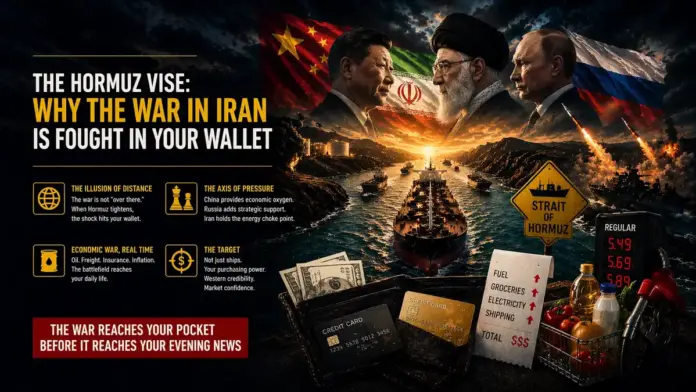
The Hormuz Vise: Why the War in Iran Is Being Fought in Your Wallet
The most dangerous illusion in Western societies is that war remains “over there,” locked inside the Middle East and somehow disconnected from daily life in Europe and the United States.
That illusion breaks the moment the Strait of Hormuz moves into uncertainty. Hormuz is one of the world’s most important energy chokepoints: around 20 million barrels per day transit the strait, roughly a quarter of global seaborne oil trade, while only limited pipeline capacity exists to bypass it.
The IEA also notes that the strait carries a major share of global LNG exports from Qatar and the UAE. In plain terms, when Hormuz shakes, the shock does not stay on the water. It moves into oil prices, shipping, insurance, inflation, and household budgets.
That is the real meaning of the Hormuz vise. Iran does not need to keep the passage closed forever to achieve a strategic result. It only needs to tighten and loosen the threat, long enough to make markets price fear and long enough to make every Western reassurance look fragile.
Reuters reported that oil fell about 9% when signs suggested commercial traffic might continue, only for uncertainty to return after Iran reasserted control over the passage and turned back tankers over “unauthorized transit.” This is not random volatility. It is method.
The war in Iran is therefore not fought only with missiles, ships, and statements. It is also fought with freight premiums, Brent futures, insurance rates, LNG exposure, and the slow corrosion of confidence that the West can still guarantee normality in the arteries that keep the global economy moving.
That is why the conflict reaches the consumer long before it reaches moral clarity in prime-time television.
The illusion of distance is the first thing that collapses
When a society believes conflict is geographically distant, it also believes the cost will stay distant. Hormuz destroys that fiction.
The IEA warned that disruptions to oil and gas flows through the strait have major implications for energy security, affordability, and the world economy, while Reuters showed that even partial uncertainty was enough to cap optimism across Gulf markets.
This is how war travels in the 21st century: not only through battlefield footage, but through price transmission.
That is also why this article belongs next to Newsio’s earlier analysis of why a seizure or blockade of the Strait of Hormuz would hit far more than the Gulf itself. The point is not simply that Hormuz matters. The point is that Hormuz converts regional tension into global cost with terrifying speed.
The operational web: China, Russia, Iran
It has to be said plainly, but carefully: Iran does not operate in strategic isolation. China provides vital economic oxygen, and Russia provides strategic, technological, and informational support. Reuters reported that China absorbed more than 80% of Iran’s seaborne oil exports in 2025, making Beijing the single most important external economic valve for Tehran.
Reuters also reported that Iran was nearing a deal to buy Chinese supersonic anti-ship missiles, while another Reuters report said Russia supplied Iran with cyber support and spy imagery to sharpen attacks. That is not a slogan. It is a visible anti-Western convergence with different roles and one shared effect.
This does not mean Iran is a passive puppet with no agency of its own. It means Tehran functions as a forward pressure point inside a broader anti-Western structure of erosion.
China does not need to hold the valve at Hormuz itself if it can keep alive the regime that does. Russia does not need to run the strait if it can strengthen the actor that injects instability into it. And Iran, for its part, controls the one button that matters most: the chokepoint where geostrategic tension becomes global economic cost.
That broader pattern also fits Newsio’s English analysis in The Critical U.S.–NATO Turning Point, where the key argument was that Tehran benefits whenever pressure reveals cracks, hesitation, or incoherence inside the West.
Economic war in real time
Every time oil slides from panic highs only to surge again when Hormuz uncertainty returns, we are not watching a market “breathe.” We are watching a market learn to fear. Reuters reported that Gulf market sentiment remained subdued because uncertainty over the strait kept overriding moments of relief.
Barclays raised its 2026 Brent forecast to $85 a barrel and warned that a prolonged disruption could push prices significantly higher; Reuters also reported Barclays’ estimate that a prolonged Hormuz closure could remove 13 to 14 million barrels per day from the market. That is economic war in real time: measurable, immediate, and global.
When the Islamic Revolutionary Guard Corps tightens the vise, it is not targeting ships alone. It is targeting market confidence, the credibility of Western deterrence, and the resilience of the family budget.
In Hormuz, the shock is never only military. It is also financial, institutional, and psychological. If markets begin to believe that one narrow corridor can repeatedly destabilize the system despite American power, then the damage is larger than oil. It reaches the idea that the West still controls the rules in the world’s vital spaces.
That is why this article also sits naturally beside Newsio’s earlier piece on what the U.S. blockade of Iranian ports near Hormuz actually changed for oil, shipping, and Western strategy. The operational move matters. But the deeper story is what that move still failed to remove: Tehran’s ability to turn uncertainty itself into leverage.
Eroding Western credibility is part of the objective
Iran is not playing only with energy. It is also playing with belief. Great power does not rest only on fleets, bases, and strike capabilities. It also rests on whether allies, insurers, traders, and societies believe that Western guarantees still translate into stable reality. When Washington signals calm, progress, or restored order and the field quickly returns to ambiguity, the damage is not a minor communications problem. It is a strategic rupture.
Reuters’ reporting on market behavior around Hormuz makes this plain: every swing in confidence is also a swing in the credibility of the systems that claim to contain the crisis. In that sense, Hormuz is not just an oil corridor. It is a credibility battlefield.
This is also why the argument connects directly to Newsio’s English analysis of why the regime in Tehran exports crisis, rebrands war as national survival, and hides behind the people of Iran. Tehran does not need decisive victory. It only needs to prove that it can keep imposing cost while making Western promises look less durable than they sound.
Hormuz is also a regime-survival theater
Pressure in Hormuz is aimed outward, but it also serves the regime internally. A coercive system that fears erosion at home benefits from crisis abroad, because external confrontation helps reframe weakness as resistance and repression as necessity.
The regime needs scenes of strategic relevance. It needs to show domestic audiences that it can still hurt the wider system, still raise the cost of pressure, and still force the West to react.
That is why Hormuz is more than maritime geography. It is political theater, a place where vulnerability inside Iran is repackaged as leverage over the world. The stronger the perception that Tehran can still squeeze a critical global artery, the easier it becomes for the regime to narrate itself as durable and necessary.
The war reaches your pocket before it reaches your evening news
The hardest truth is simple: the war in Iran does not stay in Iran. Once Hormuz moves into uncertainty, the conflict travels into energy prices, transport costs, insurance costs, inflation expectations, and the total cost of daily life. The person paying more for fuel, food, freight, or electricity may never see the strait on a map, but they are already inside the economic aftershock of what happens there.
That is the entire point of the Hormuz vise. Iran does not need to conventionally defeat the West to impose pain on it. It only needs to keep one vital nerve of the global system under recurring tension and squeeze it at the right moment. Once it does that, war stops being “regional.” It becomes financial, social, and domestic.
The safe but relentless conclusion
Hormuz is not a distant headline. It is the place where geostrategic pressure becomes more expensive energy, shakier markets, weaker purchasing power, and a more brittle everyday life. China provides the economic oxygen.
Russia supplies strategic and technical reinforcement. Iran holds the choke point. The result is not a symbolic crisis. It is a live mechanism of pressure against the West and against the wallet of the ordinary consumer.
Anyone who still thinks the war in Iran belongs only to the Middle East has already lost half the truth. The other half is written at the pump, on the utility bill, in the freight price, and in the grocery receipt.