

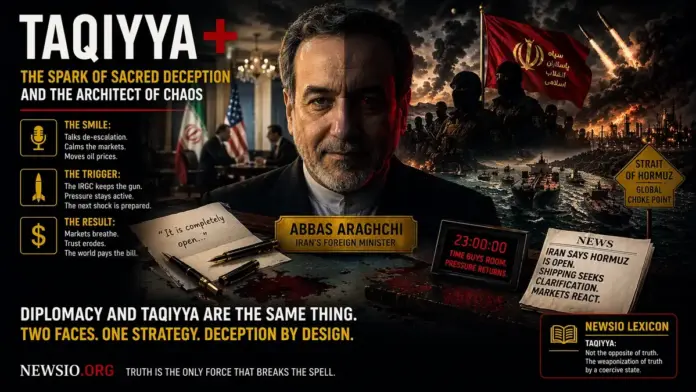
Taqiyya+: The Spark of Sacred Deception and the Architect of Chaos
Abbas Araghchi is not just Iran’s foreign minister. He is the polished interface of a coercive state that knows how to speak softly while pressure remains active underneath. That is the first thing the reader has to understand. The issue is not whether Araghchi sounds calm, technical, or reasonable in public.
The issue is what his language does in real time: it reassures markets, buys time, softens immediate reaction, and opens a temporary window in which Tehran can regain strategic room without surrendering the machinery of pressure behind it.
Reuters has described Araghchi as perhaps the most powerful foreign minister the Islamic Republic has had, with deep trust from the supreme leader, a central role in past negotiations, and roots inside the Iranian state system, including wartime service in the Revolutionary Guards.
That is why the core line of this article is not theological nostalgia or abstract labeling. It is functional clarity. When diplomacy reassures while coercive leverage remains intact or returns almost immediately, diplomacy stops behaving like a bridge and starts behaving like a timing mechanism.
In the Newsio editorial reading, that is where diplomacy and taqiyya converge: not as an academic definition, but as two hands of the same strategic method. One hand calms. The other preserves the threat. One hand lowers the temperature just enough for the system to breathe. The other makes sure the next shock is still available.
This matters because the world does not absorb such language as philosophy. It absorbs it as signal. Markets react.
Shipping firms react. Insurance reacts. Governments react. And ordinary people, whether they know the name Abbas Araghchi or not, end up paying for the consequences when that signal briefly stabilizes the system and then collapses back into uncertainty.
That broader transmission is exactly why this piece belongs next to our earlier Newsio analysis of why a seizure or blockade of the Strait of Hormuz would hit far more than the Gulf itself.
Araghchi does not sell negotiation alone. He sells time.
In April 2026, Reuters reported that Araghchi said passage for commercial vessels through the Strait of Hormuz was “completely open” during the ceasefire window. Markets responded immediately. Oil fell sharply.
The broader mood softened. For a moment, the world was invited to believe that order might be returning. That is the key move. Not resolution. Not peace. A window. A breathing space. A temporary misreading.
But that is exactly where the deeper mechanism begins. If a regime can create even a short-lived sense of normalization, it can reduce pressure on itself, expose Western overconfidence, and reposition the next round of instability as something sudden, surprising, or externally triggered. In practice, the crisis is not solved. It is masked just long enough to alter the rhythm of reaction.
That is why Araghchi matters. He is not important because he speaks. He is important because he speaks at the right moment, in the right tone, with the right institutional weight, so that markets and political audiences misread temporary relief as structural change. That is not failed diplomacy.
That is diplomacy functioning as strategic timing. It is also why this argument connects directly to The Hormuz Vise: Why the War in Iran Is Being Fought in Your Wallet, where the wider economic transmission of Hormuz pressure into fuel, food, freight, insurance, and household cost was already laid out in full.
The smile and the trigger are part of one system
The easiest mistake is to imagine two separate realities: a diplomatic one, where reasonable men in suits seek calm, and a coercive one, where military, paramilitary, and ideological organs do the regime’s harder work.
That separation is too naïve. In authoritarian systems under pressure, these are often not competing logics but complementary functions.
Here the article’s hardest line has to be stated clearly: when one part of the system speaks the language of de-escalation while another preserves or prepares the means of pressure, we are not watching contradiction.
We are watching division of labor. One face reassures. The other keeps the cost of disobedience alive. One face lowers the market pulse. The other keeps the strategic artery under tension.
That is the hidden trigger behind Araghchi’s public usefulness. He does not need to threaten in every sentence. He only needs to help the system create intervals of misreading.
Once that happens, the market does half the work itself. Prices move. Risk is repriced. Western statements become vulnerable to field reality. And the regime has already won something important before a single new military escalation is announced.
“Bazaar style” is not a harmless cultural flourish
Reuters reported that Araghchi, in his 2024 book, compared Iranian negotiating practice to “bazaar style” bargaining: persistent, patient, layered, and time-consuming. That description can sound almost charming if read superficially. It should not be.
At state level, this “bazaar style” becomes a pressure method. You stall, soften, test, reposition, extract time, and wait for the other side to expose itself. Then, when the political and market environment has shifted enough, you move again.
This is what makes Araghchi more dangerous than a shouting propagandist. The propagandist mobilizes the faithful. Araghchi influences the hesitant.
He speaks to diplomats, investors, editors, governments, and analysts who want to believe that there is still a rational off-ramp.
Sometimes there may be. But his value to the regime lies in making that off-ramp seem nearer, safer, and cleaner than the field actually allows.
That is why he should be read not as a detached technocrat, but as a state operator with cultural fluency in how the West hears moderation. He understands the psychology of reassurance.
He understands how little is needed to make a market exhale. And he understands that once the system exhales, the next tightening of fear becomes even more effective.
Araghchi is the translator of regime intent into market language
Every coercive state has different instruments for different theaters. Some actors move missiles. Some manage surveillance. Some drive propaganda. Araghchi belongs to a more refined category: he translates regime intent into internationally legible language. He converts pressure into reassurance, not to remove the pressure, but to make the pressure more useful.
That makes him structurally more valuable than a crude ideologue. He does not merely repeat slogans. He packages the regime’s need for time, ambiguity, and maneuverability in a way that can pass through embassies, shipping desks, financial screens, and Western media. In that sense, he is not just a minister. He is an interface.
And that interface exists inside a broader anti-Western pressure web. China has been Iran’s main economic oxygen line by absorbing the overwhelming majority of its seaborne oil exports, while Reuters has also reported Iranian proximity to a deal for Chinese supersonic anti-ship missiles.
Reuters separately reported that ships crossing Hormuz needed approval from the IRGC after the reopening, which matters because it shows the state never truly surrendered operational control even while the public message sounded calming. What matters analytically is the cumulative structure:
Beijing helps keep the regime economically alive, Tehran preserves the choke point, and Araghchi helps package tactical relief as credible stabilization.
This is also why the article connects naturally to Why the U.S.-Iran Talks Collapsed: the Real Gap Behind the Failure. The problem was never one missing sentence in a negotiation room. The problem was that both sides were dealing with a system that uses talks, pauses, threats, and pressure as one continuous strategic field.
Hormuz is not just a waterway. It is a theater of state deception.
The problem with Hormuz is not only that it is a chokepoint. That much is already well known. The deeper problem is that Tehran can use Hormuz as a stage on which reassurance and pressure alternate fast enough to destabilize interpretation itself.
A statement that the passage is open does not function merely as information. It functions as a signal to shipping firms, risk managers, insurers, markets, and governments that perhaps the panic premium can fall.
Then the field clouds over again. Shipping firms seek clarification. Markets hesitate. Political leaders who had already signaled calm suddenly look exposed. The damage is therefore double: fear returns, and credibility weakens. Reuters’ reporting that shipping firms sought clarifications before crossing after the reopening matters for exactly this reason. The system did not treat relief as stable. It treated relief as conditional and reversible.
That is also where this piece ties directly into When the Regime in Tehran Fears Collapse: Why It Exports Crisis, Rebrands War as National Survival, and Hides Behind the People of Iran. The same state that exports crisis to preserve itself internally also uses diplomatic softness to preserve the option of renewed pressure externally.
The spark is not the word. It is the mechanism.
The strongest version of this argument is not “here is a term, therefore here is the whole truth.” The strongest version is mechanism-first. Araghchi reassures. Markets respond. The regime gains time. Pressure returns. Western credibility weakens. Ordinary consumers pay. That is the chain. That is the spark. That is why his role matters.
If readers only see Araghchi as a calm foreign minister trying to cool things down, they will miss the architecture. If they only see him as a cartoon villain, they will also miss the architecture. The sharper truth is more serious: he is the polished instrument of a system that has learned how to alternate softness and threat without ever abandoning the coercive core that gives the softness value.
That is why the “invisible trigger” becomes visible only when the article forces readers to stop separating the soothing message from the still-active system behind it. The smile is not outside the machine. It is one of the machine’s most effective moving parts.
The safe but ballistic conclusion
Abbas Araghchi is not the opposite of the Islamic Revolutionary Guard Corps. He is their complementary language. When violence remains available and diplomacy speaks beautifully to lower immediate reaction, we are not watching two different realities. We are watching one strategy in two forms.
That is the hard truth this article has to leave with the reader. Araghchi’s value to the regime lies in his ability to turn the language of de-escalation into a prelude to the next shock. He does not erase the machinery of pressure. He helps it breathe, reset, and strike again from a stronger psychological position. Reuters’ reporting on his Hormuz remarks, his political weight, and the market reaction makes that mechanism visible enough to analyze seriously.
Once that mechanism is seen clearly, the invisible trigger is invisible no more.