


Table of Contents
The Accordion Diplomacy Trick: How Iran Turns Hormuz Into a Weapon of Uncertainty
The Strait of Hormuz is not just a narrow shipping lane between the Persian Gulf and the Gulf of Oman. It is one of the world’s most sensitive energy chokepoints, which is exactly why even limited uncertainty around it can rattle oil prices, insurance costs, shipping decisions, and political confidence far beyond the Gulf.
The U.S. Energy Information Administration and the International Energy Agency both treat Hormuz as a critical oil transit chokepoint, with roughly 20 million barrels per day moving through it and only limited pipeline capacity available to bypass it.
That is why Iran does not need to shut Hormuz forever to produce a strategic result. It only needs to tighten and loosen the threat. Reuters reported that oil dropped sharply when signals suggested commercial shipping might continue, only for uncertainty to return when
Tehran reasserted control over the waterway and turned back tankers over “unauthorised transit.” That is the method. Temporary relief, then renewed pressure. Temporary confidence, then renewed fragility.
We in newsio, we strike hard, but not at people. We strike at the systems that cage them. We do not want to burn human beings. We want to break the machinery that keeps them unfree. This war is asymmetrical. This war is something entirely new but fortunately, it’s a technology that we know.
The entire battle is based on systems, algorithmics, and technology, which doesn’t hit you with a bulleteven if you think you are far away, just hits your pocket or your economy.
And when tricks go with Islam together, you know there is no Christianity or ten commandments that just disable you from doing harm to other people not only for the sake of the technology, but the beliefs also. These people are playing very, very dirty and they are not alone. They want to change the balances worldwide!
This is the real accordion diplomacy trick. Tehran does not always need a maximal move. It often gains more by manipulating expectation itself. In that environment, oil stops behaving like fuel alone.
It starts behaving like blackmail currency, because the real target is not only supply. It is the psychology of the market and the credibility of the powers that claim they can keep the system stable.
Hormuz is where asymmetric pressure becomes global pressure
Iran does not possess the aggregate military or economic strength of the United States and its allies. Its advantage lies elsewhere: in its ability to impose asymmetric cost through a narrow geography the world cannot easily ignore.
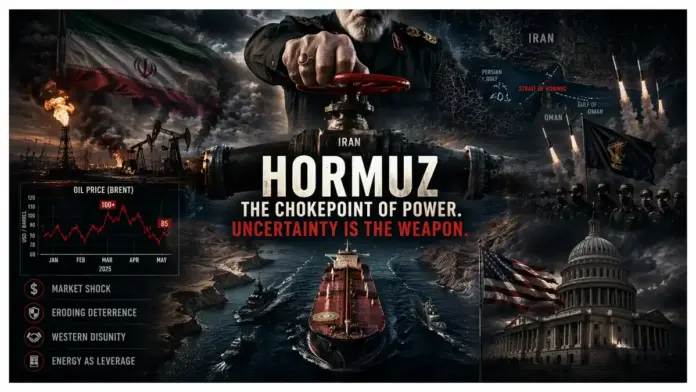
That cost is not theoretical. Reuters reported that Barclays raised its 2026 Brent forecast to $85 a barrel because of severe disruption tied to Hormuz, and warned prices could move toward $100 if the disruption lasted longer.
The IEA’s March 2026 oil market report also said crude and product flows through Hormuz had nearly halted, disrupting close to 20 million barrels per day and straining both producers and consumers globally.
This is the strategic logic. Tehran does not need to prove that it controls the whole global energy system. It only needs to prove that it can shake one critical artery often enough to make everyone else pay for preparedness. Once that happens, uncertainty itself becomes power.
That is also why the central question is not simply whether Iran can close the strait in an absolute sense. The deeper question is whether it can keep the world pricing the risk of closure. If the answer is yes, then Tehran has already achieved part of its objective without needing a permanent blockade.
For readers who want the clearest Newsio baseline on why this corridor matters far beyond the Gulf itself, our earlier analysis on why a seizure or blockade of the Strait of Hormuz would hit much more than the regional oil trade lays out the structural vulnerability in full.
The market shock is not collateral. It is part of the weapon
Financial markets do not wait for a perfect military event before reacting. They move on probability, signaling, and perceived vulnerability. Reuters reported that Gulf markets stayed subdued because uncertainty over Hormuz capped optimism, even after temporary signs of de-escalation.
That matters because it shows the mechanism clearly: market shock is not an accidental byproduct of the crisis. It is one of the crisis’s strategic outputs.
This is where the Western reading often stays too narrow. If analysts wait only for the final, dramatic move, they miss the damage already being done in the gray zone before it. Insurance premiums rise.
Shipping calculations become more defensive. Energy-importing states start planning around risk rather than normality. Investors stop pricing order and start pricing vulnerability.
That is a strategic win for Tehran even before any full rupture. A weaker power does not always need to dominate the battlefield. Sometimes it is enough to force a stronger power to subsidize constant vigilance and repeated reassurance.
Tehran is not targeting only tankers. It is targeting belief in Western guarantees
The real target is larger than cargo movement. Iran’s pressure strategy is also aimed at the credibility of American and Western assurances. If Washington signals calm or control and the field soon produces fresh ambiguity, then the damage is psychological as well as strategic.
The problem is not only whether the United States can strike. The problem is whether allies, markets, insurers, and political audiences continue to believe that U.S. guarantees translate into stable reality.
That is why Hormuz is a credibility battlefield. Great power rests not only on bases, fleets, and air power, but also on belief. Once that belief weakens, the rupture travels outward into alliance cohesion, market confidence, and political trust.
This connects directly to the broader Newsio line already developed in The Critical U.S.–NATO Turning Point, where the central argument was that Tehran does not need total victory. It only needs to prove that the West cannot remain fully coherent under pressure.
The IRGC does not need total war to achieve strategic effect
One recurring Western mistake is to look only for the maximal event: full closure, total war, final rupture. But the Islamic Revolutionary Guard Corps does not necessarily need the biggest move to get results. It can operate at a lower band of escalation that still produces major cost. That is the essence of asymmetric pressure.
At this level, success does not mean conventionally defeating the United States. Success means forcing the stronger side to keep calming markets, reassuring allies, absorbing shipping stress, and living with the permanent possibility that one more surge of risk could undo the previous day’s message. In that sense, Hormuz is not just a chokepoint. It is a laboratory of controlled pressure.
This is exactly why the article belongs in geostrategy rather than ordinary daily conflict coverage. The real story is not simply movement at sea. It is the conversion of geography into leverage.
Oil becomes blackmail currency when uncertainty becomes the method
In Hormuz, oil does not function only as an economic commodity. It functions as a lever of coercion. The threat of disruption can move prices, scramble policy, strain alliances, and expose political weakness faster than many conventional military moves. That is what makes this corridor so dangerous.
This is also why the “accordion” metaphor matters. A permanent shutdown would be dramatic, but also costly and potentially self-defeating for Tehran. A fluctuating threat can be more effective. Open, tighten, pause, threaten, repeat. That rhythm does not signal confusion. It is the method itself.
Readers should connect this argument to our Newsio piece on what the U.S. blockade of Iranian ports near Hormuz actually changed for oil, shipping, and Western strategy. That article explains the operational side of the maritime pressure. This one explains the wider geostrategic logic behind Tehran’s use of uncertainty as leverage.
This is also a regime survival instrument
Hormuz pressure is not aimed only outward. It also serves the regime’s internal political needs. A coercive system that fears internal erosion benefits from external crisis, because crisis helps reframe weakness as resistance and repression as emergency necessity.
That matters because the regime needs scenes of strategic relevance. It needs to show domestic audiences that it can still hurt the wider system, still raise the cost of pressure, and still force the West to react. As we argued in When the Regime in Tehran Fears Collapse, the export of crisis is not a side effect for Tehran. It is one of the regime’s survival instruments.
In that sense, Hormuz is more than maritime geography. It is also political theater. It allows Tehran to present itself not as a contained regime under pressure, but as an actor that can still impose consequences on the global system.
From shipping lane to geostrategic instrument
The biggest misunderstanding is to think Iran’s success depends only on whether the strait is fully closed or fully open. That is too binary. Tehran’s deeper geostrategic success lies in maintaining enough uncertainty to erode confidence in Western deterrence, raise the cost of security, and prove that even superior powers cannot remove risk from a narrow but essential corridor.
That is why Hormuz should be read as a school of modern asymmetric geostrategy. Iran does not need global supremacy. It only needs to keep one vital nerve of the system under recurring tension and squeeze it at the right time.
If it can do that, it has already achieved something greater than a short-lived naval disruption. It has imposed doubt where the West wants to project certainty.
The strongest external anchors for this article
The strongest external baseline for the scale of the chokepoint is the EIA’s analysis of world oil transit chokepoints, alongside the IEA’s own overview of the Strait of Hormuz. Those two references establish why the passage matters globally, not just regionally.
The strongest market-pressure anchor is Reuters’ reporting on Hormuz uncertainty capping market optimism and Reuters’ separate report on Barclays raising its Brent forecast because of Hormuz disruption. Those reports matter because they show how quickly strategic ambiguity becomes hard economic pain.
What readers should keep
First, Iran does not need to shut Hormuz forever to produce a strategic result. It only needs to manipulate the threat environment well enough to keep the system pricing fear.
Second, the real target is not only shipping. It is also Western credibility. Hormuz becomes dangerous because it turns every reassurance into a test.
Third, this is geostrategy in its modern asymmetric form: a weaker power using a narrow geography to impose disproportionate cost on stronger rivals.
Fourth, oil in this environment is no longer just fuel. In Hormuz, it becomes blackmail currency — a way to move fear, money, and strategic pressure through one of the world’s most vital maritime arteries.