


Table of Contents
Trump did not send NATO a bill — he broke Europe’s mirror
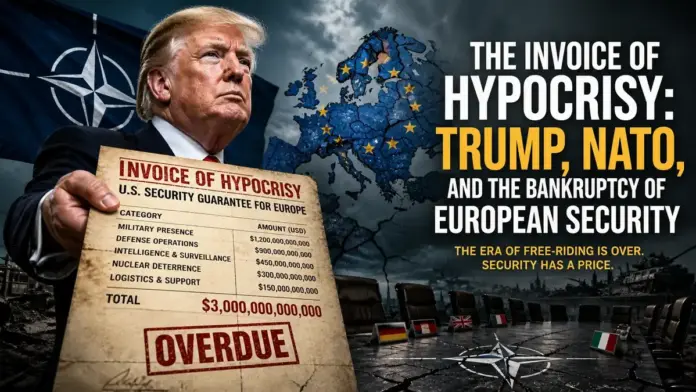
Donald Trump’s message to NATO was not just another blunt American warning to European allies. It was the moment Washington forced Europe to face the question it avoided for decades: how long can a continent speak about strategic autonomy while depending on American power for the final guarantee of its security?
The number is not only financial. It is geostrategic. NATO has moved from the old 2% benchmark toward a new 5% commitment by 2035, including at least 3.5% of GDP for core defense requirements and up to 1.5% for broader defense- and security-related spending. NATO’s own language makes clear that allies are now expected to submit annual plans showing a credible path toward that target.
The real issue is not whether Trump’s tone is harsh. The issue is that Europe spent decades consuming security faster than it produced hard power. Now the international system is no longer waiting for Brussels, Berlin, Paris, or Rome to grow comfortable with the cost of deterrence.
The “trillion-dollar invoice” is not accounting — it is a political indictment
Trump’s argument is not a clean spreadsheet. It is a political indictment of a real imbalance.
The United States has carried a disproportionate share of the West’s military infrastructure for decades: nuclear deterrence, strategic lift, intelligence, logistics, global naval reach, missile defense, space assets, and the final political guarantee behind Article 5. European allies have increased spending, but the deeper pattern remains clear: Washington built the sword; Europe too often enjoyed the shield.
NATO’s 2025 defense expenditure data estimated U.S. defense spending at roughly $845 billion for 2025, while European allies and Canada have been increasing their own defense outlays after years of pressure and after Russia’s full-scale invasion of Ukraine changed the strategic environment.
That is the nerve Trump strikes. He is not only saying “pay more.” He is saying America will no longer treat European hesitation as a strategic entitlement.
Europe is not asleep anymore — but it is late
A serious analysis must be fair. Europe is not standing still. The continent is spending more, thinking harder, and moving faster than it did before Russia’s 2022 invasion of Ukraine.
The European Defence Agency has documented a major rise in EU defense spending, and NATO has recorded a broader allied shift toward higher defense investment. Germany, the country that for years symbolized Europe’s strategic hesitation, is now planning a major defense-heavy budget path, with Reuters reporting that Berlin’s 2027 defense outlays could rise sharply as part of a wider borrowing and modernization push.
But late movement is still late. The question is no longer whether Europe has begun to wake up. The question is whether it can convert budgets into usable power before the world forces the next test.
NATO’s parade era is over
For decades, NATO lived inside a comfortable division of labor. America had the hard power. Europe had the communiqués. The United States had carriers, bombers, satellites, nuclear depth, logistics, and global reach. Europe had summit language, legal caution, and the self-image of a moral power.
That system worked while the world looked manageable. It does not work when Russia redraws borders through war, China builds naval and technological mass, Iran pressures energy chokepoints and nuclear thresholds, and North Korea turns weapons production into geopolitical currency.
Newsio has already analyzed this wider pressure structure in The Four-Part Axis and the Siege of the West, where Russia, China, Iran, and North Korea do not need a formal alliance to benefit from Western fragmentation. They only need enough overlap to stretch the West across multiple theaters.
That is why NATO can no longer survive as a ceremony of democratic reassurance. It must function as a machine of deterrence.
The 5% target is Europe’s adulthood bill
The 5% target is not simply Trump’s victory. It is Europe’s adulthood bill.
At The Hague, NATO allies agreed that the new 5% commitment would include 3.5% of GDP for core defense and capability targets, plus 1.5% for wider defense- and security-related investments such as resilience, infrastructure, civil preparedness, innovation, and the defense industrial base.
This matters because the old 2% target had become psychologically weak. It was treated by many capitals not as a minimum floor, but as an uncomfortable ceiling. The new target forces a different conversation: Europe must no longer ask whether defense spending is politically convenient. It must ask whether underinvestment is strategically suicidal.
The Stockholm International Peace Research Institute has warned that the new target carries major challenges and risks, including the scale of adjustment required for many allies and the still-unclear boundaries of the additional 1.5% category. That warning is important. But it does not cancel the underlying truth: Europe’s previous defense model was no longer adequate for the age it has entered.
Free-riding is not an insult — it is a strategic diagnosis
The word “free-rider” sounds brutal. But in NATO’s history, it describes a structural problem: states that benefited from the American security umbrella while investing less than the threat environment demanded.
Not all European states belong in the same category. Poland, the Baltic states, Finland, and countries closest to the Russian threat understood earlier that history had not ended. Other European governments, especially in parts of Western and Southern Europe, took far longer to abandon the luxury of strategic denial.
That difference matters. Europe is not one actor. It is a continent of very different threat perceptions. But NATO cannot remain credible if the front-line states treat defense as survival while richer rear-area states treat it as a budgetary inconvenience.
Security cannot be outsourced forever.
The real bankruptcy is psychological
The bankruptcy of European security is not only financial. It is psychological.
Europe learned to speak the language of rules without always maintaining the power needed to defend them. It learned to invoke international law while hesitating when enforcement required cost. It learned to condemn aggression while too often delaying the military investments that would make condemnation credible.
This is the deeper problem that runs through the transatlantic crisis. Newsio’s analysis of the critical U.S.–NATO turning point showed that the cracks between Washington and Europe are not only procedural. They are strategic. They affect how Tehran, Moscow, Beijing, and Pyongyang read Western cohesion.
When the West looks divided, its adversaries do not hear nuance. They hear opportunity.
Europe wants security without trauma
Post-1945 Europe built its political culture around the rejection of militarism. That was historically necessary. It helped save the continent from the return of its worst instincts.
But the same success produced a dangerous side effect: many European societies began treating military power as something morally suspicious even when their own freedom depended on it.
Peace is not preserved by good intentions alone. It is preserved by deterrence. Deterrence requires ammunition, air defense, industrial capacity, cyber resilience, intelligence, transport infrastructure, naval reach, energy security, and political will.
The new NATO framework recognizes that broader resilience matters. But resilience cannot become a loophole for avoiding hard defense. A bridge that can move tanks matters. A factory that can produce ammunition matters. A political system that can make decisions under pressure matters even more.
Trump is a violent accelerator
Trump is not a smooth manager of alliances. He insults, shocks, threatens, disrupts, and often turns diplomacy into public pressure.
But effectiveness is not always polite. Sometimes a frozen system moves only when someone breaks its language.
That is what happened to NATO. Years of polite European statements did not produce the same psychological rupture that Trump produced by making burden-sharing personal, transactional, and politically unavoidable.
This does not mean Trump’s method carries no risk. It does. If American pressure becomes uncertainty over Article 5, adversaries may test the alliance. If U.S. transactionalism looks like conditional defense, NATO’s deterrent clarity can weaken. But the European answer cannot be offended paralysis. It must be capability.
If Europe fears American unpredictability, the answer is not complaint. The answer is power.
Germany is Europe’s central contradiction
No country symbolizes Europe’s contradiction more than Germany.
It is the continent’s industrial giant, the core economy of the European Union, a central NATO state, and a country with the capacity to transform European defense if it moves seriously. Yet for years Germany remained strategically hesitant, energy-dependent, and slow to accept the full cost of power.
Now Berlin is moving, but it is moving under pressure. Reuters has reported that Germany’s defense-heavy 2027 budget plans involve major borrowing, significant defense increases, and continued support for Ukraine.
That shift matters. But it also exposes the old failure. If Europe’s largest economy needed Russian war, American pressure, energy shock, and geopolitical humiliation to move decisively, then the problem was never just money. It was political imagination.
The new defense bank tells the same story
The emergence of a NATO-linked Defense, Security and Resilience Bank adds another layer to the story. AP reported that Canada will host the headquarters of a future NATO-affiliated financial institution designed to lower borrowing costs for military spending among members and help allies meet the new defense commitments.
That development is important because it shows that NATO’s spending shift is not just rhetorical. The alliance is beginning to build financial architecture around rearmament and resilience.
But this also proves the core point of the article: Europe is no longer living in the cheap-security era. Defense is becoming a financing problem, an industrial problem, a political problem, and a state-capacity problem at the same time.
The bill has moved from speeches into institutions.
Ukraine proved the price of delay
Ukraine exposed the difference between moral support and strategic capacity.
European governments supported Kyiv politically. Many gave serious aid. But the war also revealed shortages in ammunition, air defense, production lines, logistics, and readiness. It showed that democratic will without industrial depth becomes fragile over time.
If Europe had built harder deterrence earlier, Russia would have calculated differently. If Europe had maintained deeper defense production, Ukraine would have faced fewer gaps. If Europe had understood the return of history sooner, it would not need every crisis to become an emergency procurement lesson.
The lesson is not that Europe did nothing. The lesson is that Europe did too much too late.
Iran, China, and Russia read the cracks
The adversaries of the West study behavior more than speeches.
Russia measures European fatigue. China measures American distraction. Iran measures fear of escalation. North Korea measures how much value it can extract from being useful to Moscow and disruptive to the West.
That is why internal Western arguments matter. They are not private family disputes. They are signals.
Newsio’s U.S. strategy toward Iran already showed how pressure works through chokepoints, infrastructure, deterrence, regime confidence, and the cost equation. The same logic applies to NATO. If the West cannot align costs, threats, and commitments, its adversaries will search for the seam.
The seam is Europe’s old comfort zone.
NATO is not dead — but the old NATO is
The correct conclusion is not that NATO is dead. It is not.
NATO remains the strongest military alliance in the world. It remains the core structure of Western deterrence. It remains the bridge between North America and Europe. It still matters more than any alternative security arrangement Europe can currently build.
But the old NATO is over.
The NATO where America paid, Europe debated, and the threat looked manageable is gone. The NATO where European states could treat defense as a reluctant accounting category is gone. The NATO where American patience was assumed to be permanent is gone.
The new NATO will be more expensive, more demanding, more transactional, and more uncomfortable. But it may also become more real.
The alliance must bleed financially before it bleeds historically
Trump’s message sounds brutal because it removes the polite wrapping from a hard truth: it is better to bleed financially for deterrence than historically for defeat.
Europe does not need to become militaristic. It needs to become serious.
It does not need to copy the American model of power. It needs enough of its own power to stop outsourcing strategic responsibility. It does not need to follow every American operation blindly. But it cannot demand American protection while treating proportional European sacrifice as optional.
If Europe wants peace, it must finance deterrence. If it wants rules, it must fund enforcement. If it wants autonomy, it must pay for the instruments of autonomy.
The final conclusion
Trump did not create the bankruptcy of European security. He exposed it.
Europe spent decades inside a comfortable postwar room where American power remained in the basement, ready to carry the weight when history returned. Now history is knocking from several directions at once: Russia, China, Iran, North Korea, energy corridors, maritime chokepoints, technology, nuclear uncertainty, hybrid pressure, and democratic fatigue.
The age of geostrategic free-riding is ending. Not because Trump said so. Because the world made it unavoidable.
NATO does not only need more money. It needs a new political truth: whoever wants security must pay for it. Whoever wants influence must accept responsibility. And whoever wants to live under an umbrella must help keep it open.