

Table of Contents
The problem is not faith — it is power wearing the sacred as armor
The most durable form of power is not always the one with the largest army. It is the one that convinces people that obedience does not belong to the state, but to God. That is the core of every theocratic machine: it does not merely demand political compliance. It demands inner surrender.
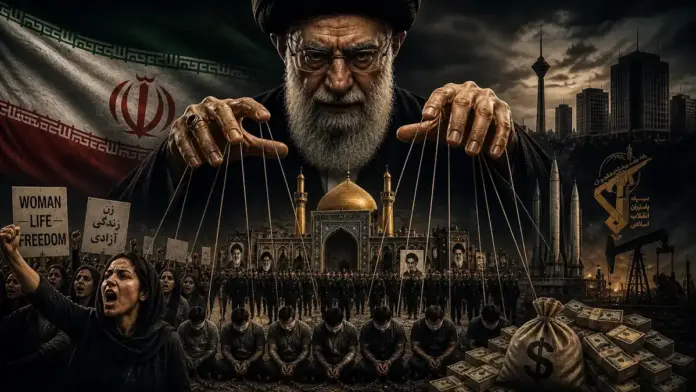
The Islamic Republic of Iran is not simply an authoritarian state with religious language. It is a system that has turned faith into political software: a language of authority, a mechanism of fear, a tool of social control, and a geopolitical shield for repression, regional expansion, and permanent internal discipline.
The distinction must be absolute. Personal faith belongs to freedom of conscience. Theocratic coercion belongs to the history of power. One is an individual’s search for meaning. The other is a state’s attempt to control meaning itself. That is where the light must fall.
When God becomes a ministry, faith stops being a refuge
The problem with theocracy is not that human beings believe. Human beings have always believed, doubted, prayed, searched, argued, and built moral worlds larger than themselves. The problem begins when a political authority seizes that human need and turns it into a public command.
At that moment, faith stops being an interior life.
- It becomes public discipline.
- It no longer says, “I believe.”
- It says, “I obey.”
- It no longer says, “I search.”
- It says, “I fear.”
- It no longer says, “conscience.”
- It says, “mechanism.”
This is the great trick of theocratic power: it presents political control as sacred necessity. A citizen who questions the law is no longer treated merely as a citizen who disagrees. The citizen becomes morally suspect, spiritually dangerous, hostile to the sacred order, and potentially disloyal to the state.
In Iran, this logic is not theoretical. It appears in the state’s treatment of women, dissidents, religious minorities, journalists, artists, students, workers, and anyone who claims the right to think without permission.
- Theocracy does not only fear disbelief.
- It fears independent thought.
The first moral line: the believer is not the jailer
Every serious analysis must begin with a clear moral distinction: the ordinary believer is not the enemy. A Muslim citizen is not the regime in Tehran. A person who prays is not the Islamic Revolutionary Guard Corps. A woman who freely chooses a religious identity is not the state machinery that forces dress codes onto other women.
- The problem is not the existence of faith.
- The problem is power that demands faith in the form most useful to itself.
That distinction protects both truth and human dignity. Without it, criticism of tyranny can slide into suspicion toward millions of people. And when that happens, analysis loses its force. It becomes blunt, easier to dismiss, and politically weaker.
The point is not to attack believers. The point is to expose the machinery that uses believers as political material. The point is to show how a state can seize the sacred, turn it into law, reinforce it with police power, and present it as moral order.
This is not hatred of religion. It is political analysis. It is the defense of freedom against every system that tells the citizen: “I do not only demand your obedience. I demand that you believe your obedience is holy.”
The sacred as political software
Every authoritarian system needs a language. It needs symbols. It needs rituals. It needs enemies. It needs a way to explain why its power is necessary and why resistance against it is dangerous.
Theocracy has one advantage that ordinary authoritarian regimes often envy: it can present repression as moral order.
- It can strike women in the name of modesty.
- It can imprison dissidents in the name of faith.
- It can control education in the name of purity.
- It can fund armed movements in the name of resistance.
- It can demand sacrifice from the poor in the name of a sacred mission rarely paid for by those who rule.
That is how the sacred curtain works. It hides naked power behind words that ordinary people may be afraid to challenge.
Newsio has already examined how contested readings of the Qur’an can become political software for coercive power. The central issue is not only the text. It is the moment when a political authority declares: this interpretation is no longer debate — it is state law.
That is where the theocratic machine begins.
Iran as a laboratory of political religion
The Islamic Republic does not use religion merely as cultural identity. It uses it as an organizing principle of power. The clerical establishment, the Supreme Leader’s office, the Revolutionary Guards, the courts, surveillance bodies, morality enforcement, and ideological education all operate inside a system that presents political obedience as religious duty.
This does not mean all Iranians believe the same thing. It does not mean Iranian society is identical with the regime. In fact, the tension between society and state proves the opposite. The system does not govern because it naturally represents the whole population. It governs because it holds instruments of coercion.
The UN’s Independent International Fact-Finding Mission on Iran warned in March 2025 that the government continued to restrict the rights of women, girls, and others demanding human rights as part of a broader effort to crush dissent after the “Woman, Life, Freedom” protests.
That warning does not describe a cultural disagreement. It describes state power using gender, faith, and law as instruments of discipline.
Amnesty International has also reported that Iran’s compulsory veiling framework intensified oppression against women and girls, including severe penalties such as prison terms, flogging, and other punitive measures designed to crush resistance to mandatory veiling. The issue is not the hijab as a personal choice. The issue is compulsory veiling as state enforcement.
That is exactly where faith and coercion must be separated.
Mandatory veiling is not only about clothing
Mandatory veiling in Iran is not merely a dress rule. It is a public declaration of state sovereignty over the female body. It is the regime’s daily message that a woman’s body does not fully belong to herself, but to the moral order defined by power.
That is why the struggle over the hijab became so central.
- It is not only fabric.
- It is the question of who decides.
- The woman or the state.
- Conscience or police.
- Choice or surveillance.
The OHCHR’s fact-finding work has described the Iranian state’s continued efforts to restrict women and girls after the 2022 protest movement. Amnesty has separately documented surveillance and enforcement campaigns around compulsory veiling, including public-space monitoring and pressure against women who resist state dress codes.
This is why Newsio’s English analysis of Tehran’s “Ghost Women” and the propaganda of regime survival matters inside this wider argument. The regime does not only enforce rules. It stages symbols. It tries to manufacture images of loyalty at the very moment when large parts of society are showing exhaustion, anger, or refusal.
- Theocracy does not only control bodies.
- It tries to control the meaning of bodies.
Repression dressed as moral administration
When an authoritarian state suppresses a demonstration, it may claim to protect security. When a theocratic state suppresses a demonstration, it can claim to protect security and moral order at the same time.
- That makes the violence deeper.
- It strikes the citizen and then tells the citizen that resistance was morally dirty.
Human Rights Watch’s 2025 country chapter on Iran describes unfair trials, impunity for serious abuses, expanded penalties against women who violate discriminatory dress codes, and persecution against Baha’is. This is not a random list of isolated abuses. It is a pattern of control that touches law, religion, gender, and minority life at once.
The U.S. Commission on International Religious Freedom has likewise described religious freedom conditions in Iran as particularly severe, noting that the government invokes its own interpretation of Islam to deny religious freedom to citizens, including women and girls who oppose mandatory hijab policies, while also targeting religious minorities such as Baha’is, Christians, Jews, and Sunni Muslims.
Newsio has already documented the same structural logic in Khamenei: Repression and Executions Under His Rule. The point is not to reduce a whole system to one man’s psychology. The point is to understand the architecture: security doctrine, courts, coercive bodies, propaganda, punishment, and fear.
That architecture is the real subject.
Religious minorities expose the insecurity of the theocratic state
A state that is confident in its legitimacy does not need to hunt minorities. It does not need to fear the Baha’i, the Christian, the Sunni, the Sufi, the secular dissident, the atheist, the reformist believer, the woman who rejects compulsory dress codes, or the citizen who asks for political choice.
Theocratic power fears these people because they prove society cannot be contained inside one state-approved interpretation of the sacred.
The USCIRF 2025 Annual Report stated that religious freedom conditions in Iran remained poor, especially for religious minorities, religious dissidents, women, and girls. It also noted that prisoners detained on religious grounds faced torture, severe punishment, and denial of medical care.
This is crucial because it shows the issue is not a simplistic civilizational conflict between “Islam” and “the West.” The issue is a specific regime’s conflict with every form of religious or moral autonomy it cannot control.
- Theocracy struggles with plurality.
- Plurality proves that God cannot be reduced to an administrative decree.
Propaganda as a ritual of obedience
Theocracy does not survive only through prisons. It survives through rituals: slogans, enemies, staged images, public ceremonies, repeated words, and symbolic performances that no longer require explanation because they function as reflexes.
In Iran, anti-Western propaganda is not simple political theater. It is a mechanism for defining reality. It tells the citizen who the enemy is, which anger is acceptable, which doubt is treasonous, and which citizen becomes suspect.
Newsio has already shown in its analysis of Iranian propaganda and the “Death to America” ritual that such slogans are not aimed only outward. They discipline the inside. They teach society the language power wants repeated.
- Propaganda is the public liturgy of the theocratic state.
- It does not need to convince everyone.
- It only needs to convince enough, frighten more, and make the rest lower their voices.
The Revolutionary Guards and the militarization of the sacred
No serious analysis of Iranian theocracy can stop with the clerical establishment. The Iranian system is not merely theological. It is militarized. The Islamic Revolutionary Guard Corps operates as a hard-power core, a security apparatus, an economic actor, and a geopolitical instrument.
Here, the sacred acquires weapons.
The language of faith becomes tied to regional expansion, armed groups, missile deterrence, nuclear pressure, and strategic influence from Lebanon to Yemen. Religion does not remain in mosques, seminaries, or public rituals. It becomes foreign policy.
When theocracy is militarized, it does not merely say, “believe.”
It says, “fight, obey, sacrifice, and remain silent.”
Newsio’s English report on the network of violence behind the regime in Tehran explains why this matters regionally. The same power structure that suppresses its own people built external leverage through armed proxies, ideology, money, the IRGC, and the Quds Force. That is not a side issue. It is one of the clearest examples of sacred language becoming geopolitical infrastructure.
- This is where Iran’s domestic model and regional posture meet.
- The state disciplines the inside and exports pressure outside.
Theocracy as an economy of power
Every regime that speaks constantly about the sacred must be examined even more closely in material terms.
- Where does the money go?
- Who controls resources?
- Who benefits from sanctions?
- Who controls business networks?
- Who receives privilege while the public is asked to sacrifice?
Who decides that ordinary citizens must endure hardship in the name of a historic mission?
Theocracy often presents itself as anti-materialist. In practice, every power system has a material core. It has budgets, networks, contracts, patronage systems, companies, property, security interests, and protected elites.
The sacred can become a curtain for very earthly matters: money, coercion, privilege, inheritance, military power, and political survival.
That is why religious rhetoric must always be read alongside state structure. Who is imprisoned? Who gets rich? Who fights? Who sacrifices? Who decides? Who never faces accountability?
The answer reveals whether a regime serves society or uses society as material for its own survival.
The lie of moral superiority
Theocratic power always seeks moral height. It wants to appear cleaner than secular politics, above Western corruption, and closer to a deeper truth.
But prisons, courts, executions, surveillance, and gender policing break that image.
When a system needs prison, flogging, intimidation, surveillance, forced confessions, unfair trials, and executions to enforce its morality, its morality is no longer persuasive. It is administrative violence.
Reuters reported in April 2026 that the UN human rights chief said Iran had executed at least 21 people and arrested more than 4,000 on national-security-related charges since the beginning of the war between Iran, the United States, and Israel two months earlier. The report also cited concerns over enforced disappearances, torture, mock executions, coerced confessions, and risks faced by vulnerable groups.
The Associated Press separately reported that Iran executed at least 975 people in 2024, the highest number since 2015 according to a UN report, with concerns over minorities, politically connected executions, and broad human rights violations.
This is why the language of morality cannot be accepted at face value. A regime that claims sacred purpose must still answer the earthly question: what does it do to human beings?
The “resistance” narrative as sacred cover for power
Theocratic language does not remain domestic. It travels outward as geopolitical narrative. There, the key word often becomes “resistance.”
That word can carry real historical weight in some contexts. It can refer to occupation, dignity, trauma, or national memory. But in the hands of regimes and armed networks, it can also become a blank check.
- Every act of violence becomes resistance.
- Every opponent becomes an enemy of God.
- Every compromise becomes betrayal.
- Every victim becomes necessary sacrifice.
This is where religion becomes geopolitical fuel. It mobilizes fear, identity, grievance, and historical pain. A regime can use those materials to expand influence, pressure adversaries, and keep a permanent state of emergency alive.
Permanent crisis is useful to theocratic power.
- In crisis, the citizen is told to stay silent.
- In crisis, opposition is labeled a luxury.
- In crisis, the state demands discipline.
And when crisis is dressed in sacred language, discipline acquires metaphysical weight.
The people become hostages of the mission
Every totalizing system tells the people they live for something greater than themselves. Theocracy says it with even more force. The citizen is not merely asked to serve the state. The citizen is asked to serve a historical, religious, and metaphysical mission.
But every sacred mission contains a brutal question: who pays?
- The mother who loses her child pays.
- The student who is arrested pays.
- The woman who is surveilled pays.
- The minority that is targeted pays.
- The worker living under economic pressure pays.
- The prisoner facing an unfair trial pays.
- The ordinary citizen watching the country become more isolated pays.
- The ruling elite rarely pays in the same way.
That is where the political and class reality behind sacred rhetoric becomes visible. Sacrifice is demanded from below. Power is preserved above.
This is the great fraud of every theocratic power system: it speaks of eternity while managing very earthly privileges.
Why theocracy fears the question
The most dangerous act inside a theocratic system is not always open revolt.
It is the question.
- Why?
- Who decided?
- With what legitimacy?
- Who checks the authority that claims to speak for God?
- Where does faith end and power begin?
- Why does God need police?
- Why does morality need cameras?
- Why does truth fear a woman without a mandatory veil?
- Why does a power that claims divine legitimacy tremble before free thought?
Theocracy fears the question because the question opens space between the human being and the machinery. In that space, freedom begins.
When the citizen starts separating personal faith from state coercion, the system loses its strongest weapon: the identification of God with power.
Freedom of faith against the tyranny of theocracy
Freedom of faith is not protected by theocracy. It is protected by the rule of law, freedom of conscience, and the right to believe, not believe, doubt, change, pray, remain silent, or reject metaphysical claims without fearing the state.
Theocracy claims to defend religion. In practice, it often imprisons religion inside one official interpretation.
- Those who believe differently are targeted.
- Those who interpret differently are threatened.
- Those who do not believe are stigmatized.
- Those who ask for freedom are treated as dangers.
- That is not protection of faith.
- It is monopoly over the sacred.
Real freedom does not fear the believer. It does not fear the atheist. It does not fear the dissident. It does not fear the woman who chooses. It does not fear the minority. It does not fear criticism.
Real freedom fears only one thing: the moment a political authority gains the power to speak in God’s name and punish in God’s name.
This is not a war between the West and faith
The Iranian regime wants criticism of its system to appear as an attack on religion, the Iranian people, tradition, or the East. That distortion is useful to power. It turns political accountability into civilizational defense.
But the real struggle is not between the West and faith.
It is between free conscience and state coercion.
It is between the citizen and the machinery that wants to define how the citizen dresses, speaks, thinks, fears, worships, and obeys.
That distinction is essential. When criticism becomes crude, the regime benefits. It can say, “They hate us for who we are.” But when criticism is precise, the regime has less room to hide. The question becomes political, not civilizational:
- Why does a state need fear to govern?
- Why does a regime need sacred authority to censor?
- Why must society submit to one official interpretation of faith?
Those are the questions theocracy cannot easily answer.
The political use of myth in the 21st century
The 21st century has satellites, artificial intelligence, genetic engineering, quantum research, space programs, and global information networks. Yet in many parts of the world, political authorities still use myths, sacred symbols, and metaphysical certainty to control societies.
This does not apply only to Iran. The political use of religion appears in different traditions and different systems. But the Iranian case is especially clear because the theocratic principle sits at the core of the state.
- The problem is not that societies have traditions.
- The problem is when tradition becomes a lock.
- The problem is not that people have sacred texts.
- The problem is when power claims a monopoly over interpretation.
- The problem is not that societies have identity.
- The problem is when identity becomes surveillance.
The political use of myth survives because it gives power three things: simple answers, absolute enemies, and fear of doubt.
The real fracture inside Iran
The deepest fracture in Iran is not between a “religious people” and a “secular West.” It is between a changing society and a ruling system trying to hold that society inside an old architecture of obedience.
Younger generations, women, students, workers, minorities, believers, skeptics, and secular citizens may disagree on many things. But many meet at one central point: the right not to have their lives fully owned by the state.
That is what makes the Iranian question so deep. It is not only nuclear. It is not only regional. It is not only diplomatic. It is also human: what kind of person does theocratic power try to produce?
- A person who does not ask.
- A person who fears.
- A person who repeats slogans.
- A person who accepts that public life belongs to the state.
Against that person, society produces another figure: the citizen who wants to breathe.
The sacred does not need a jailer
Iran exposes one of the hardest truths of modern politics: when power dresses itself in sacred language, it becomes harder to challenge and more dangerous to enforce. It does not present its commands as ordinary state decisions. It presents them as moral necessity.
But the sacred, if it is truly sacred to a human being, does not need a jailer.
- It does not need a camera.
- It does not need a whip.
- It does not need prison.
- It does not need morality police.
- It does not need state fear.
When all of these appear, they do not prove the strength of faith. They prove the insecurity of power.
Theocracy in Iran is not afraid because society is faithless. It is afraid because society may stop confusing God with the regime. It is afraid of the moment when citizens see clearly that behind metaphysical language stand human interests: control, money, violence, privilege, fear, and political survival.
- That is the end of the sacred curtain.
- Not the disappearance of faith.
- The exposure of the power that hid behind it.
What readers should take away
The first conclusion is clear: criticism of theocracy is not an attack on the ordinary believer. It is a defense of human freedom against every regime that uses faith to demand obedience.
The second conclusion is sharper: Iran is not merely a state with religious identity. It is a system in which religious legitimacy, security institutions, social surveillance, propaganda, and regional strategy operate together.
The third conclusion is human: the Iranian people are not the regime. Many of the people living under this machinery are among its first victims.
The final line is simple and unforgiving: the problem is not that people believe. The problem begins when power demands that they believe in the way power requires. At that point, faith stops being an inner search and becomes a political prison.
Every society that wants to call itself free must know the difference between the believer and the jailer who claims to speak in God’s name.