


Table of Contents
Nantes: When a Bookstore Becomes a Target — Europe’s Crisis of Reason in the Heart of the 21st Century
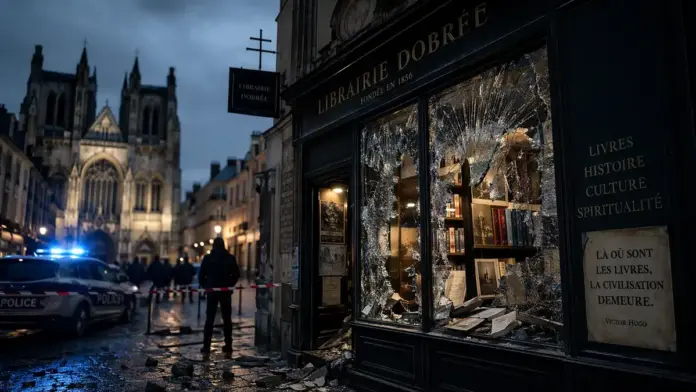
In Nantes, France, a video shows a group of men smashing the storefront of the Catholic bookstore Librairie Dobrée. On the surface, it looks like another clip of urban unrest, another shard of violence in a Europe that has grown used to seeing disorder circulate online in fast, angry fragments.
But this is not just about broken glass. It is about the moment a bookstore becomes symbolically attackable, and the moment a society begins to lose its instinctive understanding of what must remain protected.
The footage has been independently analyzed and tied to unrest in Nantes during 2023, which matters because it restores the factual frame without reducing the deeper significance of the act. Les Surligneurs’ analysis of the Nantes bookstore footage
FRANCIA: Islamistas y activistas de extrema izquierda atacan una librería católica en Nantes, acusándola de ser "fascista" por vender la Biblia, libros cristianos y estatuas de Jesús y María.
— Isaac (@isaacrrr7) April 15, 2026
¿Qué se ha hecho Europa a si misma?pic.twitter.com/wE0EOGb5UF
That distinction is crucial. A serious article does not need false novelty to be powerful. The event does not become smaller because it is tied to an earlier period of unrest. It becomes clearer. And once it becomes clearer, it becomes harder to dismiss.
What emerges is not simply vandalism, but a revealing scene in which a space of books, memory, religion, and continuity is treated as a legitimate object of destruction. At that point, the incident stops being merely local. It becomes civilizational.
The distortion of language
Every age of intellectual decline begins by corrupting language. Words that once carried civilizational weight are emptied, inverted, or turned into accusations. Tradition becomes suspect by default. Faith becomes shorthand for domination.
Continuity becomes coded as repression. A society does not collapse into confusion only when its institutions fail. It begins to collapse when its vocabulary can no longer distinguish between what should be contested and what should be protected.
That is why the attack in Nantes matters beyond the literal act. A bookstore is not only a retail space. It is a cultural signal. It is a place where a civilization stores fragments of itself and hands them forward.
Once such a place becomes emotionally or ideologically reclassified as a target, the conflict has already moved past politics and into symbolic destruction. The question is no longer only who attacked the glass. The question is how a society reached the point where smashing a bookstore could carry ideological meaning at all.
This is where your own ecosystem already gives the article a stronger backbone. In Newsio’s English piece Khamenei: Repression and Executions Under His Rule (Fact-Checked), the same structural logic is visible from another angle: language is turned into an enforcement tool, dissent is morally recoded, and reality is narrowed until power alone can define what counts as acceptable truth. The contexts differ. The mechanism does not.
The shared fear of the book
The book has always been dangerous to closed minds not because paper is powerful, but because reading distributes interior independence. The person who reads is harder to flatten into a slogan. The person who thinks historically is harder to trap inside a single emotional script. The person who encounters a continuity older than the current ideological mood becomes less manageable.
That is why books, libraries, schools, classrooms, publishers, and bookstores occupy such a strange place in every conflict over control. Even where the state does not formally censor them, the symbolic hostility remains.
Books are tolerated until they begin to signify a continuity someone wants broken. At that point, they stop being neutral objects and become reminders of depth in an environment that increasingly rewards speed, fury, and simplification.
This is also why the Nantes incident cannot be read as random noise. Even if one avoids overclaiming the precise political identity or motive of every individual in the footage, the cultural meaning remains. A bookstore was struck, not by accident, but as part of a scene in which it had become exposed. That exposure is itself the story.
Europe’s crisis of tolerance
Europe’s moral vocabulary still leans heavily on tolerance, and for good reason. Tolerance is one of the continent’s real civilizational achievements. But tolerance that loses all distinction between pluralism and disintegration becomes confusion. A society that cannot say what deserves protection without embarrassment slowly stops deserving protection itself.
That is the deeper warning contained in Nantes. The issue is not whether Europe should become intolerant. The issue is whether it still knows the difference between openness and paralysis. A bookstore that carries religious and cultural memory should not have to prove its moral legitimacy in order to be defended. If it does, then the problem is already larger than the bookstore.
The same broader weakness appears in another form in Newsio’s English analysis When a Regime Stops Seeing Its Own People as Its People: The Anatomy of Iran’s Repression, where the focus falls on what happens when a system no longer recognizes dissenters as members of the same civic body.
In Nantes, the setting is different, the scale is different, and the actor is different, but the fracture around belonging, legitimacy, and symbolic exclusion belongs to the same century.
Europe confronting itself
The weakest possible reading of the Nantes incident is to reduce it to camp language: left, far-left, radical, extremist, reaction, counter-reaction. Those labels may matter in investigative work, but they do not exhaust the meaning of the event. The stronger question is what kind of environment makes a cultural space vulnerable in the first place.
Because that is where Europe is truly being tested.
A civilization is not threatened only by outside force. It is also threatened by internal vagueness about what it is, what it carries, and what it must defend without apology. If a church, a bookstore, a school, or a library can be symbolically degraded without triggering a deeper moral recognition, then the erosion is no longer abstract. It is underway.
This is not an argument for panic. It is an argument for clarity.
The structural truth
The structural truth is harder than the shouting on either side. Not every act of vandalism is a theory. Not every smashed window is a manifesto. But every society that permits its spaces of knowledge and memory to become vulnerable without deeper reflection enters a phase of weakness.
The broken glass is not the whole story. It is the visible surface of a more serious condition: a weakening ability to distinguish between disagreement and desecration, between conflict and symbolic barbarism, between ordinary unrest and the targeting of continuity itself.
That is why “it was just vandalism” is not an adequate conclusion. It describes the act, but not the condition that made the act meaningful.
The sharper conclusion
What happened in Nantes is not the end of a story. It is an indicator. It tells us that Europe has entered a period in which its relationship with memory, religion, knowledge, and cultural self-defense is being tested under new pressure.
In such periods, small incidents are never really small. They are pressure points. They reveal where instinct has weakened and where a civilization is no longer certain what it is protecting.
That is the real force of the bookstore image. It is not “only” about a bookstore. It is about what becomes possible when a society forgets that places of memory must remain more than commercially open. They must remain morally legible as worth defending.
And once that moral legibility fades, every shattered window starts to say more than it seems.