


Table of Contents
Tehran’s nuclear hourglass is not measuring rumors — it is measuring time
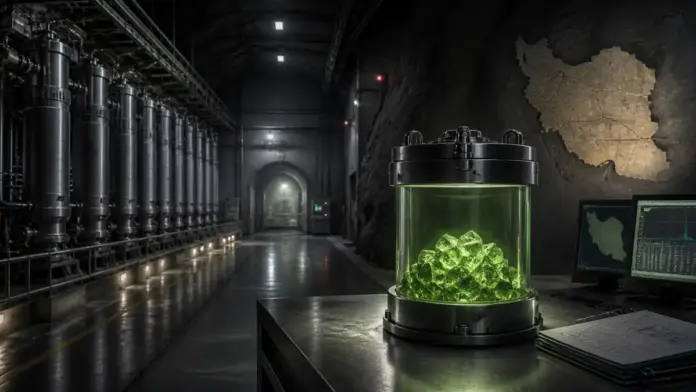
The claim circulating online about Iran and “40 kilograms of uranium” is not just another piece of nuclear panic. It points to a real technical threshold: roughly 42 kilograms of uranium enriched to 60% can be enough, if further enriched to weapons-grade levels, to produce the fissile material for one nuclear device.
But the most important correction is this: the 40-kilogram figure is not Iran’s total stockpile, and it is not the same thing as “breakout time.” Breakout time refers to how long a state would need to produce weapons-grade material once it decides to make the final enrichment move. The 400-to-420-kilogram figure refers to the quantity of 60% enriched uranium that makes that final move strategically dangerous.
That distinction matters because the real story is worse than the viral version. According to the International Atomic Energy Agency, Iran had accumulated 440.9 kilograms of uranium enriched up to 60% before the June 2025 military strikes, with 432.9 kilograms verified in UF6 form. That means the question is no longer whether Tehran is approaching the symbolic material threshold for one bomb. The question is how far it has already moved into a zone of multiple-bomb potential if the material were further enriched and weaponized.
What the 40 kilograms actually mean
Uranium does not become a nuclear weapon simply because it crosses a number on a scale. A bomb requires more than enriched material. It requires further enrichment, conversion, engineering, weapon design, a detonation system, delivery integration, and a political decision.
That is exactly why the issue must be handled with precision. There is no public, conclusive evidence that Iran has already assembled a nuclear warhead. It is also not accurate to say that 40 kilograms of 60% uranium equals a ready bomb.
The danger is different: 60% enriched uranium sits much closer to weapons-grade material than low-enriched uranium does. Once a state reaches that level, the technical distance to 90% becomes shorter, the warning window shrinks, and every delay in inspection becomes strategically heavier.
The IAEA’s May 2025 report already placed Iran’s stockpile of uranium enriched up to 60% at 408.6 kilograms, a major increase from the previous reporting period. The later 440.9-kilogram figure confirms that the issue is no longer a marginal enrichment dispute. It is a nuclear threshold crisis.
The myth: “Iran is racing to reach 40 kilograms”
The weakest version of the story says Iran is trying to reach the 40-kilogram mark. That framing is outdated and misleading.
The more accurate reading is sharper: Iran has already exceeded that benchmark many times over, based on the available IAEA reporting. The crisis is not about whether Tehran can collect enough 60% uranium for the theoretical material basis of one weapon. The crisis is about stockpile size, location, inspection access, and whether the international community still has enough visibility to know where the most sensitive material is.
That is why the issue cannot be reduced to a social media number. The number matters, but the loss of confidence matters more. When high-enriched material grows and inspection access weakens, the risk does not rise in a straight line. It accelerates.
The truth: the threshold is not the bomb — but it is the danger zone
A serious newsroom must hold two truths at the same time.
First, Iran does not become a confirmed nuclear-armed state simply because it possesses uranium enriched to 60%. That statement would overreach the public evidence.
Second, a state that accumulates hundreds of kilograms of 60% enriched uranium has moved far beyond the needs of an ordinary civilian nuclear program. That reality cannot be softened by diplomatic language.
The IAEA has repeatedly warned that Iran’s nuclear program raises serious verification concerns. It has also noted that Iran is the only non-nuclear-weapon state under the Nuclear Non-Proliferation Treaty known to have produced and accumulated uranium enriched to 60%. That is the line that changes the strategic meaning of the entire file.
The hourglass, therefore, is not only counting centrifuge cycles. It is counting the narrowing distance between capability, decision, and loss of international visibility.
Why Tehran wants the nuclear shield
Iran’s nuclear program cannot be understood only as a technical file. It is also a regime-survival instrument.
For Tehran’s ruling structure, the nuclear threshold offers something more valuable than prestige. It offers deterrence, bargaining power, and a possible shield against external pressure. A regime that feels militarily exposed, economically strained, regionally pressured, and internally contested may see nuclear ambiguity as its ultimate insurance policy.
This is where the nuclear file connects directly with Newsio’s broader English coverage of Iran under pressure. In Three U.S. Carriers and Diplomacy in the Shadow of Force, the same logic appears from another angle: diplomacy is not happening in a neutral room. It is happening under the shadow of force, escalation, maritime pressure, and internal regime anxiety.
That matters because uranium is not just material. In this crisis, it is leverage.
Natanz, Fordow, and Isfahan are not just names on a map
The nuclear crisis is geostrategic because location matters. It is not only about how much uranium Iran has. It is about where the material is, how protected it is, how quickly inspectors can verify it, and how difficult it would be to neutralize or monitor the relevant facilities.
Natanz carries the history of enrichment. Fordow carries the logic of underground protection. Isfahan now carries special concern because the IAEA believes much of Iran’s highly enriched uranium may still be stored there.
The Associated Press reported that IAEA Director General Rafael Grossi believes the majority of Iran’s 60% enriched uranium likely remains at the Isfahan nuclear complex, while inspections have not resumed at the same level since the June 2025 strikes. AP also reported that Iran has 440.9 kilograms of uranium enriched up to 60%, a short technical step from weapons-grade levels.
This is geostrategy in its purest form: space, protection, access, concealment, deterrence, and response time. Before a nuclear weapon becomes a military object, it becomes a problem of geography and control.
Diplomacy can be a solution — or a clock
Diplomacy with Tehran should not be dismissed automatically. A verifiable agreement that reduces the stockpile, restores inspection access, and closes the weapons-grade pathway would be preferable to war.
But diplomacy becomes dangerous when it functions as a clock rather than a solution.
That is the key issue around Iran’s negotiating posture. Moderate language, technical formulas, and public references to cooperation do not mean much unless they produce measurable results: access, verification, stockpile reduction, export or dilution of enriched material, and enforceable limits on enrichment.
Reuters reported in April 2026 that the White House said Iran had indicated it would turn over its enriched uranium stocks, while the U.S. continued to emphasize that surrendering enriched uranium remained one of President Donald Trump’s main priorities. The public significance of that report is not that a deal already exists. It is that the enriched uranium stockpile has become the central object of crisis diplomacy.
If diplomacy removes the material from the danger zone, it lowers the crisis. If diplomacy only buys time while visibility remains weak, it strengthens the wrong side of the clock.
The IRGC logic: nuclear ambiguity as regime insurance
The Islamic Revolutionary Guard Corps does not need a fully declared nuclear arsenal to benefit from nuclear ambiguity. It only needs enough uncertainty to complicate the calculations of Israel, the United States, Gulf states, and European governments.
That is why the nuclear threshold can become a political weapon even before an actual weapon exists. It forces adversaries to calculate risk under uncertainty. It raises the cost of military action. It gives Tehran room to threaten escalation without openly crossing the line.
That pattern fits the broader pressure map described in Newsio’s U.S. strategy toward Iran. The crisis is not shaped by one dramatic target or one public statement. It is shaped by pressure points: Hormuz, infrastructure, deterrence, regime durability, and the cost equation inside Tehran.
For the IRGC, nuclear ambiguity is not only about attacking others. It is about making others hesitate.
The 60% stockpile is a political message
Uranium enriched to 60% sends several messages at once.
To Washington, it says: the window is narrowing.
To Israel, it says: the cost of delay may rise.
To the Gulf, it says: Iran can create regional anxiety without firing a missile.
To domestic elites, it says: the regime still has strategic cards.
To ordinary Iranians, however, it says something darker: the system is willing to spend national energy on strategic survival while society carries the weight of sanctions, repression, inflation, and uncertainty.
This is why the nuclear file cannot be separated from Iran’s internal control system. Newsio’s fact-based English piece on Khamenei, repression, and executions shows the domestic architecture behind the foreign-policy posture. A regime that governs through fear at home often seeks deterrent armor abroad.
A bomb cannot feed a country
A nuclear threshold can protect a regime from certain forms of external pressure. It cannot repair a state.
It cannot reduce inflation. It cannot build trust. It cannot reverse brain drain. It cannot create political legitimacy. It cannot make a fearful society loyal. It cannot turn coercion into consent.
That is the strategic paradox Tehran faces. The closer it moves toward the nuclear threshold, the more it may feel protected from outside force. But the same movement deepens isolation, hardens sanctions pressure, increases the risk of military confrontation, and widens the gap between the regime’s survival agenda and the public’s daily reality.
The Soviet Union had a vast nuclear arsenal and still collapsed from within. The lesson is not that Iran will follow the same path mechanically. The lesson is that nuclear capability can deter invasion, but it cannot indefinitely conceal internal decay.
The Iranian people are not the nuclear program
Any serious article on Iran must draw a clear moral distinction. The Iranian people are not the centrifuges. They are not the IRGC. They are not the underground facilities. They are not the negotiating tactics of the state.
They are the first to pay the price of isolation, repression, economic pressure, and permanent crisis.
That distinction is not sentimental. It is analytically necessary. A regime can use nuclear escalation to protect itself while exposing its own society to higher costs. It can transform national resources into strategic leverage while ordinary citizens face the consequences.
The West should not confuse the people of Iran with the machinery that rules over them. But it should also not pretend that the machinery is harmless.
What the reader should take away
The 40-kilogram claim is not meaningless. The misleading part is the way it is often presented.
It does not mean Iran has a ready nuclear bomb. It does not mean 40 kilograms is the full stockpile. It does not mean weaponization has been publicly proven.
It means something more precise and more dangerous: roughly that amount of 60% enriched uranium is associated with the theoretical material threshold for one weapon’s worth of fissile material if further enriched. Iran’s reported stockpile has already moved far beyond that threshold.
That is the real story. The nuclear hourglass in Tehran is not counting rumor. It is counting the shrinking margin between enriched material, political decision, inspection failure, and strategic miscalculation.
The safest conclusion is strict: there is no public proof of a completed Iranian nuclear warhead. But there is more than enough evidence to say that Iran’s 60% uranium stockpile has pushed the crisis into a dangerous geostrategic threshold phase.
And in that phase, time is not neutral. Every day without full verification works in favor of uncertainty. Every kilogram above the threshold increases pressure. Every diplomatic delay without measurable reduction makes the hourglass more dangerous.