

Table of Contents
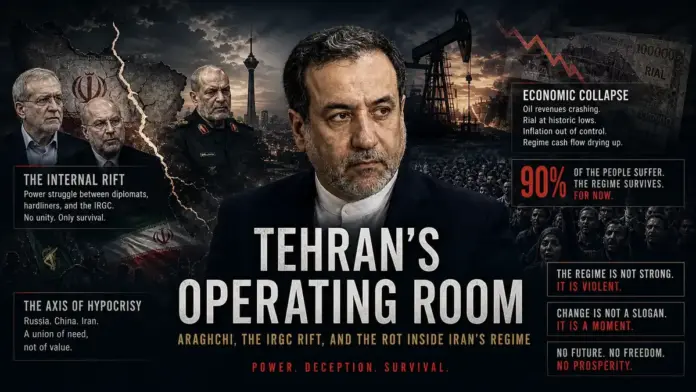
Tehran’s Operating Room: Araghchi, the IRGC Rift, and the Rot Inside Iran’s Regime
The Abbas Araghchi crisis is not a normal cabinet dispute.
It is not a personal quarrel.
It is not another minor episode inside Iran’s foreign ministry.
It is an X-ray of power.
And the X-ray shows a fracture.
According to the Iran International report, President Masoud Pezeshkian and Parliament Speaker Mohammad Bagher Ghalibaf are reportedly seeking the removal of Foreign Minister Abbas Araghchi, accusing him of following the line of Islamic Revolutionary Guard Corps commander Ahmad Vahidi in nuclear talks without keeping the president informed. The report presents Araghchi not as a foreign minister executing government policy, but as a diplomatic instrument aligned with the hard military-security core of the system.
That distinction matters.
If the report is confirmed fully from inside Tehran’s own power structure, this will not be merely the fall of a minister. It will be a public crack between the political façade of the Islamic Republic and the military-ideological machine that appears to hold the real steering wheel.
This is Tehran’s operating room: open the body of the regime, and the organs no longer work together.
The government wants to look like a government.
The IRGC wants to govern without always being seen as the government.
Araghchi stands between the two, not as a neutral technocrat, but as the smooth, internationally legible face of a system that speaks diplomatic language while keeping military nerves underneath.
Newsio has already explained this logic in America at the Table with Araghchi: Negotiating with the Polished Face of the Same Threat. Araghchi should not be read as a separate Tehran. He should be read as the polished interface of the same pressure machine.
Now Tehran itself appears to be revealing what the West often pretended not to see.
The showcase of fear: the myth of the “moderate” Araghchi
The Abbas Araghchi who appears in international rooms is not just a diplomat with a polished résumé.
He is the product of a specific Iranian architecture: revolution, war, the IRGC, the foreign ministry, Western education, nuclear bargaining, and strategic ambiguity.
His biography is not a neutral detail. Reuters described Araghchi as a former member of the Revolutionary Guards, a veteran negotiator, a central figure in nuclear talks, and possibly Iran’s most powerful foreign minister yet.
That trajectory is not accidental.
It is the model.
Tehran understands that raw revolutionary fanaticism does not travel easily through international diplomacy. It needs figures who speak English, understand Western codes, smile at mediators, and use words such as stability, framework, guarantees, reciprocity, and regional security.
But fluency in the Western code does not mean Western political ethics.
It can mean the opposite: better use of the opponent’s code.
Araghchi is useful because he does not look like a Revolutionary Guard poster. He is useful because he can appear as a “serious interlocutor” while the regime behind him holds missiles, militias, oil, prisons, Hormuz, and nuclear leverage in the same hand.
That is the fraud inside the word “moderate.”
He does not need to shout.
He does not need to wear a uniform.
He does not need to threaten in every sentence.
The system needs him precisely because he can carry hard power through a soft surface.
The West often makes a childish mistake: it confuses tone with substance. It sees a suit and hears English, so it imagines pragmatism. It hears technical language, so it imagines distance from the IRGC. It sees diplomatic calm, so it imagines an opening.
Tehran has been exploiting that weakness for decades.
The “moderate” is not always the man who softens the machine.
Sometimes he is the man who makes the machine easier to sell.
Pezeshkian, Ghalibaf, and the IRGC’s power veto
The report that Pezeshkian and Ghalibaf are pushing against Araghchi matters because it does not stand alone.
The Critical Threats Project and the Institute for the Study of War previously described an internal power struggle inside Iran’s system, with Ahmad Vahidi and hard IRGC-linked circles repeatedly constraining more pragmatic efforts by figures such as Ghalibaf to move the regime toward a more flexible negotiating line.
In its later reporting, ISW / CTP also noted that the Araghchi report suggests he may have aligned himself with Vahidi’s position on negotiations. This is not a personnel footnote. It is a power map.
Iran does not appear as a normal state deciding policy through one coherent civilian chain.
It appears as a regime with multiple centers of force, where the political surface tries to survive beside a hard military-ideological machine that sees itself as the owner of the revolution.
Pezeshkian may be president.
Ghalibaf may be parliament speaker.
But the real question is not who has a title.
The real question is who holds veto power over reality.
And here the image is blunt: when a foreign minister is accused of operating more according to the IRGC line than the president’s line, the “Islamic Republic” looks less like a republic and more like a stage set behind which a military-ideological center moves the levers.
This is not a state with an army.
It is a military-ideological machine with a state façade.
The negotiation with the West therefore stops being a clean diplomatic process. It becomes a low-intensity civil conflict inside the regime itself.
One side wants room to maneuver.
The other fears that every maneuver is a crack in revolutionary legitimacy.
Araghchi, if the reports are accurate, sits exactly there: not as a bridge of national interest, but as a channel through which the hard machine enters the room of negotiation.
Newsio’s earlier analysis, Iran Under Pressure: Three U.S. Carriers, an Internal Rift, and Diplomacy in the Shadow of Force, argued that the crisis is not only Washington versus Tehran. It is also Tehran versus Tehran.
That reading now looks sharper.
Why the West cannot find a real interlocutor
The West looks for an interlocutor because Western diplomacy is built on the assumption that states have centers.
A minister.
A president.
A council.
A line.
A door you can knock on and expect an answer.
In Tehran, that assumption is not safe.
The foreign ministry speaks. The IRGC imposes. The president appears. The supreme security structure approves or blocks. Militias exert pressure from the field. Hardliners treat compromise as betrayal. The economy rots, but the regime fears loss of control more than social collapse.
So the West sits across from one man while actually negotiating with a many-headed machine.
The problem is not that Araghchi is “incapable.”
The problem is that he may be very capable at the role assigned to him: translating the regime’s line into language that survives international cameras.
Solving a crisis is one job.
Making the continuation of the crisis look like a path toward a solution is another.
This is where diplomacy becomes a time machine.
And time is a weapon.
Newsio explained this in The Hormuz Vise: Why the War in Iran Is Fought in Your Wallet: when Tehran controls or threatens a strategic chokepoint, it does not always need to fire. It only needs to maintain uncertainty. It only needs markets to price risk. It only needs every negotiation to become another extension of pressure.
That is not diplomacy as peace.
That is diplomacy as pressure management.
The economy as detonator
Every regime that loses social legitimacy ends up governing with three tools: fear, money, and lies.
The Iranian regime has used all three.
But the money is drying up.
The economic pressure is not theoretical. Reuters reported that the U.S. naval blockade has sharply squeezed Iranian oil exports, stranded growing crude stockpiles on tankers, and pushed storage capacity toward its limits.
This is not a simple economic inconvenience.
It is an attack on the regime’s liquidity system.
Oil is not only a commodity for Tehran. It is blood in the machine. It funds salaries, networks, access, protection, shadow finance, privileges, loyalty, and black-market infrastructure.
When oil is trapped, the state budget is not the only thing under pressure. The entire architecture of regime survival is under pressure.
The pressure also hits the currency. Reuters reported another historic drop in the rial, as the market fled toward hard currency. When a currency collapses, the economy is not the only thing that breaks. Social psychology breaks with it. A citizen watching savings evaporate no longer hears ideological sermons the same way. He counts what he can buy. He counts what he lost. He counts how much survival costs.
The IRGC does not live on slogans.
It lives on networks, revenue, smuggling channels, access, privileges, contracts, oil, black-market flows, and systems of economic dependency.
When the money dries up, ideology becomes louder because reality becomes more dangerous.
This is where the explosive material sits: a population paying the price of collapse, a military-security machine trying to preserve the last channels of wealth, a civilian government trying to appear functional, and a foreign minister accused of serving the deep military state rather than the formal government.
That is not stability.
It is a sealed room filled with gas.
The majority the cameras do not show
The skeleton speaks of 90% of the people as the real power. As a precise number, it must be handled carefully. There is no single reliable measurement proving that exactly “90%” of Iranians are ready to explode politically.
But there is a truth heavier than the number: in every authoritarian system, the overwhelming majority of people do not belong to the core of violence.
They live under it.
In Iran, the ruling core is not the people.
It is the machine.
The armed networks.
The security services.
The watchers.
The judges of fear.
The ideological guardians.
The economic middlemen.
The people who feed from the continuation of the regime.
Opposite them stands a society that has learned to survive under surveillance, inflation, repression, censorship, humiliation, and managed fear.
That society is not weak because it does not always hold weapons. It is suppressed because the machinery of violence is designed precisely to make the majority feel alone.
But technology changes that arithmetic.
Images escape.
Information escapes.
Videos escape.
Economic facts escape.
Comparisons with the rest of the world escape.
Propaganda does not die, but it requires more violence to keep standing.
And when a regime needs more and more violence to prove that it still has control, it is not showing strength.
It is showing fear.
Violence works as a governing tool only while people believe there is no alternative. Once society begins to understand that the regime is not eternal, violence remains dangerous, but it loses its metaphysical authority.
Iran is not the ayatollahs.
Iran is not the IRGC.
Iran is not the militias.
Iran is not the nuclear facilities.
Iran is not the executions.
Iran is not Araghchi.
Iran is mostly the people forced to pay the bill for a regime that sells them “resistance” while stealing their future.
That is why Newsio’s earlier article When the Iranian Regime Stops Seeing Its Own People as Its People belongs beside this analysis. A regime that fears its people does not govern a nation. It occupies one.
The Russia-China axis does not offer a future
Tehran sells its people and its allies a grand illusion: that there is an alternative world, a Russia-China-Iran axis that will replace the West, break the dollar, defeat technology, provide security, and open a new historical century.
The problem is that this axis does not look like the future.
It looks like a union of wounds.
Russia needs Iranian drones and military cooperation because its war has exposed the limits of its power. The Foundation for Defense of Democracies has argued that Iran’s support for Russia has created lessons and opportunities for Tehran, but the partnership also exposes the transactional nature and strategic limits of the relationship. This is not a civilizational rescue mission. It is hard bargaining between stressed powers.
China, meanwhile, is not Iran’s savior.
It is a cold buyer of advantage.
It wants energy, access, discounts, leverage against the West, and strategic depth. It does not want to burn for Tehran.
When the crisis becomes too dangerous, Beijing looks first at its own citizens and its own interests. That is how major powers behave. They do not die for slogans written in another capital.
This is the axis when the propaganda lights go out: Russia takes what it can, China buys what benefits it, and Iran is left with wounds, dead currency, blocked oil, frightened society, and a regime that keeps promising historical destiny while delivering daily decay.
The West has massive problems. It has hypocrisies, failures, internal crises, political violence, ideological fatigue, and strategic arrogance.
Newsio does not give anyone a free pass.
But the West still controls much of the operating system of the future: capital, artificial intelligence, chips, institutional markets, technology platforms, universities, innovation, financing, and rule-based financial depth.
The Russia-China-Iran axis does not offer freedom.
It offers surveillance.
It does not offer prosperity.
It offers dependency.
It does not offer political future.
It offers regimes that fear their own citizens more than their enemies.
Newsio’s analysis The Four-Part Axis and the Siege of the West: Russia, China, Iran and the New Geopolitics of Attrition examined this wider architecture. The axis is real as a pressure network. It is not real as a humane model of the future.
That difference matters.
A pressure network can damage the world.
It cannot build a better one.
Araghchi as the last doorman of a rotten building
Araghchi is not the cause of Iran’s crisis.
He is the symptom most visible because he stands in the light.
He is the man who can speak to the West while the regime speaks to its own people through fear.
He is the man who can discuss frameworks while the IRGC holds the red lines.
He is the man who can appear as a technical negotiator while his own moves reportedly provoke accusations from the political top that he serves another master.
If Pezeshkian and Ghalibaf are truly pushing for his removal, then the meaning is brutal: the regime can no longer even agree on who has the right to pretend to be the West’s interlocutor.
This does not mean automatic collapse.
Authoritarian systems can rot for years.
They can survive through violence, smuggling, outside support, fear, executions, propaganda, and the economic suffocation of their own people.
But every such survival has a cost.
And the cost is rising.
Iran is not changing because it wants to.
It is being forced toward change because the machine is creaking.
The negotiation creaks.
The economy creaks.
Society creaks.
The axis creaks.
The narrative creaks.
And now even the position of the man meant to translate Tehran to the outside world is creaking.
That is why the Araghchi affair is not a small story.
It is a pressure gauge.
And the gauge is moving.
The final conclusion
The Araghchi affair is more than personal dismantling. It is the political autopsy of a regime that cannot decide whether it wants a foreign minister or a military envoy with diplomatic credentials.
Tehran is not showing strength when the IRGC appears to impose its line over the formal government.
It is showing that the government is a façade.
It is not showing stability when Pezeshkian and Ghalibaf reportedly push for Araghchi’s removal.
It is showing internal fracture.
It is not showing endurance when the rial collapses, oil is trapped, and society pays the bill.
It is showing economic rot.
It is not showing an alternative future when it leans on Russia and China.
It is showing that it is searching for a lifeboat among powers that look first after themselves.
And it is not showing legitimacy when it governs through fear.
It is showing that it fears its own people.
The truth is simple and does not need politeness: the Islamic Republic is not strong because it endures. It is violent because it knows it cannot persuade without violence.
Araghchi is the smooth face of that system.
The IRGC is the hand.
The economic collapse is the bill.
The people are the force that has not yet seized the final outcome.
And the Russia-China axis is not a solution.
It is a mirror.
It shows Tehran the future waiting for it if it continues down the same road: more surveillance, less money, more isolation, less life.
The operating room is open.
The body of the regime is visible.
And the diagnosis is not reform.
It is rot.