


Table of Contents
Iran Under Pressure: Three U.S. Carriers, an Internal Rift, and Diplomacy in the Shadow of Force
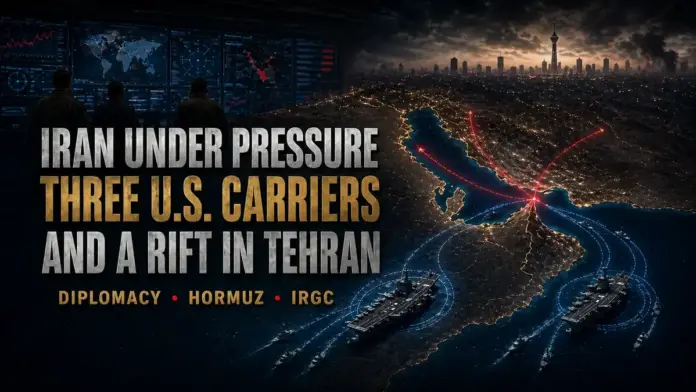
The claim circulating across social media that the United States has deployed a third aircraft carrier to the Middle East is not just online noise. The core of it is real: three U.S. aircraft carriers are now operating in the region, a concentration of naval power reported as the first of its kind there since 2003. U.S. Central Command said the deployment includes three carriers, 12 accompanying ships, more than 200 aircraft, and roughly 15,000 personnel.
That does not automatically prove that Washington has already decided to launch major strikes on Iran. It proves something serious enough on its own: diplomacy is no longer operating in a neutral atmosphere. It is taking place under the shadow of heavy, available, and politically visible American military power.
Iran sees the carriers. China has urged its citizens to leave Iran. Abbas Araghchi is moving through diplomatic channels involving Pakistan, Oman, and Russia. Inside Tehran, reports of friction between more pragmatic political actors and harder IRGC-linked power centers suggest that the crisis is not only external. It is internal.
The real picture is not simple war fever. It is pressure compression.
Diplomacy has not ended. But it has lost the luxury of calm.
The military balance has changed the atmosphere around diplomacy
Three aircraft carriers are not a footnote. They are a message.
One carrier is a floating airbase. Three carriers in the same broad theater create a different operational environment. They give Washington options: deterrence, maritime enforcement, protection of sea lanes, surveillance, blockade support, and, if ordered politically, escalation.
That distinction matters. A deployment is not the same thing as an attack order. But a deployment at this scale means the United States wants something heavier than words on the table. It wants visible force inside the crisis map.
This is where diplomacy becomes more serious. It is no longer measured only by who speaks to whom, or which mediator carries which proposal. It is measured by who has already moved power into position.
For Tehran, the United States can no longer be read only as a negotiating party. It must also be read as a military actor that has placed hardware, aircraft, sailors, and strike capability inside the crisis environment.
This connects directly with Newsio’s earlier analysis, Trump Escalates in Hormuz: What the U.S. Blockade of Iranian Ports Really Means for Oil, Shipping, and the West. That article explained why the maritime dimension of the Iran crisis was already shifting from rhetoric into operational pressure. The carrier deployment deepens that same logic.
Hormuz is not a backdrop. It is the pressure mechanism.
The crisis cannot be understood without the Strait of Hormuz.
Hormuz is not merely a sea lane. It is a strategic artery, an energy nerve, and a psychological lever over global markets. When shipping through or around Hormuz enters uncertainty, the shock does not remain at sea. It travels into oil prices, freight costs, war-risk insurance, energy expectations, and ultimately the cost of daily life.
That is why this article belongs beside Newsio’s The Hormuz Vise: Why the War in Iran Is Being Fought in Your Wallet. That analysis made one core point: the conflict around Iran does not stay inside the Middle East. It moves through the price system.
The presence of three U.S. aircraft carriers must be read inside that context. It is not an isolated military fact. It is part of a wider message: if Tehran tries to use Hormuz as a permanent instrument of coercion, Washington wants to show that it can answer with real naval power.
But that does not remove the danger. It intensifies it.
When a chokepoint becomes simultaneously military, economic, and political, every move acquires extra weight. One vessel. One inspection. One warning. One misread signal. One overconfident commander. In Hormuz, small incidents can become global events.
China’s evacuation advisory is a warning signal
China does not casually urge citizens to leave a country.
Reuters reported, citing Xinhua, that China advised its citizens to avoid travel to Iran and urged those already there to leave as soon as possible because of the security situation.
That does not prove that Beijing knows the date of an American strike. It does not prove that war is certain. But it does prove something important: a major power with deep interests and working relations with Tehran judged the security environment serious enough to warn its own citizens to get out.
In geostrategy, moves like this often function as the canary in the coal mine. They do not always predict the explosion. They do tell you the air is becoming dangerous.
And here the pattern is too important to ignore. China issues an evacuation warning. The United States expands its naval footprint. Tehran shows signs of internal disagreement over negotiation. Araghchi moves through regional mediation channels. The IRGC appears increasingly central to the regime’s hard line.
That is not normal diplomacy.
That is a crisis entering a more compressed phase.
Araghchi is moving — but who holds the real steering wheel?
Abbas Araghchi is again at the center of the diplomatic picture. Reports have placed him in a regional track involving Pakistan, Oman, and Russia, with Pakistan appearing as one of the mediation channels and other capitals potentially serving as coordination points for Tehran’s next position. Reporting on the Iran-Pakistan channel shows that diplomacy is still alive, but it is not moving in a clean or stable environment.
The deeper question is not whether Araghchi is traveling.
The deeper question is whether Araghchi is negotiating — or merely carrying limits imposed by forces stronger than his office.
That question matters because Tehran does not appear to be speaking with one completely unified voice. The Wall Street Journal reported that Iran’s leadership divisions are frustrating efforts to make progress in talks, with hard-liners pressuring officials not to compromise and figures such as Araghchi and Mohammad Bagher Ghalibaf coming under fire from ultraconservative factions.
That is the key.
A divided regime is not necessarily less dangerous. It can become more dangerous. When the political face wants room and the military-ideological machine wants control, diplomacy stops being a clean channel. It becomes an internal power struggle.
This is exactly why Newsio’s earlier article America at the Table with Araghchi: Negotiating with the Polished Face of the Same Threat matters here. Araghchi is not simply a diplomat across the table from the West. He is the polished interface of a system whose decisive levers may sit elsewhere.
The IRGC is not backstage. It is power inside power.
The Islamic Revolutionary Guard Corps is not a normal military institution.
Inside Iran’s system, the IRGC operates as a security machine, ideological guardian, economic actor, regional operator, and internal control structure. When the IRGC pressures the negotiation line, that is not just “hard-line opinion.” It is the revolutionary core reminding everyone that diplomacy is permitted only as long as it does not threaten the system.
This is where Western analysis often goes wrong. It sees ministers, statements, travel routes, mediators, and diplomatic formulas. But behind the surface lies the central question: who can actually say yes or no?
If the IRGC can restrict, pressure, or override the flexibility of the diplomatic team, then the West is not negotiating only with diplomats. It is negotiating with a system in which the military-ideological structure can hold veto power over reality.
That makes every statement fragile.
Even if a diplomat speaks about openings, frameworks, or de-escalation, the force that controls the field may read that same language as weakness, betrayal, or a threat to revolutionary legitimacy.
Araghchi’s diplomacy meets steel
The major shift is this: Araghchi is no longer operating in a space where diplomatic language can buy time without visible cost.
The aircraft carriers mean every statement is judged beside a heavy American military presence. China’s advisory means even external powers close to Tehran are reading the security picture as dangerous. Internal friction means Iran may not have a single stable line behind the words it uses abroad.
This is the end of comfortable ambiguity.
It is not the end of diplomacy. It is the end of weightless diplomacy.
Araghchi may keep speaking. He may keep traveling. He may keep presenting frameworks, red lines, and messages. But his words now move between two pressures: external American force and internal IRGC pressure.
That makes him more important, not less.
The person standing between negotiation and coercive power can become either a channel of de-escalation or the polished face of a conflict that others have already decided to harden.
Why we should not write that an attack is certain
This is where editorial discipline matters.
There is no public evidence strong enough to say that the United States has already decided to launch imminent major strikes against Iran. What we do have is confirmation of an extraordinary military concentration, confirmation of a Chinese evacuation advisory, credible reporting on internal Iranian divisions, and a broader crisis environment around Hormuz and negotiations.
Those are heavy facts.
They do not need exaggeration.
Writing that an attack is certain would weaken the analysis. Writing that the military environment has changed dramatically makes the article stronger, because it stays inside what the evidence supports.
This is the Newsio standard: do not inflate what cannot be proved. Show what can be proved, then explain what it means.
And what can be proved is already serious enough: diplomacy is now functioning under iron pressure.
Iran versus itself
This is not only Washington versus Tehran.
It is also Tehran versus itself.
On one side stands the need to negotiate. Economic strain, military pressure, blockade risk, diplomatic isolation, and the fear of uncontrolled escalation all create incentives for some form of exit.
On the other side stands the revolutionary machine, which fears that any concession may open the door to loss of legitimacy. For the IRGC and its hard-line ecosystem, negotiation is not just a technical matter. It can become a potential crack in power.
That is the dangerous point.
When a regime feels threatened externally and internally at the same time, it does not always become more rational. Sometimes it becomes more nervous. And nervousness inside a system that controls missiles, maritime pressure, proxy networks, repression tools, and energy chokepoints is not ordinary political instability. It is geostrategic risk.
That is why it remains essential to separate Iran as a country from the regime that governs it. Newsio made this distinction clearly in They Are Not Striking Iran — They Are Striking the Tehran Regime. The issue is not the Iranian people. The issue is the power machine ruling over them and using crisis as a tool of survival.
The message for a younger generation
A younger generation needs to understand something most legacy commentary often blurs: this crisis is not a series of disconnected events.
It is not just Araghchi traveling.
It is not just three aircraft carriers.
It is not just a Chinese evacuation advisory.
It is not just an internal Iranian rift.
It is all of them at once.
When these things happen together, the picture changes. We are not looking at a normal diplomatic moment. We are looking at compression: every actor is testing how far it can go without triggering an uncontrolled explosion.
The United States is showing force.
China is protecting citizens and reading the danger.
Iran is negotiating, but also struggling internally over what can be conceded.
The IRGC holds the field while diplomats try to keep a door open.
That is the real drama.
The question is not only, “Will there be war?”
The deeper question is: can a regime with this level of internal tension negotiate credibly while facing three American aircraft carriers?
The final conclusion
The presence of three U.S. aircraft carriers in the Middle East is not a minor military detail. It is an environmental shift. It means Washington wants enough power in theater to deter, pressure, enforce, or escalate.
China’s warning to its citizens to leave Iran is not proof of an imminent attack. It is a warning signal that the security environment has entered a more dangerous phase.
Reports of pressure around Araghchi, Ghalibaf, Pezeshkian, Vahidi, and the IRGC do not prove regime collapse. They do show that Tehran is not moving as a perfectly unified body.
The most accurate conclusion is also the strongest one: we do not have certainty of an immediate strike. We do have confirmation that diplomacy is now operating under iron pressure.
Iran is not facing statements alone. It is facing carriers.
The United States is not facing a foreign minister alone. It is facing a regime with internal fractures and hard-line mechanisms that do not want to lose control.
And the world is not merely watching a negotiation. It is watching a moment in which diplomacy, naval power, Hormuz, China’s warning signal, and Tehran’s internal struggle converge into one question:
who truly controls the next move?