


Table of Contents
When Hormuz Reaches China: How the U.S. Blockade on Iran Is Turning Into a Geopolitical Test for Beijing
The easiest version of this story is also the laziest one: the United States turned back Chinese ships in the Strait of Hormuz, China exploded, and a new U.S.–China maritime crisis was born. The reality is heavier than that and, in some ways, more important. What has been confirmed so far is not a blanket American move against all Chinese ships as a national category.
What has been confirmed is that Washington’s blockade targeting vessels going to and from Iranian ports is now touching Chinese-linked interests because China was the main buyer of Iranian oil and because Chinese-owned or China-linked shipping sits inside that commercial chain.
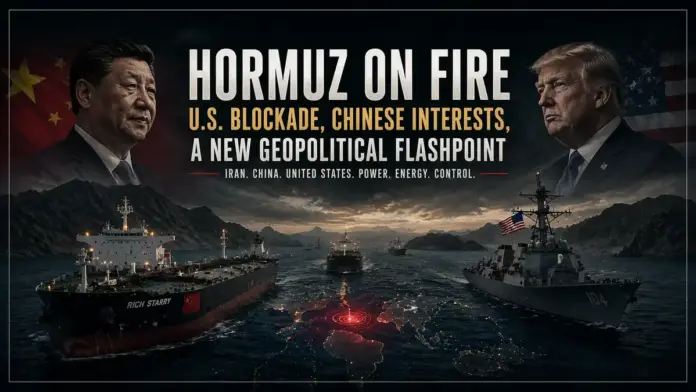
Reuters reported that at least two tankers reversed course as the blockade began, and separately reported that the Rich Starry—Chinese-owned and already under U.S. sanctions for Iran-linked trade—was among the tankers moving through Hormuz under this new pressure environment.
That distinction matters because it changes the scale of the story. Washington can still say, formally, that it is not blockading “China.” It is blockading access tied to Iranian ports. But in geopolitical terms, when U.S. naval power begins to interfere with a maritime network through which China had been absorbing Iranian energy, the crisis stops being only U.S.–Iran. It becomes an indirect but very real test of power with Beijing.
That is what makes this phase so consequential: American pressure on Tehran is now running through Chinese energy nerves. Reuters reported that China, the main importer of Iranian oil before the conflict, condemned the blockade and warned that it ran against international interests.
And that is why the Chinese response cannot be treated as routine diplomacy. Reuters reported that China’s foreign ministry called the blockade “dangerous and irresponsible,” while President Xi Jinping, in a separate Middle East-related intervention, stressed the need to uphold international law and warned against a return to the “law of the jungle.”
That is not the same as a verified special statement by Xi saying the U.S. had specifically turned back Chinese ships. There is no solid public confirmation of that narrower claim in the reporting I found. But there is a clear Chinese signal that Washington’s line in Hormuz is viewed in Beijing as destabilizing, strategically threatening, and larger than a bilateral dispute with Tehran.
The real question is not whether Washington “hit China,” but how pressure on Iran now reaches Beijing
Anyone reading the crisis only through social posts or hyper-compressed headlines will be tempted into a crude framing: U.S. Navy, Chinese ships, immediate confrontation. The real question is more serious. How does a blockade aimed at Iran become a crisis China cannot ignore?
The answer runs through oil, maritime risk, and the geography of Hormuz. China is not a detached observer here. It was the leading importer of Iranian crude before the latest escalation, which means any American move against Iran’s maritime export routes inevitably reaches Chinese interests even if Beijing is not named as the formal target.
Reuters’ reporting makes this plain: China objected not in abstract terms, but because Hormuz matters directly to Chinese energy security and to the wider stability of Gulf shipments.
That is where this stops being a regional story and becomes something larger. The United States is using its naval advantage to squeeze a regime it sees as destabilizing and dangerous.
China sees that the same naval advantage can now touch its own energy interests without Washington having to say openly that China itself is under pressure. In other words, Beijing is angry not only because a few cargoes may be delayed or redirected.
It is angry because this creates a precedent: the United States can turn a regional choke point into an instrument of unilateral strategic pressure, with consequences that spill directly into China’s external energy system.
That is why this article belongs naturally alongside Newsio’s earlier English-language pieces Trump, Netanyahu, Europe, and Iran: Why the West Is Splitting and Strait of Hormuz: would a seizure or blockade help the global economy or the United States?. The first explains why the Iran file now fractures Western strategy itself. The second explains why Hormuz is not a side issue but one of the world’s most dangerous economic and geopolitical choke points.
The Rich Starry case: the small name that reveals the larger shift
In major geopolitical crises, one ship, one convoy, or one maritime incident often makes a larger reality visible all at once. In this case, that name is Rich Starry.
Reuters reported first that the Rich Starry was among the tankers that turned around as the blockade began to bite. Then, in a separate report, Reuters said the Chinese-owned tanker—already under U.S. sanctions for Iran-linked activity—was among the vessels passing through Hormuz on the first full day of the blockade.
That sequence matters more than it might seem. It shows a Chinese-owned, U.S.-sanctioned tanker caught directly inside the new enforcement atmosphere at Hormuz. This is no longer theory. It is a tangible case where American pressure on Iran and Chinese commercial exposure meet in the same maritime corridor.
That does not prove that the United States is now broadly blocking all Chinese shipping. That would overstate the facts. What it does show is where the real line of friction now runs: not between “American ships” and “Chinese ships” in the abstract, but between Washington and any network linked to Iran’s maritime export system. Because Chinese interests sit inside that system, the line reaches Beijing whether Washington formally says so or not.
This is exactly the kind of detail that makes an article heavier and more defensible. It moves the story beyond mood and into visible evidence. Instead of saying vaguely that “China is affected,” you can show which vessel, what ownership, what sanctions history, and what strategic environment brought it to the center of the story.
Why Beijing is truly angry
China is not upset only because it disagrees with the United States in principle. It is upset because it sees a strategic doctrine being tested in front of it. Reuters reported that China called the blockade “dangerous and irresponsible” and said it opposed actions that harmed wider international interests.
Xi’s own remarks about upholding international law and resisting the “law of the jungle” fit the same logic. Beijing wants to frame the American move not merely as a technical enforcement action against Iran, but as a challenge to the kind of maritime order on which China’s own rise has depended.
Behind that language sits something more material. China’s economic model still depends on stable energy flows, manageable shipping costs, and predictability along maritime routes that connect the Gulf to Asian markets.
When Hormuz becomes a permanent zone of military uncertainty, Beijing loses more than discounted access to Iranian barrels. It loses part of its confidence that sea lanes will remain primarily commercial spaces rather than platforms for unilateral American coercion.
Reuters reported that Chinese imports were already affected by the broader conflict environment and that Beijing had linked the blockade to risks for world energy and trade.
That is why the issue is larger than the movement of any one tanker. China is reading Hormuz as a warning about the future. If Washington can pressure Beijing indirectly through Iran and Hormuz today, what might a more advanced version of that look like tomorrow in even more consequential maritime theaters?
Hormuz is becoming the first real shadow maritime test between the U.S. and China
We are not yet in an open U.S.–China military confrontation in Hormuz. That needs to be said plainly. There is no confirmed evidence that the United States has launched a general campaign to stop all Chinese vessels.
There is also no reliable confirmation that Xi delivered a special statement specifically about “Chinese ships turned back” in those exact terms. But we are clearly entering something else: the early phase of a shadow maritime test between the United States and China, with Iran as the immediate trigger and Hormuz as the operational stage.
Washington’s message is straightforward: it has the naval reach to squeeze Iran’s maritime system. Beijing hears a second message beneath it: the United States can touch Chinese energy exposure without declaring direct confrontation with China itself.
Markets hear a third message: one of the most important sea lanes in the world has entered a new era of strategic pricing, fear, and uncertain precedent. That is the real story.
This also fits cleanly with Newsio’s broader framework in The Four-Part Axis and the Siege of the West. That article argued that pressure on the West no longer arrives through one front at a time. Here, we are seeing the same logic in maritime form: U.S. pressure on Iran, Chinese energy exposure, and global market stress all converging in a single narrow corridor.
This is not just an Iran crisis. It is a test of the world after Western monopoly
To understand the scale of this moment, it helps to stop thinking in daily headlines and start thinking in structural terms. The issue is not only whether two tankers turned around or whether one Chinese-owned ship ultimately crossed. The issue is that Hormuz is becoming a live arena where three different worldviews collide.
The United States is asserting a view of maritime power in which naval dominance can still be used to impose strategic cost on adversaries through choke points and interdiction pressure. Iran is asserting the opposite kind of leverage: that geography itself can be weaponized to make the global system fear it.
China is asserting a third position: that the flow of trade and energy cannot remain hostage to a maritime order whose coercive center still sits with Washington. Xi’s language about international law and China’s language about global interests both fit that broader argument.
That does not mean Beijing is preparing for direct military escalation in Hormuz. It does mean this crisis confirms something Chinese strategists have long worried about: a rising power cannot rely forever on maritime lifelines that another power can pressure at will.
In that sense, Hormuz is not just an energy passage. It is an early laboratory of the post-Western power struggle now taking shape.
The strongest outbound link for this article
The strongest external link to elevate the article further is Reuters’ report on the Rich Starry case: U.S.-sanctioned Chinese tanker passes Strait of Hormuz despite blockade data shows. It belongs most naturally in the Rich Starry section, right on the sentence naming the tanker, because that is where the article moves from broad analysis to a concrete, documented case.
A strong in-text version would read like this:
The Rich Starry, Chinese-owned and already under U.S. sanctions, became the clearest symbol of how Washington’s pressure on Iran’s maritime system is beginning to touch Beijing in plain view.
Final conclusion
The most serious conclusion is also the cleanest one. The United States has not, based on what is publicly confirmed, launched a general anti-China blockade in Hormuz. But it has launched a blockade that strikes directly at Iran’s maritime lifelines and, through them, visibly brushes up against Chinese interests.
Beijing sees it, says so in its own diplomatic language, and is already reacting sharply. Reuters’ reporting on the blockade’s scope, China’s condemnation, Xi’s wider comments on international law, and the Rich Starry case all point in the same direction.
For a serious reader, that is the key takeaway: this is no longer just another Hormuz flare-up between Washington and Tehran. It is the moment American pressure on Iran begins to touch Chinese interests in visible, testable ways. And that is a much bigger story than a simple headline about “ships turning back.