
Table of Contents
London and New York are speaking the same political language
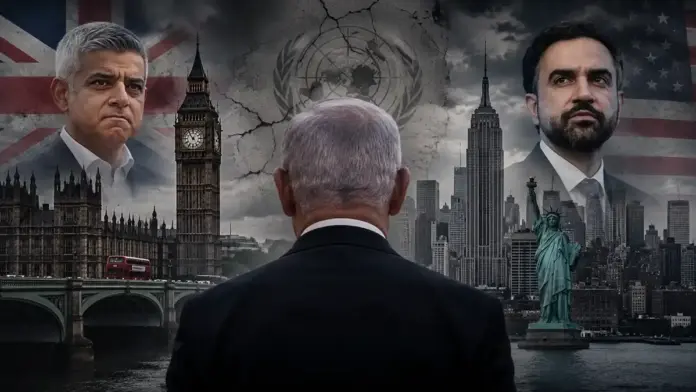
Two of the most influential cities in the Western world have now produced almost the same political message about the prime minister of Israel.
In New York City, Mayor Zohran Mamdani declared that Benjamin Netanyahu is not welcome and called on the United States government to act on the arrest warrant issued by the International Criminal Court. Mamdani ultimately acknowledged that New York City itself does not possess the legal authority to execute that international warrant.
In London, Mayor Sadiq Khan used strikingly similar language, saying that Netanyahu is not welcome in the British capital and arguing that the United Kingdom should enforce the ICC warrant if the Israeli prime minister enters the country.
The two cities operate under different constitutional systems. The United States is not a state party to the Rome Statute. The United Kingdom is. The two mayors possess different legal powers, and neither one independently controls national immigration, diplomacy or the execution of international arrest warrants.
Yet the political language is nearly identical.
That similarity does not prove the existence of a secret command center, a coordinated religious conspiracy or a formal transatlantic operation. It does, however, reveal an important ideological convergence.
A slogan that once belonged mainly to protest movements, activist networks and university encampments has reached the official language of municipal power.
“Not welcome” is no longer merely written on a placard.
It is being spoken from city hall.
What actually happened in New York
Mamdani’s position initially appeared to go further than symbolic condemnation. He had repeatedly suggested that Netanyahu should be arrested if he came to New York, particularly for the United Nations General Assembly.
The legal problem was immediate.
New York City cannot independently enforce an ICC warrant as though it were an ordinary local arrest order. The United States has not ratified the Rome Statute, the federal government controls foreign relations, and a municipal administration cannot unilaterally turn international criminal law into local police authority.
Mamdani later acknowledged that limitation. He nevertheless urged the federal government to arrest Netanyahu, described the Israeli leader as a war criminal and stated that he was not welcome in the city. President Donald Trump responded that Netanyahu would not be arrested while visiting the United States.
That clarification matters because it reveals the real nature of the statement.
This was not an executable municipal policy.
It was a declaration of political identity.
Mamdani was positioning New York City, or at least his administration’s moral voice, against the position of the federal government and against the prime minister of a major American ally.
The mayor could not legally deliver the arrest.
He could still deliver the message.
That message was aimed at several audiences simultaneously: Palestinian solidarity movements, Muslim voters, democratic socialists, anti-Zionist activists, critics of the Gaza war and a broader progressive constituency that increasingly views Israel not simply as a state whose government should be criticized, but as a political symbol of Western power, militarism and colonial injustice.
New York City was therefore being used as more than a municipal jurisdiction.
It was being presented as a moral jurisdiction.
London stands on different legal ground
The British case is not identical.
The United Kingdom is a member of the International Criminal Court. British officials have repeatedly stated that the government will comply with its obligations under the ICC framework, although any attempt to execute a warrant against a visiting foreign leader would still move through domestic legal procedures and judicial scrutiny.
The mayor of London cannot personally command the arrest of a foreign prime minister. The central government, courts, police authorities and the United Kingdom’s international obligations would all be involved.
Khan’s statement was nevertheless politically unambiguous. He said Netanyahu was not welcome in London and argued that the ICC warrant should be enforced if the Israeli leader entered Britain.
The legal framework is therefore stronger in Britain than it is in the United States.
The rhetoric, however, goes beyond a neutral promise to respect judicial procedure.
A mayor who says that a person is “not welcome” is not merely explaining the law. He is communicating a political judgment about who belongs in the civic space and who does not.
There is a difference between saying that the courts must decide whether an international warrant is enforceable and announcing in advance that the subject of that warrant is morally rejected by the city.
The first is institutional language.
The second is political exclusion.
An arrest warrant is not a conviction
Any serious analysis must separate accusation, warrant and conviction.
The International Criminal Court’s official record confirms that an arrest warrant was issued for Benjamin Netanyahu on November 21, 2024. The ICC said its judges found reasonable grounds to believe that he bore criminal responsibility for alleged war crimes and crimes against humanity connected to the conduct of the war in Gaza. Israel rejects the Court’s jurisdiction and denies the allegations.
The warrant is a major legal event. It cannot be dismissed as though it does not exist.
But it is not a final verdict.
Netanyahu has not been tried by the ICC. He has not been convicted by it. No adversarial trial has tested the prosecution’s entire case, the defense arguments and the evidentiary record.
The same precision is required when the word “genocide” is used.
South Africa’s case against Israel remains before the International Court of Justice. The Court has issued provisional measures and continued procedural orders, but it has not delivered a final merits judgment declaring Israel legally responsible for genocide. The official ICJ docket showed the proceedings continuing in 2026.
Politicians are free to express moral conclusions.
Journalists are obligated to distinguish those conclusions from completed judicial findings.
When political leaders speak as though the final judgment has already been delivered, legal process risks becoming raw material for ideological messaging.
Justice is transformed from a procedure into a slogan.
Why the identical phrase matters
The central issue is not that two mayors criticized Netanyahu.
Netanyahu is not above criticism. His government’s military decisions, its conduct in Gaza, civilian casualties, humanitarian restrictions, settlement policy and domestic political record are legitimate subjects of severe scrutiny.
The deeper issue is the transition from criticism to civic exclusion.
“Netanyahu should be investigated” is a legal and political position.
“The United Kingdom must respect its treaty obligations” is an institutional position.
“I oppose the policies of the Israeli government” is an ordinary democratic position.
“He is not welcome in our city” does something different.
It declares that a foreign leader’s physical presence would violate the moral identity of the city itself.
When that language appears almost simultaneously in London and New York, it creates more than a headline. It establishes a model that other mayors, universities, cultural institutions, unions and public agencies can imitate.
The declaration does not need to possess immediate legal force to acquire institutional power.
Its power lies in defining what should be regarded as normal.
Yesterday, the language belonged to demonstrations.
Today, it belongs to mayors.
Tomorrow, it may shape the conditions imposed on universities, museums, festivals, businesses and Jewish civic organizations.
This is not evidence against Muslims as a people
The religious identity of Mamdani and Khan is not proof of coordination, disloyalty, extremism or political Islamism.
A Muslim politician has the same democratic right as any Christian, Jew, atheist or secular official to criticize Israel and support Palestinian rights.
Treating Muslim identity itself as incriminating would be both unjust and analytically useless.
The argument must begin with political conduct, ideological language and institutional consequences — not ancestry or private belief.
That distinction is not a concession. It is the foundation of a credible analysis.
Islam is a global religion containing nearly two billion people, multiple schools of thought, different cultures and sharply conflicting political traditions. Muslim citizens include liberals, conservatives, socialists, secularists, religious traditionalists, reformers, dissidents and determined opponents of Islamist movements.
Political Islam is something narrower.
It begins when religious identity is organized as a program of political authority, communal discipline, institutional leverage or state transformation.
Newsio has drawn this boundary repeatedly. In Islam, Jihad, and Extremism: What They Really Mean and Where Distortion Begins, the distinction is made between personal faith, Islamism and violent jihadism. In The Code of the Desert: Muhammad, Power, and the Political Architecture of Islam, the analysis focuses on the historical fusion of sacred authority and political power without reducing every Muslim to that political model.
The issue is not Muslim participation in democracy.
The issue is what happens when communal identity, international religious solidarity and ideological activism become powerful enough to redefine the official language of Western institutions.
Political Islam does not always arrive carrying a religious banner
Political Islam is often imagined too narrowly.
Many expect it to appear only through clerics, explicitly religious parties, demands for Islamic law or organizations openly seeking a caliphate.
That is one form.
But political influence can also operate through secular language, human-rights campaigns, electoral coalitions, university activism, municipal politics and alliances with movements whose worldview is not religious at all.
The relevant question is not whether every participant speaks about God.
It is whether religiously rooted political interests, community mobilization and transnational ideological narratives are entering institutions through broader coalitions.
In Western cities, this frequently occurs through an intersection between three distinct currents.
One is Palestinian or Arab nationalism.
A second is radical Western anti-Zionism, particularly the framework that treats Israel as a settler-colonial project whose legitimacy is inherently suspect.
A third is political Islam, which can view the struggle over Israel, Jerusalem and Palestine not only as a national dispute, but as part of a wider religious and civilizational confrontation.
These currents do not agree on everything.
The progressive left may support social positions that Islamist organizations reject. Islamist movements may hold conservative views on women, sexuality, religious authority and free expression that conflict directly with progressive ideology.
They can nevertheless cooperate around a common opponent.
Israel becomes the bridge.
The red-green alliance is not imaginary, but it is not monolithic
The alliance between parts of the radical left and Islamist political networks is sometimes described too crudely.
It is not a single organization. It does not have one global leadership. It does not require every progressive activist to share Islamist theology or every Muslim organization to endorse socialist politics.
It is better understood as a strategic convergence.
The radical left supplies a language of decolonization, structural oppression, identity, racial hierarchy and Western guilt.
Islamist actors can translate older religious-political conflicts into that modern vocabulary.
A rejection of Jewish sovereignty does not need to be expressed in theological language. It can be described as resistance to settler colonialism.
A demand for Islamic political primacy does not need to be advertised as religious supremacy. It can be presented as community empowerment.
A conflict rooted partly in competing national and religious claims can be reduced to a simple binary: colonizer and colonized, white and nonwhite, oppressor and victim.
That simplification is politically powerful because it removes historical complexity.
Jewish history in the region disappears.
The centuries of Jewish persecution in Europe and the Middle East become peripheral.
The repeated Arab-Israeli wars, rejectionism, terrorism, Iranian proxy warfare and the October 7 massacre can be pushed outside the central moral frame.
Only one story remains: the strong state and the powerless population.
Once that frame becomes total, Israel is no longer a state whose decisions can be challenged.
It becomes a moral contamination.
From the street to city hall
The most consequential development is not the existence of anti-Israel protest.
Western democracy is designed to accommodate protest, anger, dissent and uncompromising political speech.
The transformation occurs when activist language acquires institutional authority.
A chant outside city hall is political pressure.
The same phrase spoken by the mayor becomes part of the city’s official moral identity.
The office changes the weight of the words.
This does not mean that New York or London has become an Islamic city.
It does not mean that municipal law has been replaced by religious law.
It means that ideological and electoral networks associated with the Palestinian cause, radical anti-Zionism and, in some cases, political Islam have accumulated enough influence to shape the rhetoric of the highest municipal office.
That is how political facts are established inside democracies.
Not necessarily through revolution.
Not necessarily through constitutional amendment.
Not necessarily through physical coercion.
They can be established by moving the boundary of acceptable language.
What was considered extreme becomes arguable.
What was arguable becomes mainstream.
What was mainstream becomes institutional.
Netanyahu is the immediate target, but Israel is the larger symbol
Many defenders of the two mayors will argue that their statements concern one politician rather than Israel or Jews.
Formally, that is true.
Netanyahu is a specific political figure. He is controversial inside Israel itself. Large numbers of Israelis oppose him. Criticism of Netanyahu is not antisemitism, just as criticism of any government is not hatred of its population.
But political symbolism cannot be ignored.
Netanyahu is not appearing in these declarations merely as an individual defendant. He is appearing as the elected prime minister of the world’s only Jewish-majority state.
For many anti-Israel movements, he functions as the visible embodiment of the entire Israeli project.
The target can therefore expand.
First, Netanyahu is declared unwelcome.
Then, officials who meet him are accused of legitimizing crimes.
Institutions that host Israeli representatives are branded complicit.
Jewish organizations that defend Israel’s existence are pressured to denounce its government.
Jewish citizens are asked to prove their moral legitimacy by separating themselves publicly from Israel.
The process does not have to be centrally directed.
It develops through moral escalation.
The individual becomes the government.
The government becomes the state.
The state becomes Zionism.
Zionism becomes Jewish collective guilt.
That is the line democratic societies must guard with precision.
Anti-Zionism and antisemitism are not identical — but they can intersect
It is intellectually dishonest to claim that every criticism of Zionism is antisemitic.
It is equally dishonest to insist that anti-Zionist language can never carry or conceal anti-Jewish hostility.
The relationship depends on context, content and target.
A person may oppose a particular understanding of Zionism for political, religious or ideological reasons without hating Jews.
But when Jews are treated as agents of Israel, when Jewish institutions are targeted for the actions of an overseas government, when “Zionist” becomes a substitute for “Jew,” or when Jewish participation is conditioned on repudiating Israel, the distinction begins to collapse.
The contemporary social environment makes that danger impossible to dismiss.
The Anti-Defamation League reported that 2025 was the third-highest year for antisemitic incidents in the United States since it began its audit in 1979. New York State accounted for 1,160 reported incidents and 90 assaults, 85 of which occurred in New York City. ADL also stated that New York led the United States in the overall number of recorded incidents.
In the United Kingdom, the Community Security Trust recorded 3,700 antisemitic incidents in 2025, the second-highest annual total in its history. CST reported that 1,766 incidents displayed explicitly anti-Zionist motivation combined with anti-Jewish language or targeting.
These are figures compiled by Jewish community monitoring organizations, not criminal convictions for every recorded event. They should be described accurately.
They nevertheless document a climate in which political leaders must understand that anti-Israel rhetoric does not land in a neutral environment.
Words spoken from city hall enter a public space where Jewish schools, synagogues, businesses and visibly Jewish individuals already report significant hostility.
A mayor’s responsibility is larger than the applause of one coalition
The mayor of a global city governs people who disagree radically with one another.
That includes Muslim residents who are horrified by Palestinian civilian suffering.
It includes Jewish residents who fear antisemitism and may have relatives in Israel.
It includes Palestinians, Israelis, Christians, secular citizens, activists, conservatives and people who reject both Hamas and the policies of Netanyahu’s government.
A mayor does not lose the right to hold strong views.
But the office creates an obligation to consider the wider meaning of political language.
When a mayor declares a foreign leader unwelcome, the statement may energize one community while deepening the insecurity of another.
That does not automatically make the statement illegitimate.
It makes the burden of precision much greater.
A responsible mayor must distinguish an ICC warrant from a conviction.
A responsible mayor must distinguish Netanyahu from all Israelis.
A responsible mayor must distinguish Israel from Jewish citizens.
A responsible mayor must also condemn anti-Muslim hatred, anti-Palestinian racism and antisemitism with the same institutional clarity.
The city cannot become a foreign-policy faction.
Its first obligation is equal civic belonging.
The selective-exclusion problem
There is another question that neither London nor New York can avoid.
Western capitals routinely host representatives of authoritarian, theocratic and violent governments.
Officials from states that imprison dissidents, execute political opponents, persecute women, finance proxies and suppress minorities continue to pass through diplomatic spaces.
International diplomacy often requires engagement with deeply objectionable governments.
That does not mean every leader must always be welcomed ceremonially.
It does mean that exclusion should follow consistent legal principles rather than the political energy of the moment.
When the prime minister of Israel is singled out as a civic contaminant while representatives of other abusive systems remain subject to ordinary diplomatic practice, the public is entitled to ask whether law is being applied consistently or whether Israel has become an exceptional moral target.
The answer cannot be that Israel is immune from accountability.
It is not.
The answer must be equal accountability.
A justice system that appears selective loses legitimacy.
A human-rights movement that treats one conflict as the organizing moral question of the entire world while ignoring comparable or worse atrocities elsewhere risks becoming ideological rather than universal.
The difference between legal accountability and political disappearance
Legal accountability requires jurisdiction, evidence, defense rights, judicial independence and a final decision.
Political disappearance requires only a sufficiently powerful moral consensus.
That distinction is central.
A serious defense of international law should welcome scrutiny of the ICC’s evidence, procedure and jurisdiction.
It should also preserve the presumption that a warrant initiates a process rather than completes one.
Radical political rhetoric moves in the opposite direction.
It begins with the verdict.
The legal process then becomes a tool for confirming the conclusion already reached.
Netanyahu is not simply accused.
He is treated as convicted.
Israel is not simply investigated.
It is treated as morally disqualified.
Those who question the framing are not treated as participants in a legal debate.
They are treated as defenders of atrocity.
That atmosphere does not strengthen justice.
It converts justice into a loyalty test.
The West’s deeper test is institutional confidence
The debate is larger than Mamdani, Khan or Netanyahu.
It concerns whether Western institutions still know how to defend several principles at the same time.
Can they defend Palestinian civilians without legitimizing Hamas?
Can they investigate Israeli conduct without delegitimizing Jewish statehood?
Can they protect Muslim citizens without refusing to examine political Islam?
Can they oppose antisemitism without declaring every criticism of Israel antisemitic?
Can they respect international courts without pretending that accusations are convictions?
Can cities remain open to political dissent without transforming municipal office into an instrument of transnational ideological warfare?
A mature democracy must be capable of holding all those lines simultaneously.
The collapse begins when every issue is reduced to two camps and every demand for nuance is interpreted as betrayal.
Political Islam does not need to control the state to shape it
The most important lesson is that ideological power does not always require formal control.
Political Islam does not need to abolish elections to influence the state.
It can mobilize electoral blocs.
It can shape coalition incentives.
It can make certain subjects politically untouchable.
It can use accusations of prejudice to discourage necessary scrutiny.
It can build alliances with movements that share its enemies even when they do not share its social vision.
It can transform religious solidarity into political discipline.
It can influence institutional language long before it changes institutional law.
Newsio examined the more explicit version of this ideological horizon in When a Sermon Speaks of Jihad, Caliphate, and an Islamic Europe, the West Should Listen Carefully. The present case is subtler. No mayor is calling for a caliphate or religious government. That would be a false and irresponsible claim.
The relevant question is narrower: are Western institutions increasingly adopting political positions produced by a coalition in which Islamist networks, radical anti-Zionism and progressive identity politics reinforce one another?
The events in New York and London make that question legitimate.
They do not, by themselves, provide a complete answer.
No evidence of a master plan is required to recognize convergence
Political movements often converge without formal coordination.
They read the same arguments.
They follow the same global events.
They adopt the same terminology.
They respond to the same activist pressure.
They compete for similar constituencies.
Social media makes language portable. A phrase used successfully in one city can be reproduced in another within hours.
The similarity between Mamdani and Khan should therefore not be exaggerated into an intelligence claim without evidence.
But it should not be dismissed as meaningless either.
Networked politics produces synchronized outcomes even when no central authority issues instructions.
The same moral vocabulary travels across borders.
The same campaign methods are copied.
The same symbols are amplified.
The same institutional pressure is reproduced.
This is how a transnational political ecosystem behaves.
What the democratic response should be
The response should not be hostility toward Muslims.
It should not be collective suspicion, religious profiling or the claim that Muslim citizens cannot hold public office without serving a foreign agenda.
Such reactions would violate democratic equality and hand Islamist movements the grievance they need.
The response should instead be institutional clarity.
Municipal leaders must remain within their lawful authority.
International warrants should be discussed accurately.
Allegations must not be presented as convictions.
Jewish citizens must never be made responsible for the policies of Israel.
Muslim citizens must never be made responsible for Hamas, Iran or Islamist organizations.
Foreign conflicts must not become tests of civic belonging.
Political funding, organizational affiliations and lobbying networks should be transparent regardless of ideology.
Public authorities should confront both anti-Muslim hatred and antisemitism without allowing either cause to silence legitimate scrutiny of political movements.
The principle is simple:
Protect people.
Examine power.
The Newsio verdict
No law currently bans Jews from entering New York or London.
No credible analysis should claim otherwise.
The issue concerns Benjamin Netanyahu, the ICC warrant against him and the political decisions of two mayors.
But the near-identical declarations from New York and London are still significant.
They show that radical anti-Israel language has moved from activist spaces into municipal authority.
They show that the Gaza war is reshaping Western domestic politics far beyond foreign ministries and national parliaments.
They show how political Islam, Palestinian solidarity, progressive anti-Zionism and electoral politics can converge without becoming a single organization.
They also reveal the danger of replacing legal process with political certainty.
The immediate declaration is that Netanyahu is unwelcome.
The larger precedent is that a Western city may define its moral identity through the exclusion of the elected leader of Israel before any final international conviction exists.
That precedent will not remain confined to one visit.
It can reshape which institutions host Israeli speakers, which organizations are considered legitimate, which Jewish voices are tolerated and whether support for Israel’s existence becomes a social liability.
London and New York have not become religious states.
They have not prohibited Jewish life.
They have not abolished pluralism.
But they have entered a consequential political transition.
The protest slogan has become mayoral language.
The activist judgment has entered public office.
The Middle East conflict has moved deeper into the institutional life of the West.
And the phrase “not welcome” now carries far more weight than the personal opinion of two politicians.
It is becoming a test of whether Western democracy can still distinguish justice from ideological exclusion, political Islam from Muslim citizenship, criticism of Israel from collective pressure on Jews, and the rule of law from a verdict delivered in advance.