

Table of Contents
Shots at the Correspondents’ Dinner: Trump Unharmed, Political Violence, and America Under Pressure
The shooting incident at the White House Correspondents’ Dinner should not be turned into something the evidence does not yet support. There is no confirmed public evidence that links the attack to Iran, the IRGC, China, Russia, or any organized foreign operation.
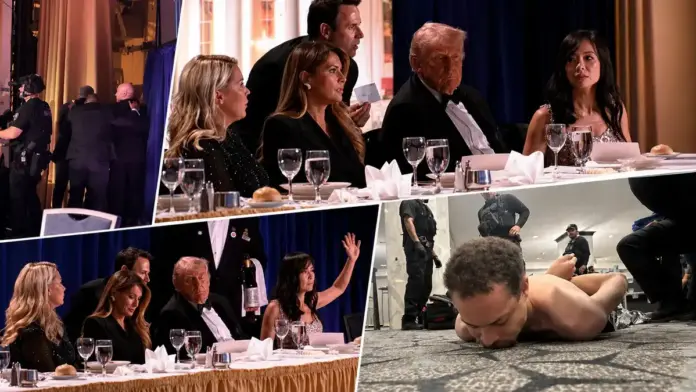
But there is a serious, confirmed event: a gunman attempted to breach security at one of Washington’s most symbolic political-media gatherings, shots were fired, a Secret Service agent was struck in a bullet-resistant vest, President Donald Trump was rushed away unharmed, and the suspect was taken into custody.
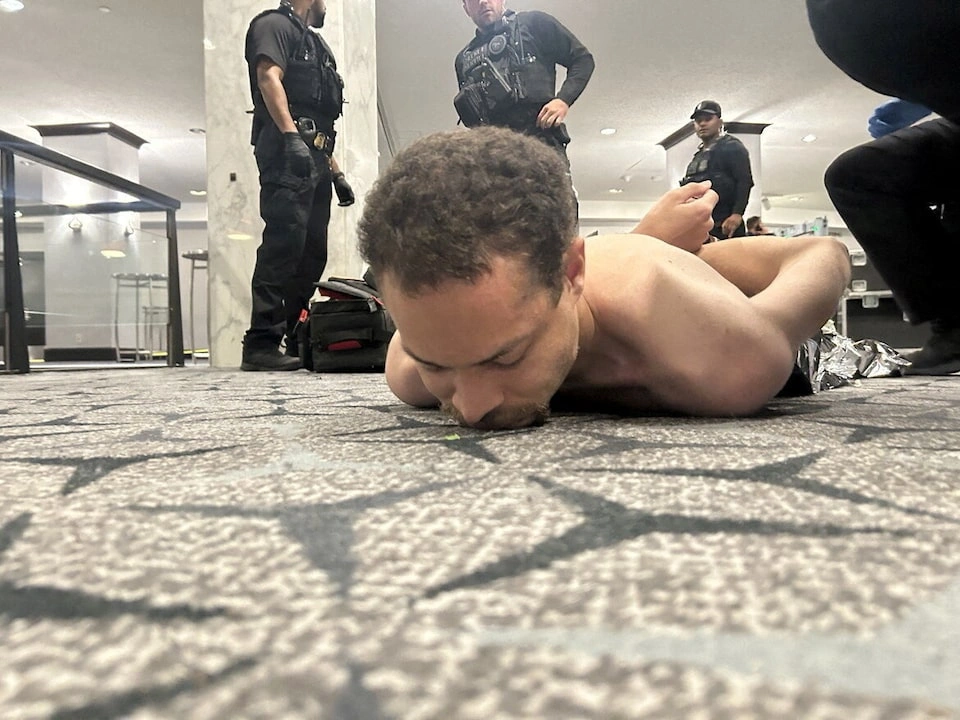
The Associated Press reported that the suspect, identified by authorities as Cole Tomas Allen, 31, of Torrance, California, was arrested after the chaotic encounter at the Washington Hilton.
That is enough to make the event historically heavy. Not because it proves a foreign conspiracy. Not because it allows responsible analysts to connect it directly to Iran, Hormuz, China, Russia, or the IRGC without evidence. But because it shows that the United States is operating under two forms of pressure at the same time: external strategic pressure abroad and internal political violence at home.
Reuters reported that Trump and First Lady Melania Trump were safely evacuated from the dinner after the suspect, armed with a shotgun, attempted to breach security. The event was ultimately canceled, and no federal officials were injured.
That is the core distinction: Trump was not reported injured. The president was unharmed. But the image of a sitting U.S. president being rushed out of a major political event after gunfire carries strategic weight far beyond the room itself.
America can deploy aircraft carriers, pressure Tehran, manage the Strait of Hormuz, coordinate with allies, and confront adversaries. But a superpower is not judged only by the force it projects outward. It is also judged by the stability it maintains at home. When presidential security becomes breaking global news, allies watch, adversaries calculate, and markets absorb another signal of political risk.
What is confirmed
The confirmed facts matter because this is exactly the kind of event where exaggeration spreads faster than verification.
According to the Associated Press, the incident took place at the Washington Hilton during the White House Correspondents’ Association Dinner, where President Trump was in attendance. A man armed with guns and knives stormed the lobby area outside the dinner and charged toward the ballroom, creating a chaotic encounter with Secret Service agents as guests took cover.
The AP reported that a Secret Service agent was hit in a bullet-resistant vest and is recovering. The suspect was arrested, and authorities believe he acted alone at this stage, though the motive remains unclear.
Reuters reported that Trump and other senior leaders were rushed out by Secret Service agents after the gunman attempted to breach security. The same report said Trump later stated that top officials, including the vice president and Cabinet members, were safe.
The Washington Post reported live updates from the scene, including that the FBI’s Washington field office said the suspect was in custody and that agents responded to the Washington Hilton, where the annual dinner was taking place.
Al Jazeera also reported that Trump, Melania Trump, Vice President JD Vance, and Cabinet members were unharmed after shots were fired and the president was rushed out of the event.
These are the facts that can be used safely. Trump was evacuated. Trump was unharmed. A suspect was arrested. A Secret Service agent was protected by body armor. The motive remains under investigation.
What should not be written as fact
This is where editorial discipline matters most.
It should not be written that Trump was shot. Reliable reports say he was unharmed.
It should not be written that Iran, the IRGC, China, Russia, or any “axis” directed the incident. No major verified source has confirmed such a link.
It should not be written that this was a foreign operation unless U.S. authorities or strong independent evidence establish that. At this stage, the AP says authorities believe the suspect acted alone, while the motive remains unclear.
That restraint does not weaken the article. It strengthens it.
A serious news organization does not need to inflate what cannot yet be proved. It needs to show what is known, identify what remains unknown, and explain why the confirmed facts matter.
And the confirmed facts already matter enormously: the U.S. president was present at a major institutional event when gunfire erupted, attendees took cover, the Secret Service moved, and the event was canceled.
That is not a small security incident. It is a symbolic shock.
Why the White House Correspondents’ Dinner matters
The White House Correspondents’ Dinner is not an ordinary gala. It sits at the intersection of the presidency, the press, political power, public ritual, and the image of democratic confidence. It is one of the few annual events where the political class, media institutions, government officials, and public performance of American democracy share the same room.
That is why the location matters.
A shooting at such an event does not only raise questions about physical security. It hits a symbolic space. A dinner meant to represent the relationship between power and the press became a reminder that American political life now operates under the shadow of violence.
The Reuters photo coverage showed scenes of panic, with guests taking cover after Trump and Melania Trump were rushed out by Secret Service agents.
That image travels. It travels to allies. It travels to adversaries. It travels into diplomatic assessments, security briefings, and the information environment.
Even if the security response worked, the scene itself becomes part of the story: the leader of the world’s most powerful country had to be removed from a protected event after gunfire.
That does not mean America is weak. It means America is visibly under strain.
Political violence as an internal front
Political violence in the United States is not new. But it has become more visible, more viral, more psychologically powerful, and more strategically relevant.
A country can possess unmatched military capabilities and still face internal instability. A state can project strength abroad while struggling with violence at home. Those two realities do not cancel each other. They coexist.
That coexistence is the heart of this article.
The United States is not simply managing external crises. It is managing a domestic political environment where threats against leaders, public events, and democratic spaces have become recurring concerns.
This matters because political violence creates a second front. It does not always look like war. It does not always involve foreign actors. But it can shape the strategic behavior of a country by forcing leaders, security agencies, institutions, and the public to operate under permanent tension.
That tension has costs.
It changes how events are organized. It changes how officials move. It changes how the public reads politics. It changes how opponents abroad assess American steadiness.
This is why the incident belongs inside a geostrategic reading, even without a confirmed foreign connection.
The global context: America under external pressure
The incident did not happen in a vacuum.
The United States is operating in a period of heightened Middle East pressure, with Iran, Hormuz, naval power, sanctions, and diplomacy forming an increasingly dense crisis environment. Newsio has already analyzed that broader picture in Iran Under Pressure: Three U.S. Carriers, an Internal Rift, and Diplomacy in the Shadow of Force.
That article’s central point was that diplomacy around Iran is no longer operating in a calm environment. U.S. military pressure, Chinese evacuation warnings, internal Iranian divisions, and the Strait of Hormuz all form one compressed strategic field.
Now the United States has also faced a domestic security shock involving the president.
That does not prove coordination. It does not prove a foreign hand. But it changes the psychological atmosphere.
A superpower under external pressure must show resolve abroad. A superpower facing internal political violence must show institutional control at home. When both pressures unfold at once, the credibility test becomes much harder.
The Iran connection must be handled carefully
The connection to Iran must be made with discipline.
We should not write that Iran was involved. There is no confirmed evidence.
We can write that the incident gains geostrategic weight because it occurred at a time when the United States is managing a high-pressure confrontation with Iran, the Strait of Hormuz remains a global chokepoint, and American naval posture in the region is central to the crisis.
That is a legitimate analytical connection.
It is not about claiming Tehran ordered the attack. It is about recognizing that every major shock to U.S. presidential security becomes part of the global strategic picture.
In geostrategy, what matters is not only who fires the shot. What matters is who uses the image created by the shot.
Adversaries do not need to have caused the event to exploit it rhetorically. They can watch the panic, study the security response, test the public reaction, and calculate how domestic instability affects U.S. decision-making.
That is where the event becomes international without becoming a proven foreign operation.
What adversaries see
America’s adversaries do not always need proof of weakness. Sometimes they only need an image of vulnerability.
A shooting incident at an event attended by the president provides that image, even if the Secret Service responded effectively and the president was unharmed.
The image says: American institutions are protected, but not untouchable. American leaders are powerful, but not physically beyond risk. American political life is open, but that openness has become harder to secure.
That message can be read in multiple ways.
Allies may see a need for steadiness. Adversaries may see domestic strain. Markets may see political risk. Intelligence services may see a security pattern to study. Extremists may see the viral power of spectacle.
That is why the event cannot be treated as a mere local crime story.
It is a domestic security event with international resonance.
Newsio’s earlier analysis, America at the Table with Araghchi: Negotiating with the Polished Face of the Same Threat, examined how credibility matters in diplomacy with Tehran. This incident adds another layer: external credibility is harder to maintain when domestic violence repeatedly pierces the image of control.
The Secret Service as the last physical barrier
The Secret Service is not just a security agency in moments like this. It is the last physical barrier between political life and chaos.
The reported response prevented a far worse outcome. Trump was removed safely. Senior officials were protected. The suspect was detained. The agent’s protective vest appears to have prevented serious injury.
That matters.
But it does not close the question. The success of the response does not erase the fact that the threat reached a highly symbolic event. It does not erase the panic inside the ballroom. It does not erase the need to ask how an armed attacker came close enough to trigger that kind of emergency response.
The system worked at the point of contact.
But the pressure still reached the door.
That is the hard lesson.
Political violence in the age of instant images
Modern political violence is not only physical. It is visual.
The act itself is one layer. The video is another. The social media interpretation is a third. The conspiracy ecosystem is a fourth. Within minutes, real footage, incomplete information, false claims, political narratives, and emotional reactions all collide.
That creates a second attack on public understanding.
People no longer respond only to what happened. They respond to what they think happened, what influencers say happened, what political camps want it to mean, and what adversarial information networks amplify.
This is why careful sourcing matters so much.
AP. Reuters. Washington Post. Al Jazeera. Guardian. Reuters photo coverage. Each adds a layer of verification. No single article should depend on one line from social media, one viral clip, or one partisan claim.
The public needs structure: what is confirmed, what is not confirmed, what remains under investigation, and what can reasonably be analyzed.
That is how a serious outlet protects truth during a fast-moving crisis.
Why the event matters for American power
American power has always rested on more than aircraft carriers, money, technology, and alliances. It also rests on the image of institutional continuity.
A president can be criticized. A government can be divided. Parties can fight. Elections can be brutal. But the world still expects the machinery of American government to function.
When political violence threatens that machinery, the impact spreads.
It affects how allies assess reliability. It affects how adversaries assess timing. It affects how markets price uncertainty. It affects how citizens feel about their own institutions.
This is why the shooting incident at the Correspondents’ Dinner matters beyond Washington.
It shows that America’s global posture now has to carry the weight of internal volatility. That does not mean the United States is collapsing. It means its power is operating under visible stress.
And visible stress changes the way power is read.
The deeper strategic problem
The deeper strategic problem is not that one event occurred. It is that the event fits into a wider pattern of political violence becoming normalized as a risk in American public life.
A democracy can survive disagreement. It can survive protest. It can survive harsh speech. It can survive ideological division. But when physical threats against political leaders become routine enough that every major event is treated like a possible security crisis, the political system begins to change.
Public space hardens.
Security expands.
Distrust grows.
Every gathering becomes a risk calculation.
That is not healthy for a democracy. And it is not invisible to the world.
The United States can still be the strongest power on earth and still face a domestic corrosion problem. Those two truths can coexist.
That is the real maturity of the analysis: America is not weak, but it is pressured; not collapsing, but exposed; not defeated, but forced to defend its political center while projecting power abroad.
The message for readers
The public needs to resist two temptations.
The first temptation is denial: to say this is only another isolated security scare and move on. That misses the symbolic and strategic significance.
The second temptation is reckless certainty: to claim a foreign plot without evidence. That turns analysis into disinformation.
The correct line is harder but stronger.
A gunman attempted to breach security at a major event attended by the president. Trump was unharmed. A Secret Service agent was protected by body armor. The suspect is in custody. The motive remains under investigation. No verified foreign link has been established.
At the same time, the event matters because it happened while the United States is managing major external pressure, including the Iran-Hormuz crisis. It shows that America’s challenge is not only to project power abroad, but to maintain institutional stability at home.
That is the story.
Not panic. Not denial. Not conspiracy.
A sober warning.
The final conclusion
The shooting incident at the White House Correspondents’ Dinner does not prove an international conspiracy. It does not prove Iranian involvement. It does not prove Russian, Chinese, or any other foreign direction.
It proves something else: political violence in America has reached a level where even one of Washington’s most symbolic institutional events can become a scene of armed danger.
Trump is unharmed. The Secret Service responded. The suspect is in custody. The worst outcome was avoided.
But the image remains.
A president rushed from a dinner. Guests taking cover. Federal agents moving through a room built for political ritual, not violence. A superpower forced to defend its own political center while managing external crises abroad.
That is the real lesson.
The United States is not only being tested in the Persian Gulf, in the Strait of Hormuz, or across the negotiating table from Tehran. It is being tested inside its own democratic space.
And a superpower can have carriers, alliances, money, technology, and global reach.
But if its institutional heart trembles every time political violence raises a weapon, its power is challenged from within as well as from without.