


Table of Contents
The Voice of the Adversary: What the Al-Zahar Vision Reveals and Why Such Hamas Leadership Survives
Public debate about Hamas often falls into one of two comforting distortions. The first reduces the organization to a purely local product of Gaza and the Israeli-Palestinian conflict, as though its horizon begins and ends with territory.
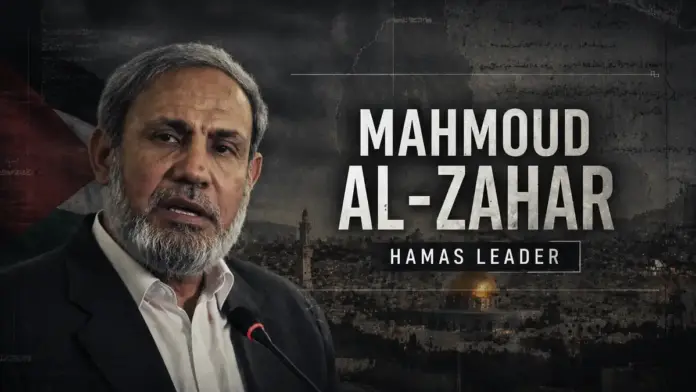
The second turns it into a vague symbol of evil without doing the harder work of reading its own language carefully. Neither approach is enough. The Mahmoud al-Zahar video matters because it forces a more serious reading. In the clip circulated from a December 2022 Al-Masirah broadcast and later highlighted in wider public debate, Al-Zahar says the “Army of Jerusalem” will not liberate only Palestinian land and speaks of a future world without Zionism and “treacherous Christianity.”
That framing was widely discussed in 2023, including by The Jerusalem Post, and the underlying video was translated and surfaced by MEMRI.
This Hamas Commander says this is not about land, not just Palestine. "The entire planet will be under our law, there will be no more Jews or Christian traitors." Only then, if everyone adopts his law, will there be peace. pic.twitter.com/97sWBcH8yJ
— CSW Latinoamérica (@CSWLatAm) October 8, 2023
That does not automatically prove an imminent operational project of global conquest. But it proves something else that is politically important and analytically harder to dismiss: for at least part of Hamas’s leadership rhetoric, the struggle is not presented as merely territorial. It is cast as the opening stage of a much broader ideological mission. That alone changes the frame.
Once the conflict is described by its own spokesman as more than land, the West can no longer pretend it is looking only at a bounded local grievance with no wider civilizational or ideological ambition. This belongs naturally beside Newsio’s English-language analysis The Four-Part Axis and the Siege of the West and Trump, Netanyahu, Europe, and Iran: Why the West Is Splitting, because both pieces already map the wider environment in which ideology, proxies, and anti-Western attrition connect.
“We are not talking only about liberating our land”
This is the line that matters most. As long as the discussion stays at the level of “liberating land,” a Western audience can continue to imagine that it is dealing with an extreme but still basically national-territorial movement. The moment the rhetoric says it is not only about land, the nature of the struggle shifts. It becomes ideological, expansive, and historically open-ended.
That is not a small difference. One kind of movement says: “I want control over a specific place.” Another says: “The local battlefield is part of a larger historical mission.” The first belongs to a negotiable, however violent, political conflict. The second belongs to an ideological project with no natural stopping point, because its horizon is not a border but a worldview. That is why the video has such value as evidence. It does not require the reader to rely on an opponent’s hostile interpretation. The voice is the voice of the speaker himself.
This is the point where media simplification starts to fail. Humanitarian suffering is real. Civilian tragedy is real. But when those truths are used as a filter to remove the ideological content of what leaders in violent movements are saying openly, the public is given only half the picture. Serious analysis does not erase the humanitarian frame. It refuses to let that frame become a screen that hides everything else.
The fantasy of total order
When rhetoric reaches for global prophecy, sweeping religious destiny, or a future world purified of named enemies, it should not be read first as a literal military operations plan. That would be weak analysis.
It should be read as a window into ideological imagination. It reveals what kind of world is viewed as legitimate, what kind of world is seen as temporary, and what kind of world is marked for removal.
That is what gives the Al-Zahar clip its real weight. A future without Zionism and without “treacherous Christianity” is not the language of coexistence. It is the language of a totalizing order in which pluralism survives only if subordinated. The problem is not simply violence.
The problem is the political theology of exclusion: the idea that the rival civilization, faith tradition, or legal-political order does not merely stand in the way but lacks durable legitimacy in the future world being imagined.
That is why this article should not drift into crude generalizations about Muslims, Islam, or entire populations. The object of analysis here is narrower and more precise: a specific political-religious rhetoric of power. Treating it with precision is what gives the argument its strength.
Hamas between ideological core and political adaptation
To make this companion article genuinely strong, it needs the other half of the truth as well. Hamas is not frozen in the language of its 1988 charter alone. In 2017, the movement issued a new policy document that softened part of its public language, accepted the idea of a Palestinian state on the 1967 lines as a formula of national consensus, and tried to project a more politically calibrated image.
Reuters covered that shift at the time, while also making clear that the document did not amount to recognition of Israel or abandonment of armed struggle.
That distinction matters because a large part of Western commentary tends to overread tactical moderation as ideological transformation. The 2017 text mattered, but it did not erase the deeper worldview. In fact, that is precisely why the Al-Zahar video is so important.
It cuts through the most polished policy language and brings the underlying horizon back into view. It reminds the reader that political adaptation and ideological continuity can coexist inside the same movement.
This is where the article gains depth. It stops being a polemical reaction to one clip and becomes a more serious argument: Hamas has shown an ability to move between diplomatic repositioning and harder ideological signaling depending on audience, context, and strategic need. That is not unusual in militant political movements. But it is vital to understand.
Why such leadership survives
The next hard question is the blunt one: if the rhetoric is this explicit, why do such figures remain active, influential, or politically useful for so long?
The answer is not moral. It is geopolitical.
First, because leadership in movements like Hamas is often dispersed across internal and external nodes. Some figures operate inside conflict zones. Others function through outside capitals, mediation channels, protected political offices, or states that see value in hosting, containing, or leveraging them.
Reuters reported in late 2024 that the United States warned Turkey against hosting Hamas leaders, while Qatar remained central to ceasefire mediation efforts and broader diplomatic contacts. That alone shows how complicated the ecosystem around the movement is. These are not just fugitives moving in a vacuum.
They are embedded in a layered regional structure of pressure, mediation, patronage, and utility.
Second, because such leaders are not only targets. They are also bargaining assets. In environments where hostage negotiations, ceasefires, backchannel communication, prisoner exchanges, and crisis management all move through semi-formal or indirect channels, not every state actor sees the total elimination of political leadership as automatically beneficial.
That is a brutal truth, but a real one. Figures can be both dangerous and useful at the same time. In geopolitics, usefulness often extends life.
Third, because elimination itself is rarely as clean as popular rhetoric suggests. Reuters’ 2024 profile of Hamas leadership noted that Al-Zahar had not appeared publicly after October 7 and that his status was unknown at the time. That detail matters. It does not weaken the ideological argument; it strengthens the analytical one.
It shows that public influence can persist even when the exact physical condition or location of a figure is unclear. The body may disappear from view while the ideological residue remains politically active.
The media problem: humanitarian framing without ideological substance
The problem is not that major media outlets discuss the humanitarian disaster. They should. The disaster is real. The problem begins when humanitarian language becomes the entire interpretive frame and ideological substance is pushed out of view. Once that happens, the public is left with a conflict stripped of the worldview of the actors inside it.
That is where this chapter becomes genuinely important. The Al-Zahar material should be treated as Exhibit No. 1, but in the right sense. Not as mystical proof of every maximalist theory someone wants to attach to it. Rather, as the clearest available piece of evidence that at least part of Hamas’s leadership rhetoric places the struggle inside a wider ideological and civilizational frame. That is enough. In fact, it is more than enough.
And that is exactly why the article becomes stronger, not weaker, when it resists exaggeration. The evidence is already heavy. It does not need inflation. It needs clarity.
The other danger: overstatement
There is, however, a danger on the opposite side. Once such video material appears, there is a temptation to load it with too much meaning, to turn it into proof of every future scenario, every fear, every totalizing claim. That is where analysis starts to loosen. Once it loosens, critics can attack the weakest overstatement and then try to discredit the whole argument.
That is why the strongest Newsio line is the disciplined one. The article should say this:
The Al-Zahar video is not proof of a fully formed global operational blueprint.
It is powerful evidence of an expansive ideological horizon.
It does show that the movement’s self-presentation, at least in part, reaches beyond Gaza.
And it does expose the weakness of any analysis that insists on treating the conflict as purely humanitarian or purely local.
That is already a major conclusion. It does not need dramatization to become serious.
The strongest outbound link
For the external anchor, the strongest fit in this article is The Jerusalem Post report that brought the Al-Zahar clip into wider public view and highlighted the specific language about “510 million square kilometers” and “treacherous Christianity.” It belongs naturally in the section where the article first explains why the video matters as political evidence.
A clean in-text version would read like this:
The video discussed publicly in 2023 matters because it captures Al-Zahar describing the struggle in language that goes far beyond Gaza or a bounded territorial dispute.
That link works because it supports the precise point where the article shifts from general framing to the quoted ideological content itself.
Final conclusion
The Mahmoud al-Zahar video is not a minor extremist fragment at the edge of the story. It is dense ideological material. It shows that for at least part of this leadership culture, the struggle does not stop at Palestine, does not end at Israel, and does not recognize the Western order as a legitimate framework of coexistence. It sees that order as a rival civilization. And that by itself is enormous.
The second hard truth is that such leadership survives not simply because “nobody does anything,” but because it exists inside networks of protection, utility, mediation, and regional entanglement that make simple military logic insufficient.
The third truth may be the most uncomfortable for the West: as long as Western publics are encouraged to read these conflicts through only half the frame, they will continue to be surprised by things that had already been stated openly in front of them.
That is the real force of this companion article. Not that it uncovers a hidden secret, but that it takes seriously the voice of the adversary when that voice says, in effect, that the struggle does not end where many in the West would prefer to believe it ends.