

Table of Contents
The first battlefield is not the city — it is your judgment
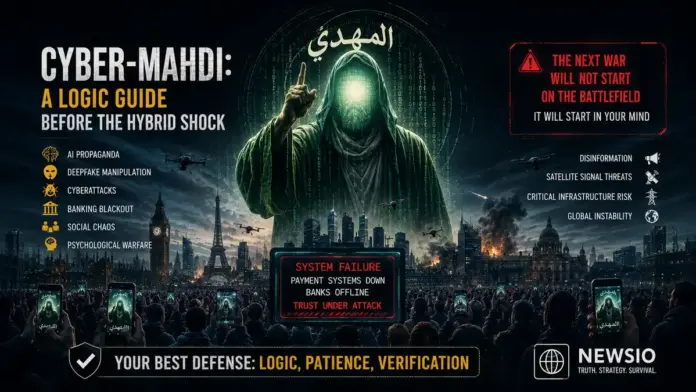
Cyber-Mahdi should not be read as prophecy, certainty or panic. It should be read as a serious hybrid-shock scenario: a possible digital provocation that could attempt to turn the screen, the bank, the religious symbol, the deepfake, the social media feed and institutional hesitation into one field of conflict.
The critical point is not whether such a lie would convince everyone. It does not need to. In hybrid warfare, the lie does not need to win the majority. It needs to win time. It needs to confuse enough people, delay institutions, activate small radicalized nodes, create lines at banks, produce fear, flood the public square with rumors and make the state look slower than the crisis.
That is the real lesson: the first battlefield is not the city. It is the citizen’s judgment. If the citizen reacts before thinking, shares before verifying, panics before understanding, the provocation has already found fuel.
Why this scenario is not science fiction
Cyber-Mahdi does not emerge from nothing. It sits on real trends: AI, deepfakes, cyberattacks, critical infrastructure risk, digital banking dependence, religious propaganda, information operations and the geostrategic crisis around Iran.
U.S. cybersecurity agencies have warned that Iranian-affiliated cyber actors have targeted internet-exposed programmable logic controllers in critical infrastructure — systems that can affect real-world operations in sectors such as water, energy and public services. That is not an abstract fear; it is a technical warning about a real attack surface. Iranian-affiliated cyber actors targeting critical infrastructure
Europol has also warned that deepfake technology can affect law enforcement, citizens and public trust because AI can generate convincing audio and audio-visual material that makes it harder to distinguish real content from manipulated content quickly. Europol’s deepfake report
So the question is not whether deception technology exists. It does. The question is whether a geopolitically pressured actor, supported by state services, proxies, money, trained personnel and international networks, could combine technological deception with a real social crisis.
The answer is yes. That is why public logic must be trained before the storm.
The truth that gives birth to the lie
The most dangerous lie of the new age does not come from nowhere. It grows on top of a real crisis.
It stands on real war. Real economic pressure. Real banks. Real payment networks. Real fear. Real technology. Real religious expectation. Real social fatigue.
That is why it is more dangerous than the old lie. It does not need to invent the whole world. It only needs to distort the world already burning.
A deepfake does not need to survive forever. It only needs to survive for a few hours — long enough for authorities to hesitate, streets to fill, payments to freeze, ATM lines to appear and fear to start behaving like reality.
Newsio has already examined this core danger in its original analysis of Cyber-Mahdi and hybrid war against the West: the problem is not only false content. It is the real behavior that false content can produce.
Phase One: the silence before the shock
Before a major information strike, the public rarely sees the attack clearly. It sees instability.
Small disruptions. Strange delays. A sudden rise in rumors. Accounts appearing at once with the same language. The same hashtags. The same anger. The same certainty. The same effort to present one narrative as already global.
At this stage, the attacker does not need to bring down the entire system. It needs to create noise.
Noise in information. Noise in markets. Noise inside communities. Noise inside trust.
The first sign for the citizen is artificial coincidence. When unrelated accounts, in several languages, suddenly push the same message with the same emotional intensity, the public may not be seeing spontaneous reaction. It may be seeing coordination.
Phase Two: the digital spark
The central shock does not need to be perfect. It needs to be fast, emotional and believable enough to create doubt.
A face in a video. A supposed apocalyptic appearance. A phrase presented as a call. Parallel translations. Voice notes. Cropped clips. Fake breaking-news posts. False confirmations from accounts impersonating journalists, institutions or authoritative figures.
The message will not simply say “believe.” It will pressure the user to act.
“The moment has arrived.”
“Governments are hiding the truth.”
“Share it before they remove it.”
“Do not wait for official media.”
That is the trap. When a message pressures you to share it immediately “before it disappears,” it is not informing you. It is recruiting you as a distributor.
Phase Three: the psychological multiplier
The critical stage is not the first video. It is the adaptation of that video.
The same material will appear differently to each audience.
In religiously charged environments, it will be framed as a sign. In anti-Western networks, as proof of Western collapse. In communities under social pressure, as a call to react. To a broader audience, as a strange event that “cannot be explained.” To political extremes, as evidence that “the system is falling.”
The same lie will wear many uniforms.
In the first hours, the goal is not necessarily a full uprising. The goal is overload. Small gatherings. Rumors of incidents. Counter-gatherings. Police confusion. False and real reports mixed together. No one knows which image is current, which is old, which is staged and which is real.
The central rule is simple:
The first wave of a hybrid attack does not ask you to believe. It asks you to react before you think.
Phase Four: the banking and social shock
If the information shock is paired with disruption in payments, e-banking, cards or basic digital services, the lie begins to ride on real fear.
The citizen does not need to believe the deepfake. It is enough to see that the card does not work.
Then the crisis changes level.
Lines at ATMs. Delays in mobile banking. Supermarkets asking for cash. Gas stations under pressure. Small businesses confused. Social media full of rumors. Politicians trying to reassure the public before they have a full technical picture.
At that moment, the false narrative connects with real experience.
The video may be fake. The outage may be real. Fear becomes real. Social reaction becomes real.
That is the most dangerous model: the lie does not replace reality. It climbs onto it.
Why Hormuz belongs in the same scenario
This scenario is not only digital. It is geostrategic.
The Strait of Hormuz is one of the world’s most critical energy chokepoints. The U.S. Energy Information Administration describes Hormuz as one of the most important passages for global oil flows, and in periods of regional conflict its importance multiplies. World oil transit chokepoints
If there is an information crisis, banking confusion and energy pressure at the same time, markets will not wait for complete institutional analysis. They will price fear.
That is the logic of the modern crisis: one event does not need to be enough by itself. It is enough for many events — real and false — to strike different nerves of the same system at the same time.
Newsio has already explained why the pipelines that bypass Hormuz are not a technical detail but a matter of geostrategic security. When oil, payments, screens and social trust enter the same frame, the crisis stops being only energy-related or only digital. It becomes systemic.
Europe as a test field for trust
European cities would not only be tested by police and security services. They would be tested by the speed of understanding.
Brussels, Paris, London, Berlin, Marseille, Amsterdam, Malmö — every major city with social diversity, political fatigue, religious communities, online networks, reactions and counter-reactions can become an information stress test.
The critical issue is not Muslim citizens as a whole. That must be stated clearly: there is no collective obedience and no collective guilt. The threat lies in small radicalized nodes, influence networks, closed channels, propaganda hubs and people already trained to view the world through anti-Western hostility and apocalyptic expectation.
Newsio has already analyzed this in its article on Islamism in Europe and the West that knows but will not say it. The issue is not ordinary faith. It is the mechanism that tries to turn faith, identity and social pressure into political leverage.
Five signs that you may be watching an AI provocation
1. The message demands immediate sharing
If a video, post or voice note says “share this now,” “they will remove it,” or “do not wait for confirmation,” it behaves like a distribution mechanism.
Truth does not fear verification. A provocation does.
The first rule is simple: the more a message pressures you to share it immediately, the more you must stop.
2. The image is spectacular but the source is unclear
If everyone is showing the same video but no one can identify the original source, time, place, first upload and credible verifier, you do not have a fact. You have material for examination.
“I saw it everywhere” is not proof. It may be the result of the operation.
3. Accounts speak with the same language
When dozens or hundreds of profiles use similar phrases, identical hashtags, the same emotional intensity and the same call to action, coordination is possible.
Spontaneous society has variety. Influence operations have uniformity.
4. The video looks “too perfect” or strangely theatrical
AI content can show unnatural lighting, strange facial movement, lip-sync mismatch, unstable shadows, distorted hands, odd skin texture, excessive clarity or a voice without natural breath.
No single sign proves manipulation by itself. But several signs together mean: stop, do not share, wait for verification.
5. The content immediately connects a religious symbol with a practical order
If a supposed sacred or apocalyptic message immediately becomes a call to action, gathering, attack, disobedience or mass mobilization, this is not faith. It is operational use of faith.
That is the most dangerous sign. When the symbol becomes an order, the citizen must understand that someone is trying to move him.
What the citizen should do in the first minutes
The citizen does not need to become a cybersecurity expert. He needs to keep his judgment.
- Do not share.
- Do not comment with certainty.
- Do not go to a gathering because “everyone saw it.”
- Do not trust a screenshot.
- Do not trust a voice note from an unknown chain.
- Do not make financial decisions in panic.
- Do not let a video impose behavior on you before you understand what you are seeing.
Keep three things: time, sources, calm.
In a hybrid crisis, calm is not passivity. It is defense.
What institutions must do if they do not want to lose the first wave
Governments cannot wait for the internet to calm down. They must speak quickly, clearly and repeatedly.
They must say what they know. They must say what they do not know. They must give a specific time for the next update. They must ask citizens not to circulate unverified material. They must protect religious communities from collective targeting. They must target manipulation networks, not ordinary citizens.
If the state stays silent, the lie will speak.
If the state speaks vaguely, conspiracy will speak.
If the state speaks late, the provocation will already have found its audience.
The technical layer of defense is necessary: platforms, cybersecurity, banks, telecommunications, intelligence agencies, police and international cooperation. But the public layer is just as critical. Citizens must hear clear language before false certainty fills the gap.
Why Russia and China do not need to appear as directors
In modern hybrid warfare, there does not always need to be one central director controlling everything.
Sometimes a convergence of interests is enough.
An Iranian or pro-Iranian narrative can be amplified by Russian and Chinese information ecosystems without visible unified command. It can be translated, repackaged, inflated, presented as “global resistance” to the West, and pushed by state media, proxy media, bots, influencers and networks that share one interest: making the West look weak, slow, hypocritical and unable to protect its own societies.
Newsio has already examined this framework through The Four-Part Axis and the Siege of the West: Russia, China, Iran and North Korea do not need to love one another or share one vision. It is enough that they share an interest in eroding Western trust.
The final lesson: do not become the fuel of the provocation
Cyber-Mahdi as a scenario is not only about Iran, Russia, China or the West. It is about the new world.
AI can make fantasy believable enough to touch reality. A deepfake can stand on top of a real war. A cyberattack can stand on top of real banking dependence. A religious image can stand on top of real eschatological expectation. A rumor can stand on top of real social fatigue.
The lie does not need to become truth. It needs to produce real behavior.
That is the new battlefield.
- Not only state against state.
- Not only army against army.
- Not only hacker against server.
- But the lie against the citizen’s judgment.
And there the most important rule is simple:
If an event orders you to react before you understand it, it is probably not informing you.
It is using you.