


Table of Contents
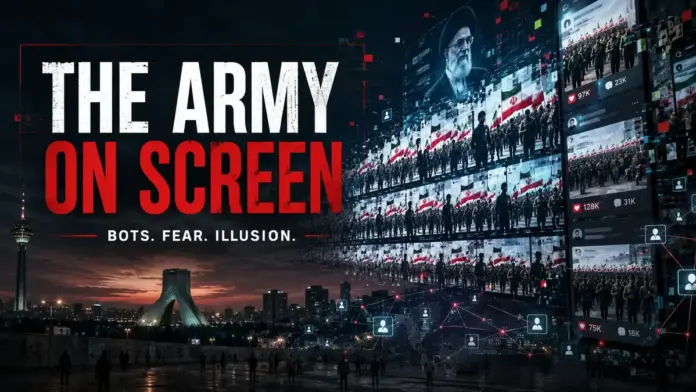
The army that exists only on screen
When a regime loses rhythm on the real battlefield, it tries to win in the only space where defeat can be hidden: the screen. There, it does not need real divisions, logistics, supply lines or military cohesion. It needs images, bots, old footage, cut clips, hashtags, AI amplification and enough fear to make the opponent see an army where there is mostly staging.
That is what the myth of “30 million soldiers in the streets” reveals. It does not need to prove that 30 million armed people actually exist. It needs the viewer to believe that they might. The lie is not asking for logical acceptance. It is asking for nervous reaction. It wants to create the impression of an endless force, a fully mobilized people, a theocratic mass moving as one body.
The reality is colder. Iran does not need to display such an army. It needs to manufacture the illusion of one. And that illusion is the prelude to the same mechanism Newsio analyzed in the Cyber-Mahdi hybrid-war scenario: an information operation that does not need to convince everyone, but only to infect enough people, delay truth and make fear behave like reality.
The mathematical absurdity of “30 million”
The first point is simple: numbers do not forgive propaganda.
Iran’s population is a little above 90 million people, with World Bank data placing the country at roughly 91.5 million people in 2024. If someone claims that 30 million people are in the streets as an armed force, he is not merely describing a “large mobilization.” He is describing almost one third of the entire country.
That would mean millions of men, women, elderly citizens, workers, students, farmers, employees, professionals and families had all been transformed at once into an endless military procession. It would require movement, food, control, equipment, communications, organization, transport, visibility and logistics on a scale that could not be hidden behind blurred clips and viral posts.
That is why the claim should not be read as a real military picture. It should be read as psychological warfare. The regime is not simply saying, “look at our soldiers.” It is saying: “fear our scale.”
Tehran is not showing an army — it is staging the feeling of an endless mass
Tehran understands the power of the image. A clip from a religious gathering, a state ceremony, a funeral, a Basij mobilization or an organized regime march can be edited and algorithmically amplified until it looks like national military mobilization.
The Basij is not imaginary. It is a real paramilitary force inside the Islamic Revolutionary Guard Corps ecosystem, built as an ideologically charged militia with a role in regime mobilization and internal control. But that does not mean every image of a crowd is a real war mobilization. It does not mean every gathering equals military power. Britannica’s overview of the Basij
This is the point: the regime can use real structures to manufacture an exaggerated image. It can take real crowds, real symbols, real ceremonies and real ideological discipline, then present them as something far larger than they are operationally.
That is not casual exaggeration. It is a strategy of visibility.
Why Tehran needs the “digital victory”
Digital mobilization is not directed only at the West. It is aimed first at Iran itself.
A pressured regime must convince its own population that it remains untouchable. It must convince frightened, tired or angry citizens that the state machine still controls the country. It must convince its own officers that the command chain has not broken. It must convince proxies that Tehran remains a center of power, not a wounded headquarters.
That connects directly with Newsio’s earlier analysis of the Iran axis and command strangulation. The Iranian network is not pressured only because it loses facilities or people. It is pressured because it loses continuity, command rhythm and operational confidence.
When real command is under pressure, the image must scream. When the battlefield does not produce victory, the regime manufactures victory in the feed. When depots burn, hashtags multiply. When new commanders hide, videos show oceans of people.
That is the mechanism of digital victory: win the impression where you cannot guarantee the reality.
Propaganda does not need to be perfect — it needs to be fast
Old propaganda wanted monopoly. New propaganda wants speed.
Not every video needs to be perfect. Not every image needs to survive forensic analysis. Not every claim needs internal coherence. It only needs to appear fast enough, loud enough and coordinated enough to outrun verification.
Microsoft has documented how Iranian state-linked actors use cyber-enabled influence operations, including efforts that combine technical disruption, fake personas, fabricated media and amplified narratives. In one case, Microsoft reported that a persona linked to Iranian activity disrupted streaming television services and pushed a fake broadcast featuring an apparently AI-generated anchor.
That is the model. When there is not enough physical success, increase the informational effect.
The most important line is this: propaganda does not need to prove that it is winning. It only needs to make the opponent wonder whether he is losing.
The virtual army as a prelude to Cyber-Mahdi
The image of “30 million” is not just another exaggerated war meme. It is psychological conditioning.
It trains the audience to imagine an endless, blind, mass force. It teaches the viewer to picture Tehran as a center capable of moving millions of bodies with a signal. It builds the background so that, if a larger digital provocation appears later, the audience’s imagination is already prepared.
That is the invisible layer. Before a digital button is pressed, the public must first be trained to believe that the button can move masses. Before a deepfake call appears, the idea must be planted that millions are already waiting to respond.
That is why Newsio’s Cyber-Mahdi logic guide is not theoretical. It is anti-propaganda defense. It teaches the citizen to stop before sharing, verify before believing and refuse to become the fuel of a provocation.
The strategy of visibility: if you cannot win, become visible everywhere
Tehran knows the West is vulnerable to the image of the crowd. A crowd on a European screen quickly becomes political emotion: fear, doubt, fatigue, guilt, insecurity.
If the average Western viewer believes he is facing an endless army of people moving in blind obedience, Tehran has already won something without firing a shot: it has gained space inside his imagination.
That is geostrategic. Fear changes political decisions. It affects markets. It pressures governments. It feeds extreme reactions. It creates social paralysis. It makes the West see masses instead of mechanisms, ghosts instead of precise networks, panic instead of analysis.
Tehran does not need 30 million people in the streets. It needs the West to behave as if they are there.
Where Russia and China enter the frame
It is not necessary to prove that Moscow or Beijing direct every image, bot, video or narrative. That is rarely visible in real time.
The practical model is more subtle: amplification, exploitation, translation, distribution and opportunistic recycling.
The European External Action Service has described Foreign Information Manipulation and Interference as a strategic threat and has built a framework aimed at making such activity costlier and less sustainable for perpetrators. Its 2026 FIMI threat report shows that democratic societies now treat information manipulation not as background noise, but as a security problem.
Newsio has already mapped this logic through The Four-Part Axis and the Siege of the West: Russia, China, Iran and North Korea do not need one command room to benefit from the same erosion of Western trust.
They do not need to agree on everything. They only need to benefit from the same image: a West that is afraid, slow, confused and unsure whether it is seeing reality or theater.
The lie of numbers and the truth of functions
A shallow reading asks only: “Are the 30 million real?”
The deeper question is different: “What function does this claim serve?”
If the number is false, that does not make it irrelevant. It means it serves a psychological function. It wants to convince regime supporters that they are many. It wants to frighten opponents into thinking they are outnumbered. It wants to show proxies that Mother Tehran has not bent. It wants to discourage internal rivals from believing that the regime is vulnerable.
The number is not statistics.
It is a weapon.
And when a number becomes a weapon, the right defense is not only to say “it is false.” It is to explain why it was created.
State actors, AI visuals and the new fog of war
The Iran war has already shown how visual misinformation can flood the battlefield faster than ordinary verification can respond. AP reported that state actors were behind much of the visual misinformation about the Iran war, including AI-generated or recycled footage pushed by Iranian state actors and allied propaganda networks.
Wired also reported that fake AI content about the Iran war spread widely across X, with fabricated images and videos amplified through platform dynamics and by accounts seeking attention or influence.
This matters because the “30 million” narrative belongs to the same ecosystem. It is not just one claim. It is part of a visual war in which crowds, fires, missiles, flags, funerals and old footage can be rearranged into a synthetic battlefield.
The viewer thinks he is watching evidence.
In many cases, he is watching construction.
The church of hypocrisy is built from pixels
The regime that speaks of sacrifice often hides its powerful men. The regime that speaks of the people often fears its people. The regime that speaks of divine mission often needs bots to look invincible. The regime that speaks of resistance often needs staging to hide weakness.
This is not theology. It is power machinery.
The “church” of this hypocrisy is not built only with sermons. It is built with pixels. Clips. Reposted videos. Artificial scale. Accounts that appear independent but speak in the same language. AI that makes the crowd look more endless, the image more imposing and the fear more immediate.
This is the new propaganda: it does not only tell you what to believe. It shows you an image that makes belief feel like instinct.
The citizen must learn to ask different questions
When an image of “mass mobilization” appears, the citizen should not first ask whether it frightens him. He should ask:
- Who posted it first?
- When was it filmed?
- Where was it filmed?
- Is there independent confirmation?
- Is it old footage?
- Is it from a religious ceremony?
- Is it from a state-organized rally?
- Why is it appearing now?
- Who benefits if I believe it?
- Who benefits if I share it?
These questions are not theory. They are defense.
In information warfare, the citizen is not only a viewer. He is a target, a node and a potential amplifier.
The real battlefield is not the crowd — it is the imagination of the opponent
The most dangerous part of the “30 million” myth is not the claim itself. It is the emotional image it plants.
- It tells the viewer: “You are surrounded.”
- It tells the proxy: “Tehran is still strong.”
- It tells the Iranian citizen: “Resistance is everywhere.”
- It tells the Western public: “This cannot be contained.”
- It tells the market: “Instability is larger than the map shows.”
- It tells the government: “Move carefully, because the street may ignite.”
This is why digital mobilization matters. It does not need to correspond to real operational power. It only needs to influence how other actors price risk.
A state can lose material capacity and still try to inflate psychological capacity. That inflation becomes a tool. It buys time. It preserves morale. It delays collapse. It confuses enemies. It signals proxies. It intimidates weak politicians.
But it also reveals fear.
A confident regime does not need to invent endless crowds.
The final conclusion: there is no army of 30 million — there is an army of impressions
Iran does not need to send 30 million people into the streets to create fear. It needs the screen to look like the street and the edit to look like reality.
That is the key.
The army the viewer sees is not necessarily an army of bodies. It is an army of impressions. Digital mobilization. Information parade. Psychological theater. An attempt to present wounded power as endless force.
But the screen is not the battlefield.
The battlefield measures command, logistics, fuel, networks, people who truly obey, routes that still function, depots that do not burn, leaders who do not hide and systems that endure.
Propaganda measures views.
And when a regime moves too much of its power into views, it is not showing omnipotence.
It is showing fear.
That is what the reader must understand: the image of “30 million” is not proof of strength. It is proof of need. If Tehran were as stable as it wants to appear, it would not need to build endless armies inside the screen.
It would have them on the field.