

Table of Contents
The West does not lack information — it lacks the courage to speak plainly
The West is not blind because it does not know. Its governments, security agencies, universities, intelligence communities, think tanks, and counterterrorism institutions know that political Islam is not only a question of religion, migration, poverty, discrimination, or integration. It is also a question of power: who defines authority, who controls communities, who interprets sacred language, who speaks for minorities, and who uses liberal freedoms to build illiberal leverage.
The public problem begins when this knowledge is translated into softened language. Words such as Islamism, separatism, radicalization, parallel societies, extremist ideology, and foreign influence are often wrapped in bureaucratic caution. Sometimes that caution protects social peace. Sometimes it protects innocent citizens from collective blame. But when it becomes a habit of evasion, it also protects the very networks that open societies need to confront.
This article does not accuse Muslims as a collective. That would be false, unjust, and strategically self-defeating. The real issue is sharper: Islamist, theocratic, and extremist networks can use faith, migration, minority insecurity, community pressure, legal gaps, and democratic tolerance as fields of influence. When the West refuses to name that mechanism clearly, it does not protect Muslim citizens. It protects the actors who want to use them.
The first lie: “There is no problem, only prejudice”
The first distortion says that every concern about Islamism is simply Islamophobia. That is not true. Anti-Muslim hatred exists. It is real. It must be confronted. But its existence does not erase Islamism as a political problem.
The distinction is everything. A Muslim citizen who wants to live freely, work, raise a family, worship or not worship, and participate in public life is not the problem. An Islamist network that seeks to turn religious identity into political discipline is a problem. Religious liberty is not the problem. The organized attempt to replace common civic law with community pressure, theocratic authority, or ideological obedience is the problem.
The United Kingdom’s own government recognized that extremist activity can aim to erode or replace liberal parliamentary democracy. Its 2024 new definition of extremism explicitly refers to ideologies based on violence, hatred, or intolerance that seek to undermine fundamental rights or democratic institutions. That definition is not limited to Islamism; it also covers far-right and other extremist ideologies. But it proves one thing: democratic states know that some movements use freedom against freedom.
That is the first clean line. Europe does not need hatred. It needs clarity.
The second lie: “Everyone who comes to Europe automatically wants integration”
Many people who came to Europe from Muslim-majority countries were looking for safety, work, dignity, and freedom. Many fled war, dictatorship, sectarian violence, corruption, poverty, or Islamist oppression. That must be said clearly.
But there is a second truth that Europe often fears saying: physical arrival in a free society does not automatically create civic integration. Crossing a border is not the same thing as accepting the constitutional, cultural, and moral framework of the country where someone settles. Integration is not paperwork. It is a political and civilizational shift.
A person can work inside a Western economy, use Western infrastructure, benefit from Western rights, appeal to Western courts, and still reject the moral architecture of the society that protects him. A person can use democracy as a shield without accepting democracy as a principle.
That does not describe everyone. It must never be turned into a collective accusation. But it happens often enough to become a political problem. And anyone who refuses to see it is not defending social peace. He is anesthetizing it.
The third lie: “The word Islamophobia ends the discussion”
The word Islamophobia has a legitimate use when it describes hatred, prejudice, discrimination, or hostility toward Muslims as people. If someone is targeted because of a Muslim name, clothing, prayer, ancestry, or religious identity, that is an issue of dignity and freedom.
The European Union Agency for Fundamental Rights has documented real discrimination and hostility faced by Muslims in Europe through its report Being Muslim in the EU. That evidence matters because a serious article must not pretend that anti-Muslim prejudice is imaginary. It is not.
But the same word can become a weapon of silence when it is used to block every criticism of Islamism, theocracy, religious separatism, antisemitic preaching, gender coercion, or the political use of faith. At that point, the word no longer protects the vulnerable. It protects the mechanism.
The distinction is decisive. Criticism of Islamism is not hatred of Muslims. Criticism of a preacher who promotes domination is not an attack on a faith. Criticism of parallel legal pressure is not racism. Criticism of theocracy is not persecution of the ordinary believer.
Newsio has already insisted on this distinction in Islam, Jihad, and Extremism: What They Really Mean and Where Distortion Begins. Confusion helps two enemies at once: anti-Muslim bigots and Islamist networks. Clarity weakens both.
Paris and London: not “occupied,” but stress-tested
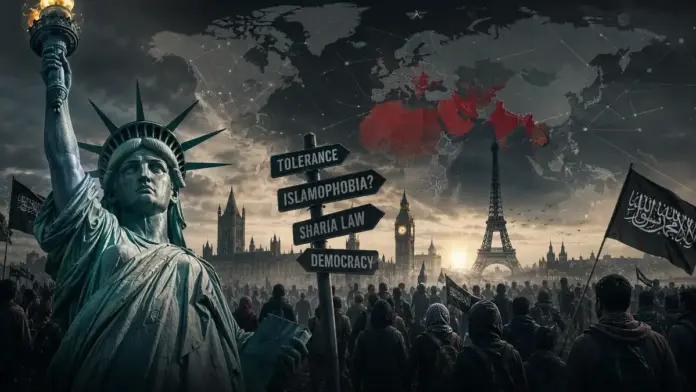
Paris and London are not “occupied cities” in the military sense. That phrase is visually strong but analytically inaccurate. They are something more revealing: stress tests for liberal democracy under demographic, cultural, security, and institutional pressure.
London is one of the world’s great plural cities. According to the 2021 census release for London, 1.32 million residents identified as Muslim, about 15% of the city’s population. Across England and Wales, the Muslim population rose from 2.7 million in 2011 to 3.9 million in 2021. the 2021 census release
France also has a major Muslim population. INSEE’s work on religious diversity in France states that Islam confirmed its place as France’s second religion, with 10% of people aged 18 to 59 in metropolitan France identifying as Muslim in 2019–2020.
These numbers do not prove a threat. They prove a transformation. And transformation requires state capacity, civic confidence, and a clear integration model. If integration works, demographic change can enrich a society. If it fails, it can produce segregation, community pressure, parallel authority, resentment, and recruitment space for Islamist networks.
The problem is not presence — it is parallel authority
A European democracy should not fear the presence of different religions. It should fear the emergence of parallel authorities that claim obedience above the state.
The problem is not a mosque as a place of worship. It is a network that uses a mosque, school, association, charity, family structure, social pressure, or foreign funding to create a closed political body. The problem is not a headscarf as a personal choice. It is coercion when dress becomes a test of obedience. The problem is not religious identity. It is the conversion of identity into political isolation.
France recognized this danger through its debate over separatism and its 2021 law reinforcing respect for the principles of the Republic. The legal text is available through Légifrance. That law was controversial, and critics warned that it could stigmatize Muslims. But the debate itself proved that France understood the deeper issue: the republic cannot survive if large communities begin to operate under competing systems of authority.
This is the narrow path Europe must walk. If it does nothing, it abandons space to networks of control. If it acts without precision, it can push innocent citizens into suspicion and feed extremist propaganda.
Dar al-Islam, Dar al-Harb, and the modern distortion of old categories
Dar al-Islam and Dar al-Harb belong to classical Islamic legal thought. Historically, they described zones under Muslim rule and zones outside it. They do not form a single modern program followed by all Muslims. Muslims across the world interpret political life, citizenship, law, and pluralism in very different ways.
But these categories matter because they can be reactivated politically. When an old legal distinction becomes a modern map of belonging and conflict, the issue is no longer simply theology. It becomes political geography.
The danger is not that every Muslim in Europe sees Europe as hostile territory. That claim would be false. The danger is that certain Islamist networks can cultivate exactly that consciousness: that the host society is not a shared civic home, but a temporary field of use, pressure, separation, or eventual transformation.
This is where the West often fails. It treats integration as social service delivery. The opposing mechanism treats it as a conflict of loyalties.
Democracy as a tool until it becomes an obstacle
The hardest point is this: some Islamist currents can use democracy not because they accept it as the final framework, but because they see it as an instrument. Voting rights, freedom of religion, anti-discrimination law, free speech, association rights, public funding, academic language, and human-rights vocabulary can all become tools of influence.
This is not unique to Islamism. Every anti-democratic ideology can use democracy to weaken democracy. Totalitarian movements did it in twentieth-century Europe. Today, far-right networks, extremist leftist groups, foreign influence operations, and theocratic movements can all exploit liberal systems.
The difference with Islamism is that it can hide inside the protective shell of religious identity. When political ideology is embedded inside faith, criticism becomes harder. Analysts fear accusations of bigotry. Politicians fear electoral cost. Institutions fear appearing discriminatory. Networks gain time.
That is why the distinction must be absolute: full protection for Muslim citizens as citizens; full resistance to any political-religious network that seeks to replace democratic sovereignty with illiberal communal authority.
The Mahdi, eschatology, and the West’s translation error
The West often struggles to take eschatology seriously. It treats it as folklore, symbolism, or irrelevant theology. That is a mistake.
In Islam, Jesus is not Muhammad. Jesus is regarded as a major prophet and the Messiah; Muhammad is regarded as the final prophet. The Mahdi is a separate redemptive figure in Islamic eschatological traditions, especially central in Twelver Shi’a thought, although not explicitly named in the Qur’an.
These distinctions matter. They are not academic decoration. They can become political material when regimes or movements convert them into a historical script.
Newsio’s analysis of Islamic Eschatology: The Mahdi, the Final Confrontation, and the Geopolitical Depth of Belief explains why end-times belief must not be caricatured or dismissed. In some contexts, it remains devotional. In others, it becomes political, strategic, and dangerous.
The problem is not that people believe in final things. Many religions have apocalyptic traditions. The problem begins when political actors treat chaos not only as a threat, but as a possible accelerator of sacred history.
Taqiyya: from theological protection to political suspicion
Taqiyya requires precision. In its classical sense, it is primarily associated with the concealment of faith under danger, especially in Shi’a contexts that historically faced persecution. It cannot be used crudely to claim that “Shi’a Muslims lie” or that “Iranians deceive by nature.” That would be false and irresponsible.
But a political observation can be made: theocratic regimes can use double language, strategic ambiguity, delay, concealment, and diplomatic fog to gain time. That should be analyzed as statecraft, not as a collective trait of a religious population.
The difference matters. A theological concept is one thing. The behavior of a regime is another.
Newsio has already explored how sacred language can become political machinery in The Code of the Desert: Muhammad, Power, and the Political Architecture of Islam. The central issue is not whether every believer applies a concept politically. The issue is who controls interpretation, and what power does with it.
The West knows — but fears its own social peace
The question is not whether Western governments know. They know.
Europol’s EU Terrorism Situation and Trend Report 2025 tracks terrorism in the European Union across categories, including jihadist terrorism, far-right terrorism, left-wing and anarchist terrorism, and other forms of violent extremism. The point is not that only one threat exists. The point is that the threat is known, measured, categorized, and institutionalized.
The UK’s Prevent statistics also show the complexity of the threat environment. In the year ending March 2025, there were 8,517 individuals referred to Prevent and 8,778 referrals in total, the highest annual number since the series began in 2015. Prevent statistics to March 2025 The data includes multiple concern categories, including extreme right-wing concerns, Islamist concerns, and cases where no clear ideology was identified.
So the institutions are not ignorant. The problem is political translation. How do you tell citizens a hard truth without triggering collective suspicion? How do you expose Islamist networks without casting a shadow over millions of ordinary Muslims? How do you defend democracy without destroying the principles that make it worth defending?
The answer is not silence. Silence gives oxygen to extremists. The answer is accurate language.
The real divide: citizen or obedience community?
Europe must decide what kind of public order it wants. Does it want citizens, or does it accept parallel communities of obedience?
A citizen has rights and duties. He lives under a common law. He can worship, disagree, organize, criticize, and speak, but he recognizes that final public legitimacy belongs to the democratic state and the constitutional order.
An obedience community works differently. The person is not first a citizen. He is first a member of a religious, ethnic, family, or ideological body. Social pressure can become stronger than law. Fear of shame can become stronger than freedom. Religious authority can become stronger than the court. Family control can become stronger than the individual.
This is where Europe’s future is tested. Not in whether Muslims live in Europe — they do, and they will. The question is whether everyone, whatever their religion, lives as a citizen under a shared democratic framework, or whether parts of society drift into separate islands with their own pressures, fears, and internal enforcers.
Europe must not hate — it must demand
Europe does not need anti-Muslim panic. It needs civilizational confidence.
It should say clearly: whoever comes here has the right to safety, dignity, work, religious freedom, justice, and protection from racism. But no one has the right to import illiberal rules as a parallel system. No one has the right to demand democratic tolerance in order to build anti-democratic pressure. No one has the right to use rights in order to deny rights to others.
That is not hatred. It is the civic contract.
Europe should not apologize for believing in equality between men and women. It should not apologize for protecting free speech. It should not apologize for rejecting theocratic law. It should not apologize for separating faith and state. It should not apologize for demanding that all citizens obey the same law.
A democracy that is ashamed to defend itself has already begun to resign.
Integration must become serious again
Integration does not mean erasing religion. It does not mean denying origin. It does not mean eliminating cultural difference. It means accepting that the common civic order stands above communal coercion.
It means a girl must be able to live freely without fear of family or community punishment. It means a young man must be able to disagree with a preacher without being treated as a traitor. It means an ex-Muslim must be protected. It means a liberal Muslim must not be crushed by conservative enforcers inside his own community. It means women, gay people, atheists, Christians, Jews, skeptics, and ordinary citizens have equal worth before the law.
If Europe cannot demand this, it is not practicing integration. It is administering ghettos.
Real integration protects the weakest inside communities first — especially those who want freedom and fear not European society, but the internal guardians of their own community.
Muslims themselves are the first battlefield
One of the biggest mistakes is to speak about Muslims as one body. They are not one body. There are believers, secular Muslims, ex-Muslims, liberals, conservatives, Islamists, anti-Islamists, Sunnis, Shi’a, first-generation migrants, second- and third-generation Europeans, women seeking freedom, people who fled theocracies, and citizens who fear extremists more than the average European does.
If Europe wants to defeat Islamism, it must stand with Muslims who want democratic life. It must not hand them over to the hardest community representatives in the name of “multiculturalism.”
The Islamist wants to appear as the authentic voice of all Muslims. That is his first lie. If Europe treats him as such, it legitimizes him. If Europe fears him, it strengthens him. If Europe confuses him with the ordinary believer, it gives him recruitment material.
The right line is exact: alliance with free citizens; resistance to systems of control.
History as software of control
The deeper issue is not only Islam. It is the use of history as an instrument of power.
Every totalitarian or theocratic system needs a myth. It needs sacred memory, betrayed ancestors, eternal enemies, lost empires, divine mandates, historical grievances, final missions. It does not govern only with police. It governs with narrative.
When a regime cannot offer a future, it sells a past.
When it cannot offer prosperity, it offers an enemy.
When it cannot offer freedom, it offers a mission.
The problem with Islamism is not that people have faith or memory. The problem is that certain actors turn faith and memory into a closed political program. At that point, the sacred stops being a personal path. It becomes a public instrument of domination.
Newsio’s historical analysis From the Mufti to Modern Hatred showed the same pattern in another context: the battle is not with religions as such, but with systems of control that take belief, identity, grievance, and historical injury and convert them into political machinery.
What power refuses to say
Power refuses to say it knows the problem because saying so creates responsibility.
It refuses to say integration has failed in certain places because then it must admit decades of political failure.
It refuses to say some networks use the word Islamophobia as a shield against legitimate criticism because then it must confront organized pressure.
It refuses to say religious freedom can be used by political-religious ideologies to weaken liberal order because then it must build a more mature legal framework.
It refuses to say Europe’s great cities are not only symbols of progress, but testing grounds for democratic confidence.
And it refuses to say that the central question is not whether a society is tolerant. The central question is whether it can distinguish between the person seeking freedom and the actor using freedom to build unfreedom.
The failure of political language
Western political language often behaves like anesthesia. It takes a real conflict and turns it into an administrative problem. It takes an ideological threat and calls it a “social cohesion challenge.” It takes a network of control and calls it a “community.” It takes failed integration and calls it “diversity.”
But reality does not soften because language softens. It becomes more dangerous. Citizens begin to see things around them that official language refuses to name. Then they stop trusting institutions.
That is where far-right politics, conspiracy, collective suspicion, and real hatred gain oxygen. Evasion does not reduce fanaticism. It redistributes it.
Clear language is not a threat to democracy. It is democratic self-defense.
Europe must fight two battles at once
The first battle is against Islamism. Not against Islam as a faith. Against the political project that seeks to replace common law with theocratic or communal authority.
The second battle is against collective anti-Muslim hostility. If Europe slips into blind hatred, it will do exactly what Islamists want: convince ordinary Muslims that they have no place in democratic society and must hide behind the hardest voices claiming to represent them.
These two battles are not opposites. They are the same battle for liberal democracy.
Whoever denies Islamism in the name of tolerance betrays tolerance. Whoever hates Muslims collectively in the name of security betrays security. The only serious line is this: no hatred toward the citizen; no tolerance for the machinery of domination.
The conclusion: the West does not need panic — it needs eyes
The West does not need panic. It needs eyes.
It must see that migration is not only a humanitarian question. It is also a question of integration, sovereignty, institutional confidence, and geostrategic vulnerability.
It must see that the word Islamophobia can protect innocent people — and can also be used to silence legitimate criticism of illiberal ideologies.
It must see that Paris and London are not merely glittering capitals. They are laboratories for the question of whether democracy can absorb major difference without surrendering itself.
It must see that many Muslims want real freedom and must be protected from racism — and also from Islamists who want to speak in their name.
It must see that faith becomes a political problem only when it becomes a project of domination.
And it must see that naivety is not kindness. In geostrategy, naivety is a defense gap.
Europe will not be saved by hatred. It will be damaged by sleep. The task is not to close the door to the person seeking life. The task is to close the door to the mechanism that wants to use that life as a vehicle of domination.
That is the real line.
Whoever comes for freedom should find freedom. Whoever comes to replace freedom with unfreedom should find a state, a law, and a society that still know what they defend.