

Table of Contents
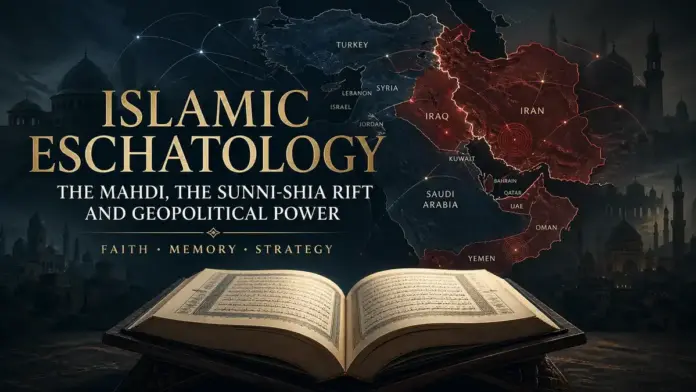
Islamic Eschatology: The Mahdi, the Sunni-Shia Rift, and the Geopolitical Depth of Belief
The most dangerous kind of ignorance about a religious-political ideology is not only crude demonization. It is shallow reading.
That is exactly where the West often fails when it looks at Islamic eschatology. It treats end-times belief as marginal theology, as something that belongs only to sermons, devotional imagination, or fringe extremists. But eschatological thought does not always remain on the margins. When it intersects with state power, revolutionary ideology, sectarian memory, and strategic ambition, it can become a mechanism of meaning, endurance, and authority.
That does not mean every Muslim thinks politically. It does not mean every Islamic tradition operates in the same way. It means something more precise and more serious: Islamic eschatology is a real, historically active, and ideologically usable field of ideas. It contains central figures such as the Mahdi and Dajjal. It has Sunni and Shia variations. And it matters geopolitically when belief moves into the hands of states, regimes, militias, and power systems.
Serious analysis does not say “all Muslims are the same.” It does not say “Islam is one unified political project.” Those are weak generalizations. Serious analysis says something more demanding: inside the Islamic world there are deep theological, historical, and political fractures, and some states or extremist networks can turn those fractures into fuel for war, influence, and regional power.
To understand that depth, three layers must be read together: Islamic eschatology, the Sunni-Shia split, and the modern use of faith as a mechanism of power.
What Islamic eschatology really means
Islamic eschatology is the body of belief about the last things: the signs before the Hour, the final judgment, the appearance of redemptive or deceptive figures, the final confrontation, and the restoration of divine justice.
This material does not come only from the Quran. Many of the detailed apocalyptic motifs come from the hadith corpus, the traditions attributed to the Prophet Muhammad that shaped later Islamic end-times imagination. Dajjal, the great deceiver, is a clear example: Britannica describes al-Dajjal as a false messianic figure in Islamic eschatology who appears before the end of time.
This distinction matters. There is no single, uniform Islamic end-times script accepted identically by all Muslims. There are shared motifs, but also important differences between Sunni and Shia traditions, between schools, regions, historical periods, and political settings.
That does not weaken the subject. It makes it more serious.
Islamic eschatology is not a cartoon. It is not a meme. It is not an optional decorative layer around doctrine. It is a powerful field of belief about history, justice, corruption, deception, trial, and final restoration.
And when that field enters politics, it can change the way crisis itself is understood.
The Mahdi and the expectation of final justice
At the center of much Islamic eschatological imagination stands the Mahdi, the “rightly guided one.” In many Sunni traditions, the Mahdi appears as a future redemptive leader who restores justice before the end. In Twelver Shia Islam, however, his role is much deeper and more structurally central.
For Twelver Shia Muslims, the Mahdi is the hidden Twelfth Imam, believed to be in occultation and expected to return as a messianic deliverer. Britannica explains that Muhammad al-Mahdi al-Hujjah is venerated by Twelver Shia Muslims as the hidden Imam who will reappear in time as the Mahdi.
That has enormous significance for understanding Shia political imagination. History does not appear only as a chain of events. It appears as waiting. As suspension. As unresolved injustice. As a movement toward a decisive moment of restoration.
In that world, injustice, defeat, martyrdom, and expectation are not merely emotions. They become theological memory.
That does not mean every Shia believer politicizes this belief. It does not mean every Shia community functions in revolutionary terms. But when a state ideology such as the Islamic Republic of Iran draws on Shia symbols, martyrdom memory, and revolutionary mission, eschatology can acquire political weight.
That is why this article connects directly with Newsio’s earlier English analysis Araghchi and the “Software of Chaos”: Why Tehran Reads Crisis Differently from the West. That piece explained why Tehran often reads risk, escalation, and uncertainty differently from the West. Islamic eschatology and revolutionary Shia memory are among the deeper layers behind that difference.
The Sunni-Shia rift: Islam’s first great political wound
To read Islamic eschatology seriously, another drawer has to be opened: the Sunni-Shia split.
This is not merely a theological disagreement. It is the first great political wound inside Islam: the question of who had the right to lead the Muslim community after the death of Muhammad.
Sunni Muslims accepted the legitimacy of the early caliphs and placed weight on continuity, consensus, and community authority. Shia Muslims held that leadership belonged to Ali, the cousin and son-in-law of Muhammad, and then to his descendants. Britannica’s overview of Twelver Shia belief notes that Twelvers believe the spiritual-political leadership of the Muslim community was ordained to pass through Ali and his line down to the Twelfth Imam.
From that point emerged a division that never remained purely theological. It became memory. It became identity. It became a story of injustice and legitimacy. It became political language. At many historical moments, it became blood.
Pew Research Center has estimated that Shia Muslims make up roughly 10% to 13% of the world’s Muslims, while Sunnis form the overwhelming majority. That proportion matters because it shows why Shia identity has often carried a minority consciousness inside the wider Islamic world. The issue is not only doctrine. It is also memory, vulnerability, survival, and legitimacy.
This does not mean every Shia hates every Sunni or every Sunni sees every Shia as an enemy. That would be false. Daily life across many Muslim societies has included coexistence, shared neighborhoods, intermarriage, common markets, and periods when sectarian identity did not define ordinary life.
But the rift remains structurally available.
That means it exists inside the historical reservoir of Islam as a political and theological wound that hardliners, regimes, militias, and extremists can activate when they need a language of existential conflict.
Hatred is not universal. But the fault line is real.
The question “Do Shia hate Sunnis?” cannot be answered with a careless yes or no.
At the level of ordinary believers, communities, and societies, reality is far more complex. Millions of Sunni and Shia Muslims have lived side by side, traded, worked, married, and built daily life without turning every theological difference into war.
But at the level of hardline ideology, extremist mobilization, and state manipulation, sectarian hatred is structurally available.
In Sunni extremist environments, such as ISIS-style or al-Qaeda-style ideological spaces, Shia Muslims have often been cast as heretics or even as an internal enemy worse than external non-Muslim powers. In those frameworks, the Shia are not merely different. They are portrayed as betrayal from inside the body of Islam.
In Shia revolutionary narratives, especially inside Iran’s ideological universe, the memory of martyrdom, oppression, and historical injustice becomes a foundation of political identity. Tehran does not simply project Shia belief. It projects Shia geopolitical mission: networks, proxies, symbols, martyrdom language, and regional depth.
So the correct conclusion is not “everyone hates everyone.” The correct conclusion is sharper: the Sunni-Shia rift is an old historical wound that can be turned into political energy when states, militias, and fanatics put their hands on it.
That is what makes it dangerous.
Iran and Saudi Arabia: when the schism becomes a geopolitical vise
The Sunni-Shia divide does not explain the Middle East by itself. It would be lazy to say every conflict in the region is “religious.” Borders matter. Oil matters. states matter. tribes matter. foreign powers matter. security calculations matter.
But the schism provides a powerful lens. It gives language. It gives memory. It gives recruitment energy. It allows state rivalries to feel like existential struggles, not merely political disputes.
The Council on Foreign Relations notes that the Sunni-Shia schism does not explain all the political, economic, and geostrategic factors involved in regional conflicts, but that it has become one prism through which to understand underlying tensions; CFR also notes that Saudi Arabia and Iran have used the sectarian divide to further their ambitions.
Saudi Arabia has historically projected Sunni legitimacy and influence. Iran projects Shia revolutionary legitimacy and regional depth. Between them, the Middle East becomes a theater of proxy conflict, militia networks, symbolic struggle, and state competition.
Syria, Iraq, Yemen, and Lebanon cannot be read properly without this underlying layer. They are not only Sunni-Shia wars. But they are conflicts where the Sunni-Shia rift can become an accelerator, a filter, and a fuel source.
That is the point: religious difference does not automatically cause war. But once war begins, religious difference can give it centuries of depth.
Tehran and the Shia arc
Iran’s geostrategy does not stop at its borders. For decades, Tehran has sought regional depth through networks, allies, militias, and political influence. What is often described as the “Shia arc” connects Iran, in different degrees and forms, to Iraq, Syria, Lebanon, and the Mediterranean.
This is not only theology. It is geostrategy.
Iran does not merely seek to protect Shia communities. It seeks depth, access, deterrence, leverage, and pressure tools against the West, Israel, Saudi Arabia, and Sunni rivals.
The Shia background gives that strategy identity and legitimacy. Militias are not presented only as security tools. They are framed as resistance, martyrdom, memory, and historical justice.
This is where faith becomes power.
The issue is not only what a sacred text says. The issue is what happens when interpretation enters institutions, armed groups, state strategy, and regional ambition. That same logic appeared in Newsio’s English analysis Taqiyya+: The Spark of Sacred Deception and the Architect of Chaos, where diplomatic language, timing, and strategic ambiguity were examined as instruments of power, not merely as words.
Eschatology as software of endurance
Islamic eschatology becomes especially important when it does not remain a private spiritual expectation, but becomes part of a political system’s endurance.
A regime that sees crisis only as danger tries to avoid it. A regime that can also read crisis as trial, historical confrontation, or a step inside a larger mission can tolerate different levels of cost.
This is where Western logic often fails. The West tends to assume that all actors fear destabilization in the same way. It assumes that the fear of chaos is enough to restrain the adversary. But a revolutionary regime with apocalyptic or martyrdom elements in its ideological bloodstream may see chaos in a more complex way.
It does not have to “want the end of the world” for the problem to exist. The issue is more subtle and more serious: it may not fear prolonged crisis as much as the West does. It may use it. It may turn it into endurance, pressure, and internal legitimacy.
A Middle East Institute study on the IRGC and Mahdism is important here because it argues that Mahdism has gained ideological weight inside parts of the Islamic Revolutionary Guard Corps and connects this worldview with missiles, militias, and apocalyptic self-understanding. The study does not prove that every Iranian decision is eschatological. It does show that such ideological currents exist and matter.
That is more than enough to change the analysis.
From theology to Hormuz
The geopolitical meaning of all this becomes visible when we move from symbols to choke points.
The Strait of Hormuz is not a theological concept. It is a maritime corridor. It is an energy artery. It is one of the most important strategic passages in the world.
But when a regime with revolutionary, Shia, and eschatologically charged elements in its self-understanding controls or threatens such a point, theology no longer stays far from geostrategy.
The Quran does not close Hormuz. The Mahdi does not move ships or missiles. The state does. The IRGC does. Naval structures do. Political decisions do. Pressure systems do.
But ideology shapes how a regime interprets risk, endurance, sacrifice, confrontation, and mission.
That is the depth.
Newsio’s The Hormuz Vise: Why the War in Iran Is Being Fought in Your Wallet explained how Hormuz can turn geopolitical tension into daily economic pain. This article moves one layer deeper: it examines the ideological and historical software that may make a regime more willing to live inside crisis and use it.
Why the West often reads this wrong
The modern secular West has one strength and one weakness. Its strength is that it can think institutionally, economically, technically, and strategically without being trapped inside religious narratives. Its weakness is that it often underestimates how real those narratives are for other actors.
So the West sees negotiations and imagines that everyone enters the room to reduce risk.
It sees sanctions and assumes everyone wants fast economic relief.
It sees military threat and assumes everyone is frightened in the same way.
But an ideological regime may think differently. It may want economic oxygen without losing the revolutionary core. It may fear military defeat while still using crisis as a survival mechanism. It may speak of Islamic unity while building a very specific Shia regional architecture.
That is why Newsio’s America at the Table with Araghchi: Negotiating with the Polished Face of the Same Threat matters inside this framework. The article showed how the polite face of diplomacy can conceal a deeper pressure system. Here, we are looking at the religious and historical soil that helps such pressure systems endure.
The illusion of Islamic unity
One of the biggest mistakes in Western public debate is to speak of “Islam” as if it were one political body.
It is not.
Islam is a vast religious world with schools, languages, ethnic differences, imperial memories, national interests, and internal fractures. The Sunni-Shia divide is the deepest of those fractures because it concerns the very source of legitimacy after Muhammad.
The West often imagines the conflict as “Islam versus the West.” That does exist inside certain radical narratives, but it is not the whole picture. The Islamic world also consumes itself from within: Sunnis against Shia, states against militias, monarchies against revolutionary regimes, national interests against religious slogans.
That does not make the problem smaller. It makes it more dangerous.
When a religious world contains internal fractures and simultaneously produces external pressure, instability does not move in only one direction. It moves inward and outward at once.
Violence is not directed only at “infidels.” Very often, it is directed at the internal rival who reads the same sacred book but rejects the same chain of legitimacy.
That is one of the hardest points for a younger generation to understand: religious identity does not always produce unity. It can also produce civil-war depth.
The most serious truth
Islamic eschatology is not a film plot. It is not online theater. It is not folklore.
It is a real field of belief, expectation, and symbolic power.
The Mahdi, Dajjal, the final confrontation, the restoration of divine justice, the Sunni-Shia rift, and the memory of martyrdom all belong to a religious and historical world that can become politically active in certain environments.
Serious analysis does not generalize crudely. It does not say every Muslim is a fanatic. It does not say every Sunni and every Shia are enemies. It does not say every Islamic end-times belief becomes a geopolitical plan.
It says something more accurate and much heavier: inside Islam there are real apocalyptic motifs, real historical wounds, real internal divisions, and real power systems capable of turning them into political force.
That is enough to change the conversation.
The conclusion
If the West wants to understand Iran, the role of Shia imagination, the endurance of the regime, and its regional strategy, it cannot look only at sanctions, drones, missiles, and diplomatic statements. It must also read the deeper software of belief, memory, and historical mission.
Islamic eschatology shows how crisis can acquire meaning.
The Sunni-Shia rift shows how legitimacy can become a wound.
Iranian geostrategy shows how both can move from theology into the field.
That is the core of the issue: this is not only about religion. It is about the way belief, once it enters state will, militia networks, strategic corridors, and systems of influence, can become power.
Anyone who does not see that will keep seeing only events.
Not the mechanism behind the events.