


Table of Contents
The world is not ruled by slogans — it is ruled by mechanisms of power
The reality of today’s world is not found in press releases, summit photographs, or diplomatic ceremonies. It is found beneath the surface: in supply chains, chokepoints, sanctions corridors, dual-use components, cheap drones with expensive consequences, authoritarian regimes terrified of their own societies, and old myths repackaged as instruments of control.
If the twentieth century taught the world that ideologies could burn continents, the twenty-first century is teaching something colder: power does not always need imperial parades. It can move through a narrow strait, a shipping insurance premium, a shell company, a Turkish customs channel, a sanctioned procurement network, a refugee lever, a NATO veto, a pipeline, a drone swarm, or a sacred narrative turned into political software.
That is the operating system of the present age. Whoever reads only the public statement sees theater. Whoever reads the mechanism sees the world as it actually functions: without sentiment, without decorative language, and without the comforting illusion that history is moved by noble intentions.
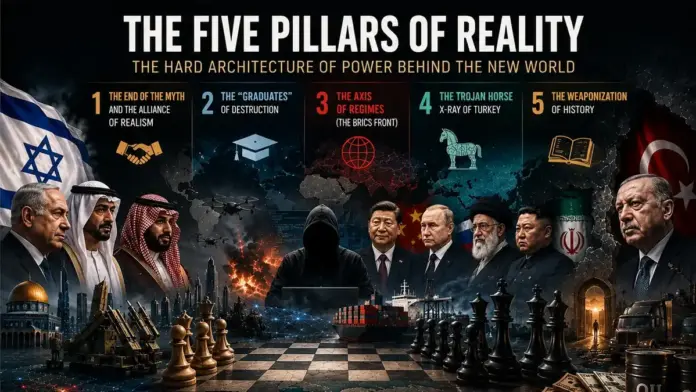
Pillar One: the end of the myth and the alliance of realism
The biggest shift in the Middle East is not that everyone has reconciled. They have not. The biggest shift is that the old “Arabs versus Israel” frame no longer explains the region by itself.
The United Arab Emirates normalized relations with Israel through the Abraham Accords. Saudi Arabia has not crossed the final diplomatic threshold and continues to publicly link full normalization to a Palestinian state. That distinction is essential. There is no fully signed Saudi-UAE-Israeli trilateral alliance. But there is something history often produces before a treaty: a convergence of needs. The Abraham Accords began with Israel, the UAE, and Bahrain in 2020, while Saudi Arabia remains outside full normalization.
That does not weaken the significance of the shift. It makes it more important. The real story is not a ceremony. It is the architecture of an alliance before the final name arrives.
Riyadh, Abu Dhabi, and Jerusalem are not converging because of emotional reconciliation. They are converging because of Iran, air defense, technology, energy corridors, drones, maritime risk, U.S. security fatigue, and the shared understanding that the future cannot be built on slogans from a previous century.
Saudi Arabia did not suddenly “fall in love” with Israel. The UAE did not become a utopian peace actor. Israel did not magically become acceptable to every Arab public. The real issue is colder: the region is maturing because the cost of illusion has become higher than the cost of realism.
The Palestinian issue has not disappeared. Saudi Arabia has repeatedly said there will be no diplomatic ties with Israel without an independent Palestinian state, with Reuters reporting Riyadh’s position that such a state should be recognized on 1967 borders with East Jerusalem as its capital.
But the strategic hierarchy of the region is changing. Gulf states increasingly see that the existential threat to their economies, infrastructure, ports, post-oil projects, and political survival does not come only from the old Arab-Israeli conflict. It comes from Iran’s ability, directly or through proxies, to turn the region into a permanent cost machine.
Newsio has already mapped this pressure in its English analysis of Iran under pressure, U.S. carriers, Hormuz, diplomacy, and the IRGC, where diplomacy does not unfold in a neutral room but under the shadow of military signaling, energy blackmail, and internal pressure on Tehran.
Hormuz proves why myths die
Geostrategy does not forgive rhetoric. The Strait of Hormuz is one of the world’s most important oil chokepoints. The U.S. Energy Information Administration says flows through Hormuz in 2024 and early 2025 accounted for more than one-quarter of global seaborne oil trade and around one-fifth of global oil and petroleum product consumption.
The International Energy Agency says nearly 20 million barrels per day of oil were exported through Hormuz in 2025, while available alternative export capacity through Saudi and UAE routes is only about 3.5 to 5.5 million barrels per day.
Those numbers explain more than a thousand speeches. When one narrow maritime passage can transmit Middle Eastern instability into fuel prices, inflation, shipping costs, and political pressure across Asia, Europe, and the United States, leaders stop thinking only in memory. They start thinking in survival.
That is why the pipelines that bypass Hormuz are not technical footnotes. They are geostrategic insurance. Newsio has already analyzed the same infrastructure in the pipelines that bypass Hormuz: Saudi Arabia and the UAE can reduce part of Iran’s leverage, but they cannot make the Strait irrelevant.
This is the adulthood of the Middle East. Not because the region has become peaceful, but because its serious actors understand that data centers, LNG flows, tourism, AI projects, oil exports, ports, and global investment cannot be secured by slogans from the last century.
Pillar Two: the “graduates” of destruction
The West has made a childish mistake for years. It has often imagined its enemies as primitive fanatics outside the modern world. That image is convenient. It is also dangerous.
The most effective asymmetric pressure does not require ignorance. It requires knowledge of the target. Knowledge of markets. Knowledge of shipping lanes. Knowledge of insurance. Knowledge of financial systems. Knowledge of media cycles. Knowledge of Western societies that panic when fuel, food, electricity, and transport costs rise.
Modern asymmetric warfare is not measured only in casualties. It is measured in shipping delays, higher insurance premiums, rerouted cargoes, market fear, political fatigue, inflation, social anger, and democratic exhaustion.
A cheap drone can create a disproportionate outcome. It does not need to destroy an entire fleet. It only needs to prove that a refinery, a ship, a pipeline, a port, a desalination plant, a data center, or an airport can be hit. After that, the market does the rest: insurance costs, preventive disruption, security surcharges, panic, political blame, and public anxiety.
This is the new mathematics of war. Low attack cost. High defense cost. Even higher psychological cost.
A drone is not only a battlefield weapon — it is an economic instrument
China, Iran, and Russia show how dual-use supply chains become strategic infrastructure. Western concerns about microelectronics, components, industrial inputs, and dual-use goods are not narrow compliance details. They are the supply skeleton of modern attrition.
Reuters reported in 2025 that U.S. Treasury sanctions targeted networks supporting Iran’s ballistic missile and drone manufacturing across Iran, the UAE, Turkey, China, Hong Kong, India, Germany, and Ukraine. The U.S. government said those networks endangered U.S. and allied forces in the Middle East and commercial shipping in the Red Sea.
The problem for the West is not that its opponents do not understand the modern system. The problem is that they understand it well enough to hit its sensitive points: prices, insurance, logistics, elections, and social trust.
They do not always need battlefield victory. They need systemic erosion.
A terrorist, militia, or state-backed asymmetric attack in the twenty-first century does not target only the object it hits. It targets the reaction: the journalist who broadcasts fear, the investor who pulls back, the insurer who raises cost, the citizen who blames the government, and the politician who looks for a simple narrative.
That is the real war behind the war.
Pillar Three: the axis of regimes and the “multipolar” storefront
The phrase “multipolar world” sounds attractive. It promises balance, different voices, the end of monopoly, and more room for the Global South. In one sense, that is a legitimate debate. The world cannot be managed forever by one center of power.
But there is a darker use of the same phrase.
When Russia, China, Iran, and North Korea speak of a new world order, they do not always mean a fairer rules-based balance. Often, they mean less accountability, lower cost for aggression, fewer constraints on repression, and a world in which authoritarian systems can operate with less pressure from democratic norms.
Precision matters here. BRICS is not a single military alliance. It is not NATO in reverse. It includes states with different interests, different regimes, and significant internal contradictions. The Council on Foreign Relations notes that BRICS has become a major force seeking a counterweight to Western influence, but its expansion has also brought disagreements, including over Russia’s invasion of Ukraine.
That does not erase the harder problem. Inside and around these structures, a sharper authoritarian convergence is forming: Russia, China, Iran, and North Korea. They do not fully trust one another.
They do not share one coherent civilizational vision. But they share something more practical: an interest in weakening Western cohesion, loosening sanctions enforcement, reducing the power of democratic rules, and making the world safer for regimes afraid of transparency.
Newsio has already described this in The Four-Part Axis and the Siege of the West: there does not need to be a single treaty, shared flag, or unified command for there to be functional convergence.
They are not united by vision — they are united by fear
This axis is not a romantic alliance. It is a survival syndicate.
Russia needs markets, drones, ammunition, technology, bypass routes, and political cover. Iran needs economic oxygen, oil buyers, procurement channels, and strategic protection. North Korea needs revenue, food, technology, and relevance. China needs a world in which U.S. power costs more, Western alliances fragment more easily, and authoritarian governance is no longer treated as a historical abnormality.
The U.S.-China Economic and Security Review Commission describes the China-Iran relationship in the context of sanctions evasion, noting that Iran remains under broad U.S. and global sanctions related to its nuclear and missile programs, terrorism, regional aggression, and human rights abuses, while China has opposed renewed UN sanctions pressure.
Russia and Iran signed a comprehensive strategic partnership treaty in January 2025 to deepen cooperation under Western sanctions. AP reported that the pact covers trade, military cooperation, science, education, culture, and other areas, while stopping short of a mutual defense clause.
This is not ideological brotherhood. It is geopolitical necessity. And that makes it dangerous, because necessity is often more durable than belief.
Pillar Four: Turkey as the gate inside the gate
If one state captures the gray-zone logic of the present world, it is Turkey.
Turkey is not merely a “difficult ally.” That phrase is too soft. Turkey is a node: a NATO member, a European interlocutor, a regional power, an energy corridor, a trade passage, a migration lever, a defense player, a mediator between Russia and the West, a channel to Iran, a rival and partner to Israel, and a country that can speak to the Gulf, Moscow, Tehran, Washington, Brussels, and Beijing without fully belonging to any one discipline.
That is not simple double-dealing. It is a full strategy.
Ankara has learned to remain close enough to the Western system to pressure it from within, and far enough from Western discipline to transact with its opponents. That is the model: access without full obedience, alliance status without full predictability, geography as leverage, crisis as bargaining capital.
Newsio has already examined that double structure in its analysis of Erdogan’s harsher rhetoric toward Israel and Turkey’s lasting strategic frame toward Greece. Turkey can raise rhetorical pressure on one front, keep channels open on another, and never abandon the core of its own strategic claims.
Turkey is not the only reason sanctions leak — but it is a critical corridor
The easiest exaggeration would be to say Turkey is the only reason sanctions against Russia or Iran leak. That would not be accurate. Sanctions evasion is multicentered: China, the UAE, Central Asia, the Caucasus, offshore structures, shell companies, shipping networks, and third-country intermediaries all matter.
The stronger and more precise point is this: Turkey functions as a critical intermediate node, gray-zone corridor, and geoeconomic valve that can reduce the cost of isolation for pressured regimes while remaining institutionally inside the Western security system.
That is enough to make the issue historic.
The U.S. Treasury sanctioned 275 individuals and entities in October 2024 for supplying Russia with advanced technology and equipment, targeting networks across 17 jurisdictions, including Türkiye. Reuters has also reported U.S. sanctions on Turkey-based firms accused of helping Russia evade sanctions and support Moscow’s war effort.
Reuters reported in 2024 that U.S. sanctions threats chilled Turkish-Russian trade and slowed some payments for imported oil and Turkish exports, showing how exposed the Turkey-Russia commercial channel was to U.S. enforcement pressure.
This is the geostrategic weight. Turkey does not need to announce that it has abandoned the West. It does not need to leave NATO. It only needs to keep valves open.
The geopolitical smuggler of the intermediate age
Turkey sells its geography to the West and its access to the West’s adversaries.
To the West, it says: without me, you cannot manage migration, the Black Sea, NATO balances, Syria, the Caucasus, energy, the Bosporus, drones, or the eastern Mediterranean.
To the West’s adversaries, it says: through me, you can breathe, trade, negotiate, reroute, buy time, and reduce the cost of isolation.
That is why Turkey is so difficult. It is not weak. It is not merely opportunistic. It is geographically useful to everyone and fully disciplined by no one.
The word “gate” is not theatrical here. It describes the place where a system that appears sealed begins to leak. Turkey is often that point for Western pressure architecture: not because it is the only corridor, but because it is the most institutionally paradoxical one — an ally on paper, a broker in practice, a pressure actor in negotiation, and a corridor in the economy.
If the West cannot manage Turkey, it cannot manage the gray age itself.
Pillar Five: the weaponization of history
All of this leads to the deeper mechanism: the weaponization of history.
No regime that fears reality governs only with guns. It governs with narrative. It needs myth. It needs memory. It needs sacred history. It needs betrayed ancestors, eternal enemies, lost empires, divine mandates, civilizational missions, eschatological expectation, and historical grievance.
When a regime cannot offer a future, it sells a past.
When it cannot offer prosperity, it offers an enemy.
When it cannot offer freedom, it offers a mission.
This is the “software of domination.” History is not used to educate. It is used to govern. Faith is not used as private refuge. It is used as public discipline. Memory is not used to prevent the repetition of barbarism. It is used to authorize the next barbarism.
This does not belong to one religion, one people, or one region. It belongs to every power system that turns the past into a chain.
Dead myths are cheaper than progress
Progress is expensive. It requires institutions, education, production, justice, accountability, infrastructure, freedom of thought, tolerance of criticism, acceptance of failure, and the peaceful replacement of leaders.
Myth is cheaper.
Myth tells the poor that hunger is heroic if it serves a sacred cause. It tells the oppressed that obedience is virtue. It tells the young that they do not need to build a life if they can die with meaning. It tells women that their prison is honor. It tells citizens that freedom is a foreign infection. It tells the nation that the ruler is father, priest, general, and historical necessity all at once.
Myth is the cheapest fuel of power.
That is why systems of domination do not truly love history. They fear it. If people learn history, they discover that the world has changed many times. Empires fall. Sacred arguments have justified crimes. No regime is eternal. Fear is a technique, not fate.
So these systems do not teach history. They teach selected memory.
The West is not innocent — but it built tools of self-correction
Serious analysis does not sanctify the West. The West carries colonization, slavery, crusades, wars, genocide, coups, exploitation, hypocrisy, and double standards. Anyone who ignores that is not doing analysis. They are doing advertising.
The difference is not that the West has been innocent. It has not.
The difference is that, through blood and conflict, it developed tools of self-correction: free press, independent courts, parliaments, rights, science, universities, civil society, elections, public criticism, and institutional challenge to power.
It does not always apply them well. It often betrays them. But it has them.
Authoritarian regimes fear exactly this. They do not only fear aircraft carriers. They fear the idea that a ruler can be checked. They fear that a citizen can ask a question. They fear that a journalist can investigate. They fear that a woman can refuse permission. They fear that a student can laugh at the myth.
At its best, the West threatens regimes not only because it has power, but because it contains mechanisms that question power.
The real global conflict: accountability versus sacred authority
The world is not simply divided between West and East. Nor between Christians and Muslims. Nor between North and South. Those categories can be useful, but they are insufficient.
The deeper line runs between two forms of power.
The first accepts, however imperfectly, that it must answer to someone. It can lose elections. It can face courts. It can be criticized. The state is not God. The leader is not fate. The party is not history itself.
The second sanctifies itself. It says power represents the nation, the revolution, God, history, security, race, anti-colonial dignity, or civilizational destiny. And whoever disagrees is not merely an opponent. They are a traitor.
That is the conflict of the age.
Everything else is an expression of it: Iran, Russia, China, North Korea, Turkey as an intermediate corridor, proxies, drones, Hormuz, the Abraham Accords, sanctions, energy routes, inflation, elections, and information warfare.
Why this is not rage — it is an X-ray
Rage without accuracy becomes noise. Accuracy without courage becomes sterile commentary.
The age needs something else: disciplined ruthlessness.
It must say that Iran uses proxies and nuclear pressure without blaming the Iranian people.
It must say that Turkey often functions as a gray-zone corridor and geopolitical broker without demonizing Turkish citizens.
It must say that the authoritarian axis fears democratic accountability without pretending the West is innocent.
It must say that radical networks use technology, finance, and asymmetric cost without treating Muslims collectively as a threat.
It must say that dead myths hold living people hostage without insulting the human need for faith, memory, and identity.
That is the line between analysis and propaganda.
The new reality in one image
To see the world from above, connect the five levels.
In the Middle East, old adversaries converge because Iran has made itself a shared fear.
In asymmetric warfare, the West’s opponents understand they do not need to defeat armies. They need to convert every crisis into inflation, panic, and political fatigue.
In the authoritarian axis, regimes that do not trust one another cooperate because they fear exposure in a world of rules more than they fear each other.
In Turkey, the West faces the most dangerous kind of intermediate actor: not an enemy outside the walls, but an ally who knows where the doors are.
In history, power systems use myth, faith, memory, and grievance to make people serve projects that are not their own.
That is the map.
Not the map of borders. The map of mechanisms.
The final conclusion: the world does not need more myths — it needs eyes
Our age is not incomprehensible. It is only brutal to those who insist on reading it with old fairy tales.
The world does not move because leaders eternally hate each other or suddenly love each other. It moves because states fear, calculate, trade, betray, adapt, and survive. It moves because markets punish instability faster than institutions do. It moves because one drone can create more political damage than a division. It moves because a NATO member can simultaneously be an ally, a broker, and a leakage valve. It moves because dictators do not fear only their enemies. They fear the truth about themselves.
Reality is not gentle. But it is readable.
And anyone who looks at it without fear will see the same pattern: the great myths of the twentieth century do not fall because morality defeats them. They fall because survival becomes stronger than illusion.
The Middle East is not maturing because it has forgotten the past. It is maturing because it has learned that the past cannot intercept missiles.
The West is not threatened only by hostile armies. It is threatened by its failure to see the mechanisms that erode it.
Authoritarian regimes do not converge because they love one another. They converge because they fear a world in which they must answer for what they do.
And peoples are not held hostage only by weapons. They are held hostage by stories telling them that their poverty is duty, their silence is virtue, and their lives belong to a mission designed by others.
That is the real battlefield.
Not only land. Not only sea. Not only air. The battlefield is the human capacity to see the mechanism behind the myth.
Because the world will not be saved by those who shout most loudly in the name of history. It will be saved by those who read history clearly, take its knowledge, and refuse to become its slaves.