


Table of Contents
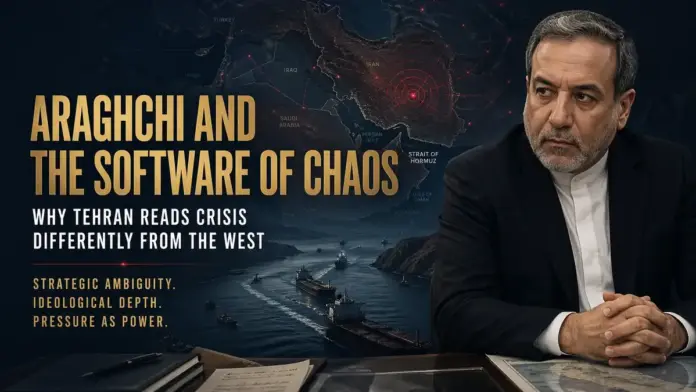
Araghchi and the “Software of Chaos”: Why Tehran Reads Crisis Differently from the West
The most dangerous Western mistake in reading Tehran is not only that it underestimates Iranian power. It is that it still assumes the Iranian regime fears escalation, systemic disorder, and strategic breakdown in roughly the same way a conventional state fears them. That assumption is too comfortable.
It misses the possibility that parts of Iran’s revolutionary system do not read crisis merely as danger, but also as opportunity, leverage, and historical mission. The core Twelver Shi’a belief in the hidden Imam, Muhammad al-Mahdi al-Hujjah, is real and central to the tradition; Britannica notes that he is believed to be in occultation and to return as a messianic deliverer.
The deeper issue is what happens when that religious background meets a revolutionary state, the Islamic Revolutionary Guard Corps, proxy networks, missile programs, and a strategic culture built around ambiguity and endurance.
A Middle East Institute study argues that Mahdism has gained ideological weight inside the IRGC and has been tied to the regime’s self-understanding, its export-of-revolution logic, and a more expansive vision of conflict and mission.
That does not prove every Iranian official seeks world war. It does show that elements of the system may read chaos, final confrontation, and historical rupture in a more ideologically charged way than most Western policymakers assume.
That is where Abbas Araghchi enters the picture. He is not important because he sits outside this machinery. He is important because he is one of its most polished expressions.
Reuters has described Araghchi as perhaps the most powerful foreign minister the Islamic Republic has had, with deep trust from the leadership, roots inside the regime’s wartime and diplomatic system, and a reputation for patient, technical bargaining. Reuters also notes that he is a former Revolutionary Guard member and a central figure in major negotiations with the West.
This means Araghchi should not be read as a soft alternative to the system. He should be read as the system’s refined interface to global markets, embassies, and Western expectations. That is precisely why this argument connects so directly with our earlier English analyses, including America at the Table with Araghchi: Negotiating with the Polished Face of the Same Threat and The Hormuz Vise: Why the War in Iran Is Being Fought in Your Wallet.
The strategy of revelation does not need to announce itself
Western systems like declared intentions. They want to hear that the other side seeks stability, fears collapse, and wants to avoid the abyss. Tehran does not need to speak in those terms to exploit the abyss. It only needs to behave in a way that shows crisis can still serve the regime.
That is what made Araghchi’s handling of Hormuz so important. Reuters reported that in March he said the Strait of Hormuz was not closed to everyone, only to “enemies,” and later reported his assurances that passage for commercial vessels was open during a ceasefire window.
Markets reacted, oil eased, and psychological pressure briefly softened. But Reuters also reported continuing confusion around passage, shipping hesitation, and a repeating pattern of “open, closed, talks on, talks off.” This is the core mechanism: Araghchi does not remove pressure. He manages its timing.
That is why the article is not really about rhetoric. It is about operational ambiguity. One of the regime’s most effective moves is not to declare full confrontation at every moment, but to create short intervals of interpretive relief.
Those intervals allow markets to breathe, Western governments to hope, and Tehran to recover room without surrendering leverage. In functional terms, this is why Araghchi matters more than a crude propagandist. He lowers resistance without giving up the architecture of pressure. Reuters’ broader reporting on Hormuz, negotiations, and maritime disruption supports exactly that reading.
Araghchi as the regime’s programmer of usable uncertainty
Reuters noted that Araghchi himself has described the Iranian negotiating style as something like bazaar bargaining: patient, persistent, layered, and time-consuming. At first glance that can sound like simple diplomatic technique. At regime level, it is more than that. It is a method of wearing down the other side, extracting time, testing political nerves, and turning ambiguity into a strategic asset.
This is where the “software of chaos” framework becomes useful. The phrase is not saying Iran wants chaos for its own sake. It is saying the regime has learned how to live inside instability, weaponize uncertainty, and exploit the fact that the West is more allergic to disorder than Tehran often appears to be.
When Western governments negotiate, they usually hope to buy down risk. When Tehran negotiates, it may also be buying time, redistributing pressure, and preserving the option of renewed shock.
That is exactly why this piece should also be read alongside our earlier English article Taqiyya+: The Spark of Sacred Deception and the Architect of Chaos. The point is not that Araghchi is a theatrical villain. The point is that he is a disciplined state operator whose value lies in converting regime depth into internationally legible calm while the coercive core remains intact.
Why Western deterrence can misfire against this worldview
Traditional deterrence assumes that the threat of catastrophe will impose caution because the other side fears catastrophe in basically the same way you do. But if parts of the opposing system read crisis not only as cost but also as proving ground, then the entire deterrence equation becomes less reliable.
The Middle East Institute paper is valuable here because it does not reduce the regime to a single slogan. Instead, it shows how apocalyptic or messianic currents can interact with the IRGC’s strategic culture, giving confrontation a deeper ideological charge. That does not mean Tehran is irrational. It means its rationality may be embedded in a framework very different from the secular, stability-maximizing logic that Western planners often default to.
That difference matters enormously. If Washington believes fear of the abyss is enough to discipline Tehran, but Tehran believes it can survive, absorb, or even politically exploit repeated crises, then Western strategy starts negotiating on the wrong map. This is not merely a gap in policy. It is a gap in civilizational reading.
That is why our earlier Newsio piece The Critical U.S.–NATO Turning Point remains relevant here. The real issue is not only military balance. It is whether the West understands the adversary’s relationship to pressure, legitimacy, and prolonged crisis.
Hormuz as a miniature of the larger logic
The Strait of Hormuz offers the clearest real-world example of this difference. Reuters reported recent maritime paralysis, sharply reduced crossings, Iranian ship seizures, and a Gulf system still functioning under severe stress despite moments when the strait was described as technically open. The point is not only economic. The point is philosophical: uncertainty itself becomes a tool of dominance.
That is what Araghchi helps make usable. He can project enough calm to move psychology without removing the underlying pressure. He can speak into the system just long enough for markets to misread temporary breathing space as actual normalization.
Then the regime can return to ambiguity from a stronger position. That is not random inconsistency. It is managed instability. Reuters’ sequence of coverage around open passage, negotiations, and shipping hesitation draws that pattern clearly enough to analyze seriously.
This is also why Why the U.S.-Iran Talks Collapsed: the Real Gap Behind the Failure belongs inside this article’s internal architecture. The gap was never just diplomatic wording. It was strategic, ideological, and existential. Tehran and Washington were not reading the same negotiation the same way.
Araghchi is not trying to escape the chessboard. He is trying to change the rules of it
The easiest mistake is to imagine Araghchi as just another negotiator trying to get a better deal. The sharper reading is that he belongs to a system that does not approach crisis with the same existential logic as the West. That alone makes him more dangerous than he first appears.
Araghchi does not merely carry messages. He carries a different relationship to time, pressure, risk, and ambiguity. He is the polished form of a regime that can endure repeated crisis cycles, preserve ideological depth, and use uncertainty as leverage. If the West keeps assuming that Tehran fears systemic rupture the way Washington or Brussels would fear it, then the West will keep entering talks believing it is buying peace while Tehran may be buying room for the next phase of pressure.
That is why the strongest conclusion is not that Iran “wants World War III” in a cartoonish sense. The stronger conclusion is more serious: Tehran may not fear crisis in the same way the West fears it, and that difference is enough to distort negotiation, weaken deterrence, and make Araghchi far more consequential than a conventional foreign minister would be. Reuters’ reporting on his institutional weight and the Hormuz sequence, together with the MEI analysis of Mahdism and IRGC ideology, supports that darker but more durable reading.
The safe but ballistic conclusion
Abbas Araghchi is not just a diplomat of Tehran. He is the polished interface of a regime that often reads crisis, strategic ambiguity, and prolonged pressure differently from the West. Twelver Shi’a belief in the hidden Imam is real. The ideological weight of Mahdism inside parts of the IRGC is documented.
Araghchi’s deep integration into the Islamic Republic’s diplomatic and power structure is also documented. Taken together, those facts do not prove a simplistic end-of-the-world doctrine. They do prove that the West is dealing with a system whose relationship to destabilization may be more resilient, more ideological, and more dangerous than standard diplomatic language suggests.
The real Western problem, then, is not only that it underestimates Araghchi. It is that it still too often assumes the man across the table fears the abyss the same way it does. If that assumption is wrong, then Western deterrence, Western negotiation, and Western crisis management all begin from a place of strategic weakness.
And in that case, Araghchi stops looking like just another diplomat. He looks like what he actually is: the refined operator of a regime that has learned how to turn uncertainty itself into power.