


Table of Contents
Iran is not only losing people — it is losing command time
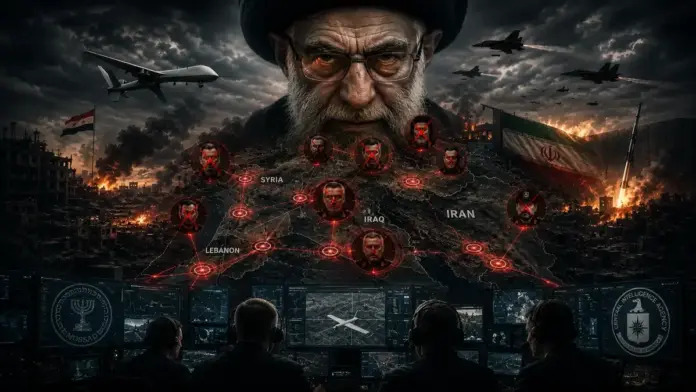
The latest phase of the conflict around Iran is not measured only in explosions, dead commanders, damaged infrastructure, or destroyed weapons depots. It is measured in something deeper: the loss of the time a power network needs to replace people, reconnect channels, rebuild trust, and turn political orders into operational action.
That is the point often lost inside the noise of war reports. Tehran can appoint a new officer on paper. It can assign a new liaison, a new militia coordinator, a new logistics handler, or a new Hezbollah contact. What it cannot replace overnight is the invisible architecture that makes command real: personal trust, operational memory, safe routes, codes, local credibility, procurement channels, and the human relationships that move weapons, money, and orders across borders.
This is why the pressure on the Iran axis is no longer only military. It is administrative. Public reporting shows repeated pressure on Iran-linked militia sites in Iraq, Hezbollah infrastructure in Lebanon, diplomacy around the war, and the nuclear file that still hangs over every tactical decision.
Reuters reported that Saudi warplanes struck Iran-backed Shi’ite militia targets in Iraq during the war, while Israel has continued targeting Hezbollah-linked structures and commanders in Lebanon.
The difference between a strike and strangulation
A strike destroys a target. Strangulation destroys rhythm.
The first can be spectacular. The second is more dangerous to a power system. When a military organization, intelligence service, or proxy network suffers one major strike, it counts losses and continues. When it suffers repeated hits on commanders, depots, corridors, middle managers, safe houses, and reassembly points, it loses more than material. It loses continuity.
That is the emerging pressure around the Iran axis. Tehran is not only dealing with the loss of senior names or physical infrastructure. It is dealing with pressure on the people trying to fill the gaps.
Some of the most dramatic claims circulating about newly appointed commanders killed in recent days remain difficult to verify through public sources. But the strategic pattern is clearer: the opponents of Iran are targeting the layer where replacement is most fragile.
The decisive issue is not always the name of the man killed. It is the function that does not have time to stabilize.
The top hides first; the middle layer burns first
Every authoritarian or proxy-based system has a hard truth: the top protects itself first. Senior leaders move less visibly, reduce digital exposure, change communication patterns, rely on intermediaries, and push operational burden downward.
That middle layer is the real spine. It does not always appear on posters. It does not always carry the title that foreign audiences recognize. But it knows who moves what, which route is still alive, which local commander obeys, which warehouse matters, which truck is real and which is bait, which courier is trusted, and which militia cell can still act.
If that layer burns, the system may not collapse immediately. But it begins to lose nerve.
That is command strangulation: the continuous attrition of the layer that converts strategy into action. Iran may still hold ideology, missiles, proxies, a nuclear threshold, and regional ambition. But if the networks cannot reliably replace the humans who operate them, power becomes slower, noisier, more exposed, and more brittle.
Newsio’s earlier analysis of Iran under pressure, U.S. carriers, Hormuz, diplomacy, and the IRGC matters here because the crisis is not only Washington versus Tehran. It is also a contest over who controls the operating room inside Tehran’s system.
Hezbollah is the laboratory of attrition
Lebanon shows the new logic clearly. Hezbollah is not only a militia with rockets. It is a political, social, military, logistical, and intelligence system. To function, it needs command, local liaisons, storage networks, safe movement, recruitment channels, communications discipline, and the ability to rebuild after every hit.
When Israel targets Hezbollah commanders, infrastructure, and operating points, it is not only trying to reduce immediate rocket fire. It is trying to break continuity. Reuters reported that Israel carried out a May 6 strike in Beirut’s southern suburbs targeting a commander of Hezbollah’s elite Radwan force; a later Reuters report identified him as Ahmed Ali Balout and described him as one of the most senior Hezbollah figures killed in the war so far.
That matters. The Radwan force is not an ordinary symbolic unit. It represents Hezbollah’s offensive edge, border pressure, and operational depth. When such nodes are targeted, the message is not only “we killed one man.” The message is: we know where the nervous system is.
The Guardian also reported that Israeli strikes in southern Lebanon killed at least six people hours after a ceasefire extension, while Israel said it was targeting Hezbollah infrastructure.
Hezbollah is not only losing positions — it is losing the right to hide behind Lebanon
The Lebanon file is not only military. It is a question of sovereignty. As long as Hezbollah holds weapons, command lines, and war decisions outside full state control, Lebanon cannot fully decide war and peace for itself.
That is why Hezbollah’s attrition has a double effect. Militarily, it reduces capability. Politically, it exposes the cost of non-state power. Every time Lebanon pays a price for decisions that do not pass through the Lebanese state, Hezbollah’s old “resistance” narrative becomes harder to sustain.
Newsio’s analysis of Hezbollah-controlled Lebanon and the crisis of state sovereignty explains the deeper issue: Hezbollah does not appear only as an armed group where the state is weak. It can become a substitute authority, and that is precisely why command disruption has political meaning beyond the battlefield.
Iraq and Syria are corridors, not background scenery
The Iran axis is not a single state. It is a network. Tehran needs Iraq, Syria, and Lebanon not only as friendly spaces or ideological theaters. It needs them as corridors.
Corridors for weapons. Corridors for drones. Corridors for missile components. Corridors for money. Corridors for intelligence. Corridors for men who can move between the formal and the deniable.
When those corridors function, Iran converts geographic distance into strategic depth. When they are hit, Tehran’s influence loses physical continuity.
Reuters reported that many Iran-backed militias in Iraq were not eager to join the war at the scale that might once have been expected from one of Tehran’s strongest regional instruments. That does not mean the militias disappeared. It means their activation is not automatic, cost-free, or detached from local calculations.
When an axis needs proxies but the proxies hesitate, tire, calculate, or fear the cost, Tehran loses something precious: the illusion that every order from the center becomes immediate action on the edge.
Regional pressure has become multidirectional
The old model said Iran pressures its adversaries through proxies. The newer model shows that Iran’s adversaries can pressure the proxies as weak points in the Iranian system.
That changes the logic of the conflict. If Tehran strikes through Hezbollah, Iraqi militias, the Houthis, or other aligned networks, its opponents do not always need to answer only at the center. They can cut limbs. Destroy depots. Burn intermediaries. Break transfer routes. Force Iran to spend time, money, and people rebuilding what was just lost.
Reuters reported that the war has reshaped regional calculations, leaving Tehran more isolated while Gulf states and other actors reassess the costs of Iran-linked escalation.
This is no longer simply Iran versus Israel, or Iran versus the United States. It is a struggle over the functionality of Iran’s entire regional web. Who controls the corridors? Who can replace commanders? Who keeps communications alive? Who has enough time to rebuild?
Newsio’s broader map of the network of violence behind the regime in Tehran is essential here: the real subject is not one battlefield, but the system that allows Tehran to project pressure through multiple armed structures across the region.
Diplomacy and strikes are moving together
Western political language often treats diplomacy and military action as separate rooms. In the Iran file, they increasingly operate in the same hallway.
Tehran negotiates, answers proposals, delays, seeks guarantees, uses mediators, and sends political signals. At the same time, the battlefield shows that its adversaries are not waiting only for negotiation texts. They are degrading Iran’s operational capacity while diplomacy remains alive.
Reuters reported that Iran sent a response through Pakistan to a U.S. proposal aimed at ending the war, while AP reported that Iranian Foreign Minister Abbas Araghchi said lack of trust is blocking talks with Washington.
This is the new reality: talks do not necessarily mean pressure stops. They can mean the opposite. Each side tries to enter the next diplomatic phase with a stronger field position. For the United States, Israel, and Iran’s regional opponents, that means Tehran’s ability to reassemble power must be constrained before it becomes bargaining leverage.
The nuclear file casts a shadow over succession
None of this is separate from the nuclear program. Pressure on command, proxies, logistics, and routes matters because Iran is not simply a state under attack. It is a state operating under nuclear shadow.
Reuters reported that President Donald Trump said stopping Iran’s nuclear program outweighed Americans’ economic pain, showing that Washington is framing the nuclear file as a strategic priority even when the war carries domestic costs.
That matters because the pressure campaign has more than one layer. It aims to keep Iran uncertain while it tries to protect the nuclear program, preserve proxies, negotiate through mediators, and rebuild command.
Newsio’s analysis of Tehran’s nuclear hourglass and the uranium threshold is part of the same picture. The danger is not only a number of kilograms. It is the interaction between material, decision, verification, command, deterrence, and regime survival.
The succession kill zone is more dangerous than decapitation alone
Targeting senior figures carries symbolic power. When a high-ranking official dies, the message is political, psychological, and strategic. But attrition inside the succession layer can be even deeper.
Why?
Because the top can have a replacement on paper. Middle command is an ecosystem. It takes time. It requires contacts, credibility, local knowledge, access to trusted people, and the ability to move through gray zones where obedience is not automatic but negotiated through money, fear, loyalty, ideology, and personal history.
When newly appointed commanders or liaisons enter that ecosystem under constant targeting pressure, they do not have time to become nodes. They remain crisis managers. A crisis manager does not generate the same power as the old man of the network.
That is the real wound for the Iran axis: replacement is not restoration.
Tehran is sending people into a machine that is already burning
A regime under pressure often makes the same mistake: it believes willpower can replace capability.
It cannot.
Tehran can appoint new officers. It can send new liaisons. It can activate new names inside militias. It can issue orders to networks that have long depended on Iranian money, training, weapons, or political cover. But if routes are watched, warehouses are hit, intermediaries are exposed, and local commanders understand that participation now carries higher cost, command slows down.
In geostrategy, slow command kills.
It does not always kill in one explosion. It kills through delay, hesitation, fear, miscalculation, false signals, unreturned calls, stalled transfers, local commanders who wait, and men who no longer know whether the next message is an order or a trap.
Intelligence is the real weapon
Command strangulation does not happen without intelligence. To hit a commander, liaison, or depot at the moment that matters, someone must know.
That means Iran’s axis is not only facing airstrikes. It is facing visibility.
Visibility is lethal. If an adversary can see when a position changes hands, when a new officer moves, when a network tries to reconnect, when a warehouse becomes valuable, or when a route is reactivated, it does not need to strike everything. It only needs to strike what allows the system to stand back up.
That is the most serious message for Tehran. If its adversaries can see succession, they can kill continuity.
What this means for the region
The erosion of Iran’s command structure does not automatically mean peace. It can also mean instability.
A system that senses it is losing control can become more dangerous. It may choose a rushed attack to prove it is still alive. It may use proxies with less discipline. It may allow local commanders to improvise. It may seek symbolic targets. It may shift pressure toward energy, Hormuz, maritime routes, or high-psychological-impact operations.
That is why command attrition is a double phenomenon. It weakens the axis, but it can also increase the risk of spasmodic escalation.
The region is not simply entering a phase of Iranian weakening. It is entering a phase in which Iran may try to prove that it is not weakening. That is often the most dangerous moment in the life of a regime: when real power falls, but the need to display power rises.
Newsio’s prior analysis of Middle East escalation from Tehran and Beirut to the Gulf belongs inside this reading. The danger is not only intensity; it is the multiplication of fronts and the risk that weakened control produces wider miscalculation.
The final conclusion: not only leadership is being killed — continuity is being killed
This phase of the conflict should not be read as a simple sequence of strikes. It should be read as a battle over the continuity of the Iran axis.
Iran still has a state, services, proxies, missile logic, nuclear ambiguity, ideological language, and regional footprint. It has not disappeared. It should not be underestimated. But the pressure against it no longer concerns only what can be hit today. It concerns whether Tehran can rebuild tomorrow.
Iran can appoint new people. The question is whether those people can become real command before they are detected, isolated, pressured, or killed.
That is the meaning of the succession kill zone.
It is not only blood. It is time. It is not only dead men. It is memory. It is not only facilities. It is routes. It is not only strikes. It is the ability of an axis to move orders, weapons, money, and fear from Tehran to Beirut, Baghdad, Damascus, and Hormuz.
If that ability keeps being targeted, the Iran axis may not lose first through one ceremonial defeat. It may begin losing in the harshest way possible: every time it tries to stand back up, someone is already waiting at the place where it thought it still had shadow.